Ask Brown Thompson if there’s really a silver lining in every cloud, and the sales and marketing manager for Allied Recycling Inc. will tell you he’s a believer. In fact, he says, where it concerns the Fort Myers, Fla., metal recycling company, the bigger the cloud, the larger the lining.
Those clouds rolled across southwest Florida in waves of devastating hurricanes from 2004-06. More dark clouds loomed on the horizon in the collapse in early 2007 of the most robust building boom in the country. But far from hunkering down in endurance mode, Thompson read the market and trusted his gut. Turning tragedy and adversity into opportunity, Thompson helped Allied expand its business by launching a new division that included portable restroom rentals.
Allied is using relationships with established accounts as an entry point to introduce new services. From there, the company leverages satisfied customer referrals to expand into areas competitors have held a lock on for years. It’s a “layered” approach to business that builds on a strong and clear business philosophy.
Change blows in
Allied has two scrap metal recycling yards in Fort Myers, and another about 20 miles north in Punta Gorda. The businesses and their service areas on the southwest coast suffered greatly from a sustained, direct hit from 2004’s Hurricane Charley. The subsequent cleanup of destroyed areas resulted in an explosion of business for the metal recycling, hauling and roll-off container portions of Allied’s business.
“We were open 24/7 for about three months straight after Hurricane Charley,” Thompson remembers. “We still have containers out for cleanup on some of those islands.” Hurricane Jeanne barreled into them again a month later, with an intermediate buffeting from Hurricane Frances. The area also felt glancing blows in 2005 from Tropical Storm Arlene and hurricanes Dennis and Rita. It took direct hits from monster hurricanes Katrina and Wilma.
Allied’s services were needed in Mississippi after the multiple-storm devastation. The company established a satellite office in Moss Point, Miss., settling in for the long haul.
Another direct hit was scored on southwest Florida by 2006’s Hurricane Ernesto, and in 2007, Tropical Storm Barry took a swipe as well.
While servicing roll-off and hauling contracts, Thompson noted a sharp upsurge in requests for related services such as portable restrooms. Harried site managers, under the gun to finish quickly so government aid could begin flowing in, looked for the easiest path to completion. Multiple services from a single provider seemed an ideal solution. Unfortunately, Allied wasn’t structured to provide that need.
Thompson, trying to provide the best service, helped customers find portable sanitation contractors. He also noted the potential profits Allied was leaving on the table. “If we’d have had the services to offer, that money would have walked right in the door with no effort on our part,” he recalls.
On top of that frustration, he began to see disturbing downward trends in what had been a blisteringly hot construction market. That didn’t bode well for the construction and demolition container part of Allied’s business.
Until early 2007, southwest Florida had claimed the largest statistical housing boom in the country. Condos couldn’t go up fast enough to meet the overly exuberant demand. Allied was doing well with its metal recycling, hauling and container business at demolition sites, while PROs were experiencing their own boom in plentiful construction contracts.
Then, as the new year began, the bubble burst in Florida. Almost overnight, the market reached saturation, secondary mortgage lenders began tightening the purse strings, and new construction dried up.
Time of reckoning
The sudden shift in fortunes shook the entire market. After 15 years in heavily construction-dependent businesses, Allied Recycling had to face conditions that could easily have led to its demise. Instead, the company sought new ways to offer value-added services to existing clients.
Strong roll-off business for hurricane debris removal stabilized the hauling business, so Thompson turned to remedying the lack of a portables division. Based on the trends he’d noted and on research of the needs of potential and existing customers, management launched Allied Portables. A third division, Allied Site Services, was created to help market and deliver services from both sides of the business.
“We didn’t have any background in portables, so we were shooting from the hip,” admits Thompson. He realized the need to get educated. “I started going to the trade shows and learning how to do it right. In daily operations, we fell back on Allied’s mission to offer superior service and value, and knew our portables customers would be expecting this level of service. When we offered it, they jumped at the chance to work with a known vendor they already had a good relationship with.”
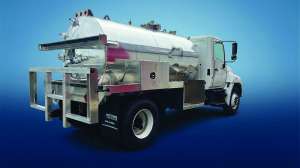
Thompson quickly learned the portable sanitation business would only be as good as the restrooms it offered and the vehicles that serviced them, so he began immediately building the fleet and the inventory. The company purchased two 2007 Satellite MAL 1350 pumper trucks/delivery vehicles with aluminum 900-gallon waste/450-gallon freshwater tanks, both carrying Masport HXL4V pumps. For large orders, Allied uses roll-off trucks to deliver up to 10 units at a time.
Those units consist of 160 PolyPortables Integra restrooms. Allied first bought 75 of these at attractive prices from another company that was changing its corporate colors.
Business mix
Metal recycling constitutes the majority of the company’s business, representing about 75 percent of the mix; roll-off container rentals account for 15 percent, and portables about 10 percent. Of that, 85 percent of the units are placed on construction sites, while the rest are rented by homeowners for private use.
“I don’t think we’re going to have a down season,” Thompson says, because even with the current slump, construction goes on all year. “Jobsites end and the units get picked up, but we’re currently putting out four units for every one that comes back.” How does Allied manage to keep growing while others have cut back?
“Even with the economy slowing, we found gaps in the market that we knew were there, and moved into them.” It was a matter of establishing an economy of scale by reaching primarily into Alllied’s existing customer pool with a new service. “People recognize our red units and labeling, so they see it’s a sister service. We did that on purpose. We’ve kept the service really streamlined, incurring almost no overhead other than buying the new units and pumper trucks. So the bump in business from cross-selling and upselling from other services is almost pure profit. Our customers love it. It’s one less subcontractor and (purchase order) for them to worry about.”
“Our competitive advantage is that we had already established a brand name in our area, and we just leveraged that,” says Thompson. “We’re a service company that just happens to service portables and roll-offs. We will go out of our way to find the most efficient and cost-effective way to serve our customers.
“We’re dedicated to solving their problems, so we don’t nickel-and-dime them for every little thing. We don’t market ourselves as cheap, though. We emphasize good value for our cost, and our units are brand new with excellent service.”
Web presence
The metal recycling industry has strict safety policies because workers are always around powerful machines and heavy equipment. This has also played a part in giving Allied’s portables customers peace of mind, since all staff receive the same safety training. All new hires, before they even interview, have their driver’s license run by Allied’s insurance company. Those that pass muster must take a drug test, and agree to submit to random ongoing tests.
Allied Portables keeps an edge on profitability by driving new business hard. “Web sites are our biggest marketing tool, for sure,” says Thompson. “We didn’t go cheap on them. They’re easy to find and use, and we’ve implemented a strong search engine optimization (SEO) program. This is the new age and that’s what’s here, so that’s where we put the majority of our budget. But we still have to hit the streets and get our name out there. We do personal and telephone cold calling.”
Allied hired a company to provide restroom decals and apply them professionally. They use Yellow Pages ads, and their trucks are branded and well maintained. They aim for a highly professional appearance, with “no cutesy quotes,” according to Thompson. “We get a lot of referrals.”
Overall, Thompson sees a bright future. “I think we at least have another couple years of the downward turn in construction, so until it turns back up, it’s going to be a fight. We not only have to protect our existing market, but also have to grow as aggressively as possible. We’ll just keep winning customer loyalty by delivering what they need and making it easy and convenient to work with us.”
In the end, he says, service really is about paying attention to details. “You can do all the big things right, but if your customers have to put up with small details that nag or annoy, that’s what they’ll remember. Since our growth strategy is to build more layers of service with existing accounts, it’s critical that we get all the details right.”
Continue reading for free