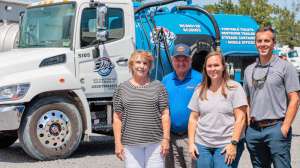
Sometimes being in the right place at the right time is all that’s needed to jump-start a business. Just ask Rodney and Kenia Fulton, who expect their fledgling marine pump-out company to benefit from new federal regulations regarding boat discharge.
“It’s definitely going to be a lot busier for us,” says Kenia Fulton, who along with her husband owns Marine Waste Management in Davie, Fla., on the Atlantic side near Fort Lauderdale. “We’re going to need more equipment. It was very good timing for us to get into this business when we did.”
At issue is a longstanding regulation that allowed boaters to skirt the Clean Water Act of 1972 and discharge into navigable waters “incidentals” such as bilge water, deck runoff and engine-cooling water. A federal judge recently struck down that regulation, which effectively bans those normal discharges from all vessels — including recreational boats, which are MWM’s main customers — as of Sept. 30, 2008.
“For example, no discharge would be allowed here on our intercoastal waterway, even if the boat has a treatment system on board,” Rodney Fulton says.
Kenia Fulton concedes that there’ll always be boaters who will secretly dump things they shouldn’t. But on the other hand, she believes that many boaters will comply because the ruling neatly coincides with the public’s growing concern about environmental issues.
“Everyone’s going green,” she says. “Also, there’ll be great awareness of this new law because it’s getting national attention — they’re making a big deal of it. There’s also supposed to be strict enforcement.”
For the Fultons, the ruling is an unexpected reward for boldly seizing a business opportunity several years ago. For Rodney Fulton, the startup wasn’t much of a stretch; he represents the third generation of his family to work in the yachting industry.
“I’ve been into boating since I was a kid,” he says. “Since high school, I was the captain of a yacht for 15 years, then worked as a project manager in a shipyard in Fort Lauderdale for six more years.”
The stint at the shipyard led Rodney to form MWM.
“We always had a problem with the boat holding tanks,” he says. “It was hard finding anyone who could come out and remove the waste, and that would hold everything up.”
STARTING FROM SCRATCH
At first, the Fultons pumped out boats on the side while Rodney still worked full time at the shipyard. During his spare time, he outfitted a 22-foot, flat-bottom boat, known as a Carolina skiff, with a 500-gallon tank, a hose and a pump.
The boat was necessary because Rodney quickly learned that a truck, even with a long hose, can’t always access some vessels for pumping.
“We can’t reach some boats because the truck is too big to fit on the slip,” he says.
Word of the Fultons’ service spread quickly, especially since many marinas don’t provide either fixed or mobile pump-out services.
“After one year of doing it on the side, there was so much demand that Rodney left the shipyard to put more time and effort into the business,” Kenia Fulton explains.
Soon afterwards, the Fultons bought a vacuum septic truck because the pump-out boat couldn’t reach dry-docked boats. And within a year after going full time, MWM’s fleet included two vacuum trucks and two boats.
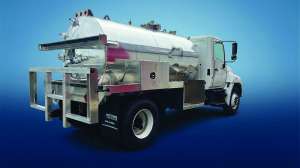
The equipment includes two used trucks; the Fultons don’t know who built them: a 1999 Ford F-550 vacuum truck with a 900-gallon tank, 200 feet of 1 1/2-inch-diameter hose (standard size for boat tank fittings) and a Conde pump from Westmoor Ltd.; and a 2000 International 4700 vacuum truck with a 1,500 gallon tank, 200 feet of 1 1/2-inch hose and a Battioni pump; the 1989 22-foot Carolina skiff outfitted with a Titan trash pump, a 500-gallon plastic waste tank and 100 feet of 1 1/2-inch hose; and a 1989 24-foot Carolina skiff, equipped with a 300-gallon plastic waste tank, a Honda trash pump and 100 feet of 1 1/2-inch hose.
MWM’s busy season runs from September through March. About 95 percent of MWM’s customers are large ocean-going yachts kept at 45 to 50 area marinas. MWM pumps black water, or sewage, and graywater, which comes from showers, sinks and the like. The trucks handle about 90 percent of service calls, with the boats picking up the rest, Kenia Fulton says.
The larger boat can ride on a trailer, which comes in handy for pump-out calls that are far away and only doable by boat.
“Around here, it could take a boat three hours to reach a customer by water,” she says. “And sometimes bridges can’t open because trains are passing over them, or the boat’s tower won’t fit under a bridge. So you sit in the water and wait and wait and wait.
“But with the boat trailer, we just drive to the dock, put in and pump out.”
PUMPING ON WATER
The marine pump-out industry is unique in several respects. For starters, there are times when inclement weather prevents MWM from using its boats.
“The boat is designed to handle some rougher water,” Kenia Fulton says. “But there just are some days when no one should be out on a boat. Weather can definitely put a damper on pump-outs, but customers are pretty understanding about it.”
Another difficulty: When MWM services the roughly 25 percent of its customers who aren’t docked at marinas, more often than not, the captain, not the owner, is on board.
“The owner pays us, not the captain. So sometimes we have to wait a while for a check from the owner, who might be in another state,” Kenia Fulton says. “Cash flow can be chaotic.”
The remaining 75 percent of MWM customers dock at marinas. All billings go through the marinas, which requires MWM to obtain a purchase order from the marina before providing service.
“The bigger marinas want us to bill customers through their billing system,” she says. “Then the marinas send bills to the boat owners that include our pump-out fees. Then we get paid in 30 days.”
During weekends when the marina office is closed, MWM is allowed to make emergency pumping runs without a purchase order, and obtain one retroactively the following Monday.
To expedite payment and as a convenience for customers, MWM accepts credit cards. “As soon as we started accepting credit cards, we experienced a jump in business,” she explains. The company uses a PayPal online account to handle all transactions. While it’s more expensive than using conventional credit card processing, PayPal automatically performs recordkeeping and is more reliable, Kenia Fulton says.
“With PayPal, you don’t have to worry about the credit-card system being down or checks bouncing,” she says.
As for fees, they’re similar to pumping out a septic tank on land. The price is based on a technician’s time, gallons pumped and disposal fees.
OVERCOMING CHALLENGES
Marine pump-outs often challenge Rodney Fulton’s creativity. For example, there are times when a large boat’s 2,000-gallon holding tanks require both cleaning and repairs, which can tie up an MWM truck long enough to create a domino-effect of scheduling problems for the day’s routes.
“So we started to use temporary plastic, 275-gallon holding tanks (kept on the dock),” he says. “That way, instead of our trucks sitting there and sucking out cleaning water as the tank is washed, it goes into the holding tanks, which we can pump out later — it only takes about 15 minutes to suck out a full tank. It gives us a little more flexibility.”
MWM disposes waste at treatment facilities in either Miami-Dade or Broward counties that are 20 or 50 miles away. Liquid waste haulers pay a 3-cent municipal fee for every gallon dumped, and the treatment facility imposes a $45 fee regardless of how much is dumped. After-hours emergency waste disposal carries a flat fee of $150, she notes.
“It benefits us to make sure our trucks are full,” Kenia Fulton says. “We don’t ever want to see our trucks going to the disposal facility only half full.
“We try to coordinate our schedules as efficiently as possible … but sometimes you drive 20 miles to make a dump, then get a call that takes you back to the slip you were just at,” she says. “That’s why I tell our drivers to drive around the marina like an ice cream truck and let boaters know we’re there. Sometimes we get lucky and someone on the boat next to one we’re pumping asks if we have time to do their boat, too.
“We also ask the marina project managers if they know of anyone else who needs pumping,” she adds.
Drivers typically make five to eight calls a day, Kenia Fulton says. If there aren’t five calls on the board, then it’s important for them to drive around the marinas to see who else might need pumping.
PRICING IS CRITICAL
The Fultons learned quickly that the price of pump-outs can rile some boaters, especially those who see free pump-out stations at some public marinas.
“Our prices are very reasonable,” Kenia Fulton says. “Everything in boating is expensive, yet a lot of people are surprised by the pumping fee.
“We charge a hookup fee and also charge by the gallon,” she continues. “In the beginning, we weren’t too sure about what to charge, so we talked to other marine pumpers and did research. We juggled with it a bit.”
MWM tries to help on the cost by offering discounts to regular customers.
“If we can do five boats in a row once a week at a marina, we’ll work something out,” she says.
The best antidote for sticker-shocked customers is topnotch service, according to Kenia Fulton.
“We try to provide the best service possible,” she says. “We schedule our appointments and get there on time, which is a big deal in this industry.”
While the prospects for growth are exciting, the Fultons remain concerned about expanding too quickly. They don’t want to get so busy that they disappoint existing customers or turn new business away.
“We don’t want to get in over our heads and lose our reputation for good service,” Kenia Fulton explains. “If you grow, you need another truck, which means another monthly payment, another driver’s salary, and so on.”
On the other hand, the couple feels good about doing their part to keep local waters cleaner.
“We have three daughters, so we have a strong vested interest in keeping water clean,” Kenia Fulton says. “I grew up here, hydrosliding and tubing and water-skiing, and I’m disappointed that our daughters can’t always do that because of the water quality.”
MWM hopes to change all that, one boat holding tank at a time.
Continue reading for free