THE TEAM
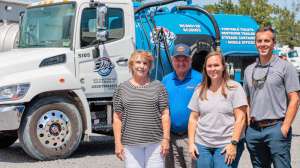
When motorcycle enthusiasts roared into Daytona Beach, Fla., in February for the 68th Bike Week festival, Paul Creech and his 11 employees at Godawa Septic Tank Service in South Daytona were as revved up as a Harley-Davidson Softail at full throttle. This Mecca for motorcycle madness, which kicks off the traditional riding-festival season for biker buffs across the country, is one of the biggest events the company handles all year — and it’s a total family affair.
Creech — a motorcycle rider himself — relies heavily on his son, Aaron, who oversees Godawa’s portable restroom division. Creech’s wife and company vice president, Linda, keeps the bill-paying systems humming. Another son, Shelby, who’s a part-time office systems troubleshooter, works as a route driver during the festival. And Creech’s daughter-in-law, Lowry, helps coordinate operations and also runs a truck during the festival.
COMPANY HISTORY
Eddie Godawa, Creech’s father-in-law, founded the company in 1947 and, in the process, created one of central Florida’s first septic tank companies. Initially, Godawa focused on manufacturing his own concrete septic tanks, then installing the tanks and drainfields.
In 1982, Paul and Linda Creech, who now own the company, entered the portable restroom rental field, and also added septic tank cleaning to its services. In 1996, Aaron Creech became head of the portable restroom end of the business. He got the company involved in processing septage — using a system he engineered and helped build — then land-applied the processed waste on family farmland.
Godawa’s service area covers about a 100-mile radius of Daytona Beach. The company owns about 1,100 restrooms, made primarily by PolyPortables Inc., PolyJohn Enterprises, Hampel Corp. and Synergy World Inc., as well as five restroom service trucks and three trailers. The company’s current business mix is about 50-percent special events and 50-percent construction and miscellaneous rentals, although it used to do much more construction rental business before the economic downturn, Creech says.
THE MAIN EVENT
The first Bike Week was held in January 1937 in conjunction with the inaugural Daytona 200 motorcycle race, held on the beaches and roads south of Daytona Beach. It slowly grew into one of the largest motorcycle events in the country, with upwards of 500,000 bike enthusiasts converging on Volusia County for the sprawling, 10-day extravaganza, usually held in late February and the first week in March.
THE JOB
Godawa has provided portable restrooms for Bike Week since the early 1980s, so by now, employees know the drill well. This year, the company set out about 300 restrooms, mostly basic Hampel units and 12 PolyJohn handicapped-accessible units. The restrooms are scattered in clusters of roughly five to 10 units at various locations around the county, ranging from taverns and individual parties to concerts and other special events, such as the infamous coleslaw-wrestling contest. In addition, Godawa also services 10 restrooms and about 100 RVs at each of two local campgrounds.
“It’s a hodge-podge of things,” Creech says. “But all the restrooms stay put for all 10 days of the festival.”
MAKING CONNECTIONS
Godawa got involved as a Bike Week vendor when the local Chamber of Commerce asked Creech to set up portable restrooms, figuring the company was prepared to set them up anyway for spring break, which typically follows Bike Week.
“But the Chamber didn’t have any money in the budget to pay us,” Creech recalls. “So we essentially did it for free, just to get our foot in the door. Then the Chamber folks started recommending us for other events, too.”
LET’S ROLL
Bike Week starts on a Friday, so setup usually starts on the prior Monday. “We leave it up to the customers as to when they want restrooms delivered,” Creech says. “Some want their restrooms earlier than others because they need to get toilets in place before they can do other things, such as set up a tent.”
To deliver restrooms, Godawa uses all three of its trailers, each of which can hold 12 units. All the units are removed on the Monday after the event, which ends on a Sunday. One Ford F-250 and two Ford F-150 pickup trucks pull the trailers.
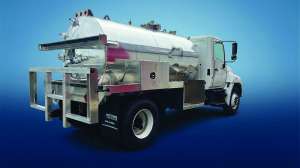
To service restrooms, Godawa relies on a 2000 Ford F-550 with a 1,000-gallon steel tank (500 gallons waste/500 gallons freshwater); a 2000 International with a 2,200-gallon aluminum tank (1,700 gallons waste/500 gallons freshwater); and 2005, 2006 and 2007 Freightliners, two with 1,500-gallon steel tanks (1,000 gallons waste/500 gallons freshwater) and one with a 1,700-gallon aluminum tank (1,200 gallons waste/500 gallons freshwater).
KEEPIN’ IT CLEAN
Godawa employees split into two shifts to handle the event, as well as service the normal routes. The company devotes four trucks to handle the festival restrooms, while the fifth truck keeps on servicing construction and other rental accounts, Creech says.
“We put two people in each truck, and I always include a family member as one of the two,” Creech says. “That way, there’s always someone riding who’s seasoned — it always goes faster that way.”
The first shift starts around 3 a.m. Festival restrooms get serviced first, followed by the campgrounds and RVs by around 8:30 or 9 a.m. Godawa’s facilities are centrally located in the middle of the restrooms it services for Bike Week, which makes waste disposal relatively easy.
“It was terrible before we handled our own waste,” Creech says. “We’d be at the mercy of treatment plants, which aren’t even open when we start servicing event restrooms. We had to offload the waste onto big tanker trucks and wait until the treatment plants opened.”
A second-shift crew comes in during late morning to handle the company’s usual construction and miscellaneous rental routes. When they’re finished, they offload waste into the processing facility and restock the trucks with supplies so the vehicles are ready to roll when the first-shift employees arrive early the next morning.
LOGISTICAL CHALLENGE
The logistics of Bike Week are intense, Creech says. “When the bars shut down, people inevitably leave a vehicle — could be a motorcycle, a truck or a car — parked right in front of the restrooms. I think the chances are directly proportional to how much alcohol they’ve consumed. We get as close as we can, then maybe throw a hose over a fence and go to work.”
To more easily handle special events, Creech outfits his trucks with two suction hoses, one on each side. “That way we don’t have to turn the truck around in tight quarters to service toilets,” he says. “We also have exterior lights mounted on the trucks, two on each side and two on the back, because we do so much night work at special events.”
With thousands of motorcycle riders on the road every day, traffic also poses a challenge. “Our drivers have to be real cautious about how they drive, with all the motorcycles on the road,” Creech says. “Lots of these bikers haven’t ridden all winter, so they’re ready to ride when they get here, and it gets a little crazy.”
ENJOY THE RIDE
About half of Godawa’s employees are bike enthusiasts, so despite all the hard work and long hours, the event is a lot of fun, too. “We ride, too, so we’re always excited about Bike Week,” Creech says. “About three-quarters of the way through it, we’re pretty tired. But we really enjoy it.”
Continue reading for free