Located on the far northeast corner of Denali National Park in Healy, Alaska, Lausen’s Dependable Disposal provides portable restrooms for the park and surrounding areas. That means extended periods of subzero, mind-numbing cold in winter and frost-heaved roads in the spring. Wildlife including moose, bears, black flies and mosquitoes join with wildfires and an influx of tourists to enliven the summers. And autumn weather has been increasingly unpredictable. It’s all in a day’s work for this PRO, who also handles septic pumping and solid waste disposal to keep his crews busy throughout the year.
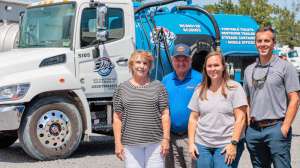
Owner Leroy Lausen runs the routes, covering a vast territory, aided by his son, Will. His wife and co-owner, Vickie Lausen, and their daughter-in-law, Sheri Lausen, cover the administrative end of things.
Last year wasn’t a typical summer season. Leroy Lausen talks about an unusual portable sanitation customer the firm serviced, crews fighting on the front lines of five major wildfires around Fairbanks. It was the hottest summer on record for the area, creating a nightmare scenario for firefighters. If they were exhausted, Lausen was right behind them.
Summer is normally Lausen’s busy season, but not this busy. Usually, it’s just tourist attractions and events, National Park units and a few construction sites. But in 2009, it was a nonstop endurance run for the Lausens. On top of that, the couple had to continue servicing their regular septic pumping and solid waste disposal customers, whose business carries them through the cold weather. It was a far cry from the eight months of cold, snowy weather that’s usually their biggest enemy.
1. B-R-R-R-R-R-R
In the 15 years since the Lausens have been in business, they’ve definitely found their biggest challenge to be the long, cold winters. With temperatures of -40 degrees F not uncommon, truck valves and liquid in the hoses freezes quickly. Restrooms must be kept in the shop before being placed on location so they don’t freeze solid overnight. Salt and chemicals are added to tanks, but when it gets seriously cold, even that doesn’t work. Plus, the plastic restrooms Lausen has used — he stocks 30 PolyJohn Enterprises Corp. PJN3 units, 80 Satellite Industries Tufways, and a few Satellite Industries Liberty handicapped-accessible restrooms — can crack under the most severe conditions. So he built 18 of his own single units, using 2 x 2 wood frames covered with 1/4-inch plywood painted light brown, and metal roofing. Inside, they’re insulated with fiberglass batts or rigid foam, and covered with thin plastic panels to improve the looks and make cleaning easier. He gets their 50-gallon PolyJohn tanks direct from the manufacturer, and attaches 50-watt pad heaters to keep them from freezing. Each unit carries a small ceramic electric forced-air heater that’s left on around the clock, and weighs roughly 450-500 lbs. The local post office jokingly refers to Lausen’s homemade units as “Denali Specials.” A dozen of these are “two-holers” — two single restrooms inside an 8-foot-square shed on skids. Built of 1/2-inch plywood over 2 x 4s, their weight is unknown to Lausen, but he says they’re “sprucing up” future designs, including a hook frame underneath for easy lifting with a hook arm. All Lausen’s portables have hand sanitizer dispensers installed, and for wildfire crews, they provide 12 Satellite Industries freestanding hand-wash sinks.
2. POOR RURAL ROAD CONDITIONS
Lausen’s disposes of waste at a lagoon in the city of Anderson, 20 miles from his nearest customer. That means a haul of up to 80 miles one way from far-flung locations. In any season, frost heave seriously affects road surfaces, and they don’t always heave up or down in the same place. When it comes to bumps and dips, Lausen says, “You just kind of learn where they’re at during different times of the year. Even though there are 65 mph speed limits, you don’t necessarily do that speed.” And some of these stretches are 20 miles long. In addition, there are strict scheduling issues for the 95 miles of gravel roads in Denali National Park. Bigger trucks must deliver their units in the evening. Aside from visibility problems in the dark, it’s also a juggle to schedule trips with a limited work crew.
3. FINDING RELIABLE EMPLOYEES
Rounding out a crew is always a challenge. Lausen estimates 90 percent of business comes between May and the end of October. While larger towns have a bigger labor pool to select from, outlying businesses like his generally draw those who only want to work for four months during the summer and then leave. Others only want to work with them until they can find a full-time job in a less isolated location. The solution is aggressive advertising, and they make extensive use of the Internet. Lausen’s posts job openings online at AlaskaEmployment.com. They place ads on local and out-of-state Craigslist.com forums, and initiate extensive word-of-mouth campaigns. Whether they get good response, he says, really depends on the economy. If the economy is good, there are better pay and benefits available elsewhere, so a down economy actually helps on the employment front. Ultimately, the Lausens usually put in a few more hours themselves rather than hire and train another employee mid-season.
4. LIFE ON THE WILD SIDE
Lausen’s heard all the polar bear jokes,
but emphasizes that these Arctic denizens live farther north on the ice cap. But it’s not at all uncommon to encounter black bears, and these have been known to knock over a unit now and then. Moose and caribou wander around on the road, so service route drivers must be careful to avoid collisions. Crashes might not kill these animals, but will definitely mess up a vehicle and can kill a driver. Sometimes curious moose calves nose around, and as with bears, drivers don’t want to get between a calf and its mother. Lausen says it’s worth taking time to size up the situation. “A lot of times, the mother will head off into the woods when a vehicle pulls up. If she has a calf or two, the cow will round them up and take them away. But if it’s just you and a full-grown moose waiting near the unit and you’re not careful, they’ll chase you.” Grown moose have been known to stomp humans to death, so it’s not a run anyone wants to encounter. Wolves are also citizens of Denali, but so far, Lausen’s hasn’t had any run-ins with those.
5. SPECIAL EQUIPMENT NEEDS
Lausen’s heavier, custom portable restrooms require more specialized vehicles for loading and delivery. Since some of them get placed on rough terrain, they need a truck that’s light and agile, but can haul a beefy load. Their 2005 Ford F-550 Flatbed roll-off truck does the trick, using a Stellar Industries Inc. Hooklift.
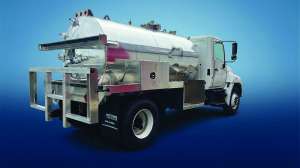
Vacuum trucks include a 2007 Sterling Acterra with a 2,500-gallon steel tank and a 2007 Kenworth T800 with 4,000-gallon waste/50-gallon freshwater tank. Erickson Tank & Pump built the Kenworth truck and its trailer. The 2006 Ford F-550 service truck carries a 650-gallon waste/250-gallon freshwater steel tank from Satellite Industries. All vac trucks use Masport pumps.
Delivering restrooms to outlying areas is rough enough, but jostling over the rugged roads seriously abuses the flatbed. So, they’ve bought a ToolCat utility work machine from Bobcat. It’s street legal with a flatbed, rubber tires and interchangeable front-end tools, can carry a small tank and is able to lift standard or custom units. They’ll outfit it with a 300-gallon slide-in tank with a small Erickson pump in the back, and use it to service outlying units while more easily navigating muddy, rutted roads. They’ll also use the versatile vehicle to lift portables around the yard, for snow removal and yard improvements.
Continue reading for free