QUESTION:
I run a portable restroom business, and I saw one of my competitor’s trucks the other day and he did not have a water pump. I stopped and asked him how he got his water out of the tank to clean the units. He told me he uses the air compressor off the truck, the one used for air brakes, to pressurize the system for restroom cleaning. Both of my trucks have separate electric water pumps. Am I wasting my money on water pumps if this other system, using the air off the truck, works?
Jay Robb
Fort Worth, Texas
ANSWER:
We’ve seen a few trucks hooked up this way. The air line runs to the water compartment and with that kind of air pressure, the result is a solid cleaning spray. So if it works, which it does, why are so many electric pumps installed on trucks that utilize air brakes? Because pressurizing your water tank compartment using the truck’s air brake system is a bad idea. Let’s back up and examine this system.
An electric pump, on the one hand, uses electricity off the truck to power the pump and does not, in any way, pressurize the tank. It is given power and it pumps at varying degrees of pressure, depending on the pump you install.
Most importantly, the water tank compartment itself is not being pressurized. This means: 1) The heads of the water compartment tank can be flat, saving money on tank construction. 2) If the tank is coated or made of aluminum or stainless steel there is little chance of corrosion over time. Consequently, an electric pump allows for a less expensive tank and increases the potential for longevity.
On the other hand, running an air line off the truck into our water tank compartment creates an entirely different situation. The concept is simple: Push air into a closed tank, the pressure builds, you open the valve, and out gushes the water. So what’s the problem?
First, you must make sure the tank can accommodate the pressure. Flat heads will fail under pressure. So dished heads must be used in construction, which is a costlier alternative.
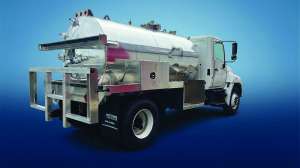
Second, pressurizing the tank requires an accurate device to measure and assure continual safe pressure level. The accompanying photo shows a vacuum truck with a pressurized water tank and no pressure gauge. Without a gauge, you create a bomb that can explode at any time. And there is no employee who is going to have a “feel” for when enough air is in the tank. If the tank is pressurized beyond its limits, the resulting explosion puts everyone in the vicinity, especially the driver, in danger. This also makes it possible for cracking or breaking of the waste tank.
The tank in the photo showed another problem. Where the constant air pressure hit the bare steel, corrosion manifested itself. If the tank is coated, the coating breaks down. With corrosion, the tank is weaker and more likely to fail and possibly explode.
The tank in the photo was brought in for repair because corrosion caused tank leaks. And, more importantly, the driver and the owner of the truck were informed that using the truck’s air is a dangerous practice, especially with no pressure gauge. The repairs cannot be guaranteed in this situation because there are too many unknowns for the repair shop to account for. Consequently, it was time to repair the tank, disconnect from the air system, and install an electric pump.
Continue reading for free