THE TEAM
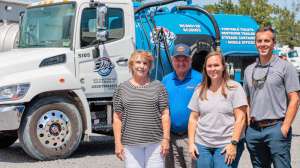
Carney’s Waste Systems, its 30 trucks and 70 employees serve British Columbia’s Sea to Sky region, a coastal area stretching from Vancouver in the South to Whistler in the north. Owner Owen Carney and operations manager Paul Kindree have built the business, which is located midway between the two cities.
COMPANY HISTORY
The company was founded by Carney in 1965, expanding to include the rental of 450 portable restrooms, removal of construction and demolition debris, septic pumping, residential garbage and recycling pickup, residential recycling transfer stations and special events waste management.
THE MAIN EVENT
The 2010 Winter Olympics and Paralympic Games were held in Vancouver, Richmond and Whistler, Feb. 12-28 and March 12-21. The event played host to more than 2 million visitors and 2,600 athletes from 82 countries.
MAKING CONNECTIONS
Carney’s interest in the 2010 Winter Olympics began as early as 2001, when he worked on various committees to bring the games to the area. “His interest was on the sporting side,” Kindree says. “When it was clear that Vancouver was going to get the games, we had to bid along with everyone else.”
Initially, The Vancouver Organizing Committee for the 2010 Olympic and Paralympic Winter Games, or VANOC, had conceived the portable restroom contract as a comprehensive bid encompassing all of the Olympic venues, Kindree says. Carney’s partnered with other companies to provide a bid covering the entire event.
“VANOC was not happy with the initial submissions,” Kindree says. “They brought in more (restroom trailers). They then broke the contracts into north and south and created a separate contract for the supply of toilets. We went back to the drawing board and successfully bid on the northern contract, which included all of the sliding, cross-country, biathlon, jump and downhill events in the Whistler area.”
Carney’s also won contracts for solid waste, recycling and potable water services.
The restroom supply contract went to PolyJohn Canada, which used a vacant yard at Carney’s Squamish facility to store and stage the 750 units that would serve the northern events. “It was a loose partnership,” Kindree says. “We assembled the units and helped with the deliveries and some of the logistics.”
TRIAL RUN
All Olympic venues are required to stage a major sporting event as a trial run. Carney’s worked the venue at the International Paralympic Committee alpine skiing event in March 2009. “It helped us to see where the toilets might be located and how we would work our way through the venue,” Kindree says. “The estimates were that 30,000 to 50,000 people would need to use the units.”
A MANAGEMENT CONTRACT
“We conceived our bid for the actual games as a management contract,” Kindree says. “Our first goal was to ensure that our core customers were looked after. The Olympics come and go, so we needed to be left with a satisfied customer base.”
Core business included non-VANOC Olympic contracts for such additional business as cruise ships, military camps and Royal Canadian Mounted Police camps.
“We were required to handle a maximum of 38,000 gallons of wastewater every day, and deliver an equal amount of potable water,” Kindree says.
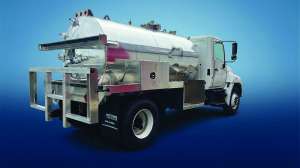
Carney’s dedicated four of its fleet vehicles to the Olympic events. A pair of Kenworth T300 service trucks were outfitted with tanks from Goldec Hamm’s Manufacturing Ltd. The tanks hold 900 gallons of waste, 420 gallons of freshwater and 120 gallons dedicated to a pressure washer. A pair of T800 Kenworths provided capacity with a pair of 3,000-gallon tanks from Wastequip Cusco.
The trucks worked only at night and in the evenings after major events had concluded.
To pull off the service requirements, Carney’s called in allies from the area, bringing in three trucks, a manager and four drivers from Pattie’s Portable Potties in Comox Valley, British Columbia, two trucks and three drivers from Smithrite Portable Services Ltd. of Coquitlam, British Columbia, and five trucks, a manager and seven drivers from Patrick’s Water Hauling in Hinton, Alberta.
Internally, Carney’s created a temporary division designed only to manage the Olympic contract. In the three months prior to the event, the company hired 12 drivers and 12 drivers’ helpers to boost the ranks for the solid waste and potable water contracts, allowing Carney’s employees to concentrate on the portable restroom contract and existing business.
SECURITY CHECK
“Security was a huge part of the accreditation for our employees,” Kindree says. “A lot of work was done ahead of time to get the employees screened. We carried a lanyard containing security passes for vehicles, parking passes, transition passes, and a lanyard with company ID and VANOC accreditation, and tags containing important contact phone numbers. We needed five keys to open each gate, and if you were missing even one of them you were in deep trouble.”
The company also had to create full training manuals for each employee, covering all aspects of the job.
BIGGEST CHALLENGE
“I think the biggest challenge was all the planning leading up to the actual day when the event started,” Kindree says. “We inspected the venue several times in the fall, but most of the toilets could not be delivered until the delivery window of between Jan. 15 and Feb. 5. The games were set to start on the 11th. VANOC employees were still moving around toilets based on camera sight lines and for other reasons right up until the day before the Olympics. But everything fell right into place and each day got easier as the games progressed.”
KEEPIN’ IT CLEAN
Access to Olympic venues occurred after event hours. Carney’s Olympic crew would arrive at 4 p.m. and hit venues from 5 p.m. to 3 a.m. “Nobody saw any sports action while they were working,” Kindree says.
Pumping restrooms and providing potable water was relatively straightforward — except for units that continued to be moved each day by VANOC employees.
“Sometimes the toilets were moved according to plan because of events held that day,” Kindree says. “Other times it would be pitch black and snowing and the crews would be trying to find the misplaced inventory by truck, driving around using the maps they were given and trying to avoid things like cables and electrical wiring.”
Part of the restroom maintenance included removing snow from the top of the units. “VANOC was praying for snow to stage the events properly, and we had to remove it each day,” Kindree says. “If you let that snow accumulate, you could get eight feet of snow sitting on top of a group of units over a week. When it starts to warm up, the weight of wet snow can crush a toilet.”
Restrooms were pumped, and filled with brine — a solution of water and 22 percent rock salt — to prevent freeze-up during the cold-weather events. The company had worked with VANOC the year before to determine the most effective locations for treating the hauled waste.
“We needed backup plans in case a transportation route was blocked or something else went sideways,” Kindree says. “We couldn’t take all of the waste to Whistler because they were concerned that if we added too much brine to the system, it would upset the balance of their treatment bacteria.”
Dump stations were split between Whistler and Squamish with a third backup site in Pemberton, to the north.
ALPINE RUN
The most challenging service location was on the side of the mountain used for the Super Giant Slalom events. The logistics of moving trucks up and down the hill would have added a large amount of time and excessive cost to the contract.
“Whistler had invested in a sewer line that traveled straight down the side of the mountain,” Kindree says. “We convinced VANOC that it would be more effective to build a dump station in the middle of the line at about 4,500 feet above sea level, so we would only have to haul to a single middle altitude.”
VANOC had purchased several Sno-cats, large tracked snow machines, and put one at Carney’s disposal during the events. An employee used a ski lift to get to the Sno-cat, and then used modified mini-tanks that could be hooked to the cat’s frontend blade mechanism. The cat also carried a brine tank to recharge the restrooms.
“Most of the toilets were located above the dump station and some below,” Kindree says. “Logistically, this saved VANOC a lot of time and money.”
IT’S A WINNER!
“The community and our customers already understood Carney’s support for the Olympics,” Kindree says. “Handling this international event showed the world what we were made of and provided a good message locally as well. It was great to work with VANOC and the entire team.’’
Continue reading for free