QUESTION:
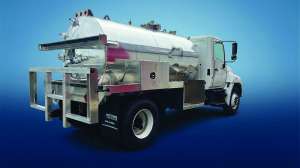
Some truck manufacturers don’t separate the water and wastewater tanks front to back, but instead install a long, round water tank down the center of the waste tank, running the full length of the tank. I assumed that was the water tank. Is there a reason to build the truck that way? Wouldn’t the long tank create a slosh factor where the water rushes from one end to the other when the truck comes to a stop?
Rusty Ingebritson
Dubuque, Iowa
ANSWER:
That is the water tank. But rather than having a big “slosh” factor, the long, cylindrical tank is baffled front to back, reducing the sloshing to where it is hardly noticeable to the driver and not a threat to push the truck into traffic at a stop light. This design is chosen to ensure better weight distribution.
By running a cylinder-shaped tank through the center of the vacuum tank and having the proper baffles in both compartments, water and wastewater are distributed evenly throughout the tank. In many portable sanitation service trucks, the water compartment is located at the front of a dual-compartment water/wastewater tank. During a service route, the water level goes down as the wastewater tank fills. That shifts the overall weight toward the rear of the truck. A heavy rear end is going to put more stress on the transmission and wear down the tread on the tires.
Overall, the central cylindrical tank design is advantageous for a portable restroom truck, and in my opinion, it is an under-utilized tank design. A balanced truck, with hauling weight constantly distributed evenly inside the tank, will help the longevity of the truck. In your next truck, consider the option of a longitudinal water tank down the center of the waste tank.
QUESTION:
I’ve heard a lot of talk about stretching truck frames. My truck will handle a larger tank, but to accommodate it I need to move the axle back and extend the frame. I’ve been told I can’t just splice a piece of channel and weld it up. I don’t know enough about truck frames to know what needs to be done. Is this something I can do or do I need a professional?
Dennis Flaherty
Houston, Texas
ANSWER:
Truck frames are made of highly tempered steel, not the ordinary variety used to make angles, flats and channels. Here is the process to follow when stretching your frame:
1. Cut the frame channels at precisely the same spot on each side. The cutting should be done at a 45-degree angle. Then move the frame section with the axle back as far as required. Obviously, you will also need to cut the driveline. You will add the extension later.
2. Using truck frame tempered steel, make sure each end of the insert piece has the ends also cut at 45-degrees so the insert piece will be welded to the existing frame in the open V-shape made by the two 45-degree cuts. Many truck frames are at least 3/8-inch thick, so it will take several passes in the welding process to weld the insert piece in place.
3. Make similar 45-degree cuts into the back end of the insert and the axle section of the frame so that welding will be done in the open “V.” Weld the insert to the axle truck frame in the same way as before, using several welding passes to accomplish the task.
4. Now it’s time to fishplate the frame on each side. This means that a normal steel plate (A-36) is cut somewhat in the shape of a long diamond (perhaps 18-24 inches long) and welded to the inside of the truck frame, centered over the weld-splices. The thickness of the fishplate should be equal to or greater than the thickness of the truck frame.
5. When all the fishplates are in place, measure and get the driveline extension you will need to connect the driveline to the rear axle.
PROCEED WITH CAUTION
This is a fairly large job and if you are not set up to handle the section pieces, such as the rear axle, then it’s best to turn the project over to professionals with experience stretching frames.
Continue reading for free