THE TEAM
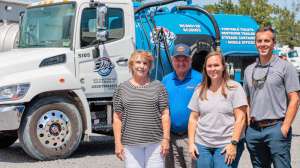
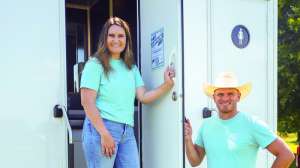
Nick Plummer works with a staff of 11 at his company, Plummer’s Disposal, in Wyoming, Mich., just outside Grand Rapids. The company provides portable restrooms and restroom trailers as well as trash and roll-off service for special events, construction sites and agricultural fields within a 50-mile radius. Joe Shepard was the lead service tech on the Enbridge project, working with technicians Steve Albaugh and Matt Mosqueda. Sam Biggio and Plummer drove to the site, regularly delivering units, bringing in supplies and handling issues that cropped up. Plummer managed logistics.
COMPANY HISTORY
In 1957, Plummer’s father, Warren, started a septic business, Plummer’s Septic Tank, adding a variety of services over the years. The portable restroom division was eventually sold and the rest of the company split up between two sons: Richard, who took over septic, and Todd, environmental. In 2005, youngest son Nick was ready to go out on his own with a roll-off container service and by 2006 reintroduced portable restrooms in response to customer requests.
THE MAIN EVENT
On Monday, July 26, 2010, a pipeline operated by Enbridge Energy Partners LLP ruptured near Marshall, Mich. Eventually nearly one million gallons of crude oil spewed into Talmadge Creek, flowing into the Kalamazoo River and dozens of smaller streams. The spill got dangerously close to Lake Michigan but was contained two days later. Cleanup has been ongoing in this remote area, involving thousands of Enbridge employees, local volunteers, industry experts and the U.S. Environmental Protection Agency.
MAKING CONNECTIONS
When Nick Plummer heard about the oil spill, he sprang into action. “I loaded a trailer full of restrooms, and drove down there on the second day,” he says. Plummer showed up unannounced, made his way through the crowd, found out who was in charge and introduced himself. “They said they had a current provider they were working with. It was maybe a week later they called us back and asked us to step in.”
BY THE NUMBERS
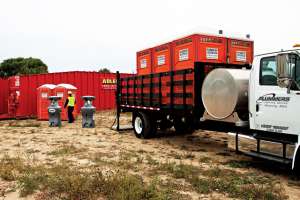
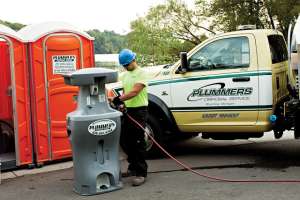
When Plummer got the call, he immediately delivered 75 orange PolyJohn Enterprises Corp. PJN3s. The challenge quickly became coming up with units fast enough. He got help from Polyjohn building units and drop-shipping them to the site. He also bought 86 units from Kurpinski Sanitation Services in Jackson, Mich. By the end of August, the company had deployed 297 restrooms, 65 Bravo sinks from PolyJohn and a few sinks and eight 250-gallon holding tanks from PolyPortables Inc.
LET’S ROLL
Units were spread out in numerous locations over a 25 mile area. There were a few banks of 10, but the majority were in groups of two to four, or even singles. They were placed by roadways, back in the woods, along river banks. Others were dropped off by boat and brought in for servicing. Computer software kept track of everything.
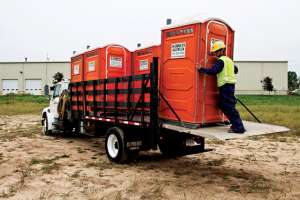
Deliveries were done using a 2006 Chevy C5500 flatbed that carries 10 units, as well as 8-unit and 14-unit company-built transport trailers, and a 53-foot semi-trailer that held 26 units.
Plummer’s Septic Tank and Plummer’s Environmental also were involved, providing equipment and hauling contaminated water and soil to their treatment plant. Together the three brothers rented a nearby five-acre lot to store their equipment, along with a 20,000-square-foot building to work from.
Most of the cleanup was accomplished by Christmas and the number of units was cut back to about 70. During 2011, the company expects to keep approximately 30 units and six to eight sinks on site.
KEEPIN’ IT CLEAN
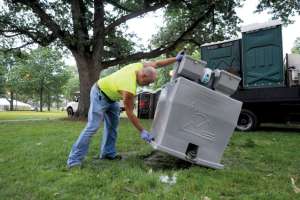
Each unit was cleaned at least once daily. The company performed 300 services a day, seven days a week, slowing down to 100 a day by Christmas. Albaugh lived in the area, but the others stayed in a hotel. “They couldn’t even drive the hour-and-a-half back to our shop because they were working 16-, 18-hour days, sleeping at the hotel, and before the sun rose, go at it the next day,” Plummer says. Units were located using GPS equipment integrated with the tracking software.
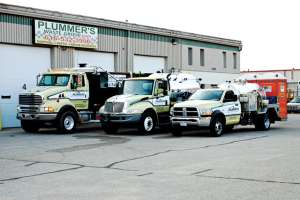
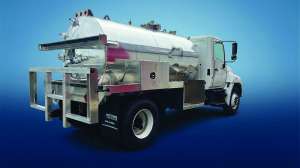
Service vehicles were from Imperial Industries Inc. – a 2007 International with an aluminum tank (1,000 gallons waste/300 gallons freshwater/300 gallons premixed deodorant) and National Vacuum Equipment Inc. pump, and a 2006 Ford F-550 with an aluminum tank (775 gallons waste/400 gallons freshwater) powered by a Masport Inc. pump. To keep up with the volume, Plummer had to find another vacuum truck in a hurry, as all other company vehicles were in service. Imperial provided a new truck, a 2011 Dodge 5500 outfitted with an aluminum tank (775 gallons waste/400 gallons freshwater) and a Masport pump. For tighter areas, they used Imperial aluminum slide-in units (300 gallons waste/150 gallons freshwater) on Chevy and Ford flatbeds.
Waste was transferred to a 6,500-gallon tanker, and eventually transported to Plummer’s Septic Tank treatment facility in the town of Wyoming.
SAFETY AND SECURITY
Access to the site was strictly controlled, adding significantly to service times. At each cleanup area, the driver signed in with the security guard, then slowly made his way through crowds and equipment. After servicing he’d have to find a supervisor in a crowd of a couple hundred people to get a signature before moving to the next site.
Prior to working on the project, company personnel went through a customized training programming regarding conduct, clothing and security. Requiredgear was hard hats, safety glasses, steel-toed boots, gloves, long-sleeved fire-retardant suits and safety vests – which made for some brutal days with the high humidity and 90-degree temperatures.
PITCHING IN
Plummer’s maintained a perfect safety record in complying with all requirements. Employees and numerous family members stepped up during what was already the company’s busy season, sacrificing summer vacations, working overtime in difficult conditions and living in hotels.
“I couldn’t be prouder of our crew, how they handled themselves, the dedication they gave to the job and to our company,” Plummer says. The reward for the hard work was a sense of
satisfaction. “Of course we didn’t want to see this happen, but we loved the challenge and were excited to be part of it.”