THE TEAM
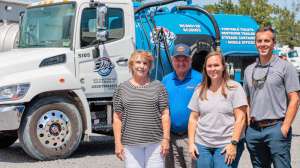
Jaime Garcia is the founder of Safiro Portable Toilets in San Diego. In addition to his duties as the company’s owner, he handles daily service routes. He is assisted by a full-time staff of four — his daughter, Alicia Garcia, in the office; and son Jaime Garcia Jr., Ron Adams and Alejandro Ramirez in the field.
HISTORY
Jaime Garcia launched his business in 1997 after working several years for trash collection companies in California. He made the decision after surveying the industry in San Diego and recognizing a shortage of portable restroom businesses. He wasn’t sure how to get started, but he talked to people for leads and advice, learned all he could about the portable restroom industry, and purchased the necessary equipment. He bought the company’s first new truck in 1998, and then quickly built the company to serve a 70-mile radius from his headquarters near downtown San Diego.
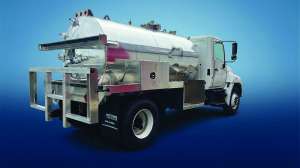
The company now has 1,000 restrooms and hand-wash units, and four trucks. For this job, Adams uses a 1996 Mitsubishi FE-SP with a 1,000-gallon (900 waste, 100 freshwater) tank and Masport pump built by Keith Huber Inc. Safiro’s second truck is a 1995 Isuzu Fuso with a 1,200-gallon (1,000 waste, 200 freshwater) steel tank with Masport pump, also built by Keith Huber Inc.
For other jobs, Safiro uses a 1998 Ford F-550 with a 1,200-gallon (1,050 waste, 150 fresh) steel tank; and a 2000 Ford F-650 with a 1,200-gallon (1,050 waste, 150 freshwater) steel tank. Both were built by Lely Manufac-turing Inc. and are equipped with Masport pumps.
MAKING CONNECTIONS
When the U.S. Navy hired Clark Construction of San Diego to build four 18-story towers to house single sailors, the contractor contacted Safiro Portable Toilets, which it worked with in the past. Safiro is also conveniently located. Its office and yard is less than a mile from the Navy construction site. Dan Heacock, Clark Construc-tion’s assistant superintendent, said Safiro is quick to respond when he calls to ask them to move, repair or rearrange the restrooms. And because the two companies have a long working relationship, Safiro trusts Clark to occasionally move some of its units if they get in the way of a project.
THE MAIN EVENT
The San Diego Naval Base is the U.S. Navy’s largest facility on the West Coast, and is the principal home port of the Pacific Fleet. It serves as home for about 50 ships and another 50 related commands. To provide modern housing for single sailors who are temporarily in port or on shore duty, the Navy broke ground in November 2006 at the 32nd Street Naval Shipyard for a three-phase construction program. This first phase is scheduled to be completed this spring. The housing unit consists of three buildings on a 12-acre site, featuring four 18-story high-rise towers connected by a skywalk on the ninth floor. The complex consists of 950 suites housing 9,000 sailors.
THE JOB
On any given day, 500 to 700 construction workers are on the site, working anywhere from the basement to the roof of the four towers. During the peak of the job’s interior construction, about 850 workers were on site. Early in the construction, Safiro also provided portable septic tanks for Clark Construction’s office trailers until they could tie into the city’s sewer system. Safiro coordinates with Heacock or other Clark Construction officials to put the units where they’re most convenient. This requires constant attention as the construction proceeds.
BY THE NUMBERS
Safiro usually maintains about 70 portable restrooms at the construction site. Most are Standard units from PolyPortables Inc., but Safiro also uses some Satellite Industries Tufway units. They place the portable restrooms individually or in clusters. Each of the four to five clusters consist of about eight units, and each cluster includes at least one PolyPortables Inc. SuperTwin hand-wash station.
In addition, Safiro maintains 30 PolyLift Highrise Portable Restrooms from PolyJohn Enterprises Corp. throughout the four towers, putting at least one on every third floor of the 18-story buildings.
Adams, who services the site for Safiro, makes at least three service runs weekly to pump, clean and maintain the ground-based units. Elevator workers from Clark Construction bring the PolyLift units down to the ground floor for servicing. Until the towers’ elevators became operational, the company used cranes for this task.
LET’S ROLL
To service large construction sites like the Navy housing complex, Safiro must be able to move units and reconfigure the clusters on a moment’s notice. Adams and Heacock talk frequently to redistribute units around the site to put them within quick reach of the ever-shifting workforce.
Adams must also be on site at 2:15 p.m. daily when crane or elevator operators on the towers finish lowering the 30 PolyLift units to the ground for servicing. As soon as Adams pumps, cleans and restocks the roofless Poly-Lifts, elevator or crane operators return them to their stations inside the towers.
For the workers’ convenience, the PolyLift units are stationed every three stories near staircases or elevators. Adams sometimes helps workers move the units off the floor and into the elevators to speed the job. Because these PolyLifts have built-in hooks, Adams says it’s easy for crane operators to hook on and lift or lower the units with no spillage.
He says the only problem is toilet paper unwinding because of winds and vibrations while being moved or lifted. To prevent this nuisance, he uses small stickers to tape the end of the roll, or a rubber band to secure the entire roll.
KEEPING IT CLEAN
Adams pumps and cleans every unit at least three times weekly, and more often as needed. He usually services the site with the 1996 Mitsubishi FE-SP, which can squeeze into tight spots between buildings, vehicles and the portable restrooms.
As Adams steps into each unit for cleaning and replenishing, he makes sure all rivets, hinges and door latches are intact. He often makes minor repairs and replaces broken handles, hinges and other items with spare parts he keeps in the truck. But if he’s missing a part or can’t repair a unit, he swaps it out with a unit from Safiro’s inventory.
Hand-wash units require extra attention because of the paints, drywall and stucco compounds workers scrub from their hands and forearms. “I take a Scotch-Brite scouring pad every time,” Adams says. “It helps loosen all that stuff. If you don’t stay after it, the sinks look like a mess in no time.”
SPIDERS AND SNAKES
Even though the units see constant use with hundreds of workers on site, Adams always scans their interiors before stepping inside. Whether it’s San Diego’s warm climate or its proximity to the ocean, there’s no shortage of insects and reptiles setting up shop inside the units.
“You don’t want to get bit,” Adams says. “I’ve opened the door and found snakes or spiders crawling around. That’s pretty common, but I’d rather deal with graffiti.”
Continue reading for free