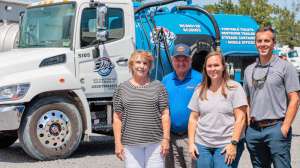
When Andy Zabrieszack finished high school in 1992, his parents gave him an unusual graduation present: a slide-in vacuum unit for his pickup truck and 10 portable restrooms.
Through firm family support, hard work and an emphasis on diversification and customer service, Zabrieszack went out and made good on that initial investment in his career. His company — A & A Porta-Potty’s Inc., based in the riverfront town of Ashland, Ky. — now owns an impressive inventory of 1,100 restrooms and seven vacuum service trucks.
But the rest of his inventory really helps his business thrive: 150 shipping containers that he rents as portable storage and office facilities, plus 2,800 chairs and 800 tables that customers rent to furnish those offices. The container/furniture rental business now represents about 40 percent of A & A’s sales volume.
DIVERSIFY NOW
“Without diversifying, we would’ve been out of the portable restroom business a long time ago,” Zabrieszack says. “Once we saturate our market, there’s no room to grow, unless we want to expand our (territory) farther out. But transportation costs make that expensive, unless you open up a new location, which also is expensive.”
Zabrieszack’s “aha” moment on diversification occurred in the mid-1990s, when he agreed to supply a customer with 13 hand-wash stations — even though he didn’t own a single unit. So he quickly bought 13 stations from Satellite Industries Inc. and had them shipped directly to the jobsite. He soon learned he could charge enough to cover the cost of the units and make a decent profit, too. That, in turn, gave him seed money to expand.
“At that moment, I realized I needed extra things to make the company go,” he says. “We grew bigger because the income from those hand-wash stations gave us extra money to play with. Why charge $5 for a hand sanitizer when you can charge so much more for a hand-wash station?”
That extra cash came in handy when Zabrieszack received a notice in the mail from a small Indiana company that was liquidating its restrooms for $25 apiece. The timing was perfect, as Zabrieszack needed more inventory to bid on a large job he knew was coming up at a local power plant.
“I bought 100 units, and they were all junk,” he says. “I only paid $10 or $15 for some of them. But we washed, repaired and painted them, and suddenly I was the new stud in town. Those 100 units enabled me to do bigger jobs — although I had to carry a drill and screws with me at all times to keep them from falling apart.”
THANKS TO MOM AND DAD
Zabrieszack says he owes his success to his parents, Allen Sr. and Hattie, who also gave his twin brother, Allen, a career as a high school graduation gift: a 2,200-gallon septic service truck.
“My grandpa and dad were in the septic business,” Zabrieszack says. “Before Allen and I graduated, Mom and Dad asked us what we wanted to do with our lives. They said that if one of us wanted to be in the septic business and the other in the portable toilet business, they’d set both of us up to get started. We were pretty excited.”
The brothers used their initials to name their company and set out to build careers (they later split up amicably and now run their own businesses). Along the way, they received unwavering support from their parents, and emulated their industrious work ethic.
“We got a paycheck whether we made money or not,” Zabrieszack recalls. “Without Mom and Dad, we wouldn’t be in business today.”
How did the young entrepreneur drum up business? He hopped in his truck and made cold calls at construction company offices and other potential customers, meeting people and handing out business cards.
“That impressed people,” Zabrieszack says. “They realized that here was a young man who really wanted to work, and who’s willing to come over in person to prove it. If they turned me down, I would tell them I was sorry they couldn’t use my services at that time, but that if they ever changed their minds, I’d be right there for them. People appreciated that I was polite.”
SAFETY CHECK
About 60 percent of A & A’s portable restroom business comes from local steel plants, refineries and other industrial businesses along the Ohio River. Construction sites and special events generate the remaining sales, Zabrieszack says.
Working with industrial customers imposes additional costs for required training and safety gear. Federal anti-terrorism laws require any unescorted person who enters a port of entry — a business on a river, for instance — to carry a Transportation Worker Identification Credential, a tamper-proof card with a computer chip that proves the carrier has passed a background check. Each card costs $132.50 and is valid for five years.
In addition, because they’re working in a hazard-laden environment, A & A workers must attend one 10-hour safety class sponsored by the U.S. Occupational Safety and Health Administration, as well as annual 2- to 4-hour regulatory training seminars, Zabrieszack says.
Furthermore, A & A employees must wear a full complement of safety clothing, from gloves, hardhats and flame-retardant coveralls to safety goggles and steel-toed boots.
“They’re working in what can be a very dangerous environment, so they have to be alert and cautious at all times,” Zabrieszack says.
Because of the risks involved, A & A requires employees to take random drug tests. Plant officials also can ask them to take a test at any time.
“They (employees) don’t have a problem with it,” Zabrieszack says. “They’ve got to know what’s going on around them. This may be a small business, but it’s my business, and I need to know that they’re not on drugs so I can go home and sleep at night. I can’t afford to lose a contract because someone is on drugs.”
CONTRACTS HELP
To offset some of the expenses associated with these clients, and guarantee steady business, Zabrieszack tries to obtain contracts for restroom service. He currently has seven such contracts, which are typically good for one or five years. Without a contract, A & A could invest a lot of time and money, only to have the customer select a cheaper restroom operator a few months down the road, he says.
“There are so many expenses associated with serving these customers,” he says. “We charge a higher price for those customers to cover those costs, but in return, they get instant service. When they say jump, we ask how high — and ask if we can wash their car, too.”
When Zabrieszack says instant service, he’s not kidding. For example, a local refinery recently called A & A at 1 a.m. to obtain 50 restrooms and 30 days worth of daily water deliveries. At 1:45 a.m., service technicians were setting things up at the plant.
“We’ve learned through the years to always keep two trailers loaded with restrooms,” he says. “That way the drivers just have to back up to the trailer, plug in the tail lights and pull out. We also keep two more trailers loaded with hand-wash stations. You’ve got to be loaded and ready.”
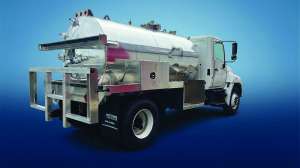
To pull those trailers, A & A relies on two flatbed trucks: a 1995 Isuzu and a 2001 Ford F-450. For restroom service, the company owns a 1995 International 4300 with a 1,000-gallon tank (700 waste/300 freshwater), built by Coleman Vacuum Tank Manufacturing Corp.; a 1997 Ford F-450 with a 900-gallon tank (600 waste/300 freshwater); a 1997 Isuzu with a 450-gallon tank (300 waste/150 freshwater), built by FMI Truck Sales & Service; a 2001 GMC Kodiak with a 1,500-gallon tank (1,200 waste/300 freshwater), outfitted by Lely Manufacturing Inc.; and a 2005 Ford F-350 and a 2006 Ford F-550, both equipped with 950-gallon tanks and built by Satellite Industries Inc. The company also owns a 1998 Ford L9000 with a 4,000-gallon tank used as a rolling holding tank at special events. It allows Zabrieszack to keep smaller trucks dedicated to servicing restrooms, instead of wasting valuable time traveling to and from a disposal site.
The company’s current restroom inventory includes units from PolyJohn Enterprises Corp., Olympia Fiberglass Industries Inc. and T.S.F. Company Inc. About 150 hand-wash stations are mostly from PolyJohn, and three restroom trailers were manufactured by Olympia.
CONTAINER NICHE
Zabrieszack got into the storage container business several years ago after meeting a vendor at the Pumper & Cleaner Environ-mental Expo International.
“I started out with 20-footers because I couldn’t afford a trailer to carry the 40-footers,” he recalls. “Then I got a call from someone who wanted to use a container as an office, so I converted a container into one. As it progressed, I started buying 40-foot containers.”
To convert a container, Zabrieszack cuts out doors, then installs studs, insulation, walls, ceiling and floors. Then he hires an electrician to wire it to code and has heat and air conditioning installed. About 75 of the 150 containers he owns are office conversions, which he rents to businesses and homeowners who need office space but don’t want to add on to their home. Some customers want half office, half storage containers; others use them as break rooms or for tool storage.
“That got us into the rental tables and chairs business,” he says, noting that customers started asking where they could get tables and chairs to stock, say, a break room. Zabrieszack figured they might as well rent them from him.
“I just do what any guy would do if he needed more money to support his family,” he says of his willingness to take risks by diversifying. “As long as it’s profitable, I’m willing to try it. My motto is this: I don’t want to be the biggest company around, just the most profitable. It doesn’t do you any good to make $1 million, for example, if it took you $2 million to do it.”
Along with diversification, Zabrieszack also believes goal-setting is critical to success. When he started out, his goal was to own 100 restrooms and get out of driving a truck.
“Now my goal is to build a company that can provide for both of my kids, if they want to take over the business some day,” he says.
Thanks to diversification, he’s already got a good jump on that goal.
Continue reading for free