THE TEAM
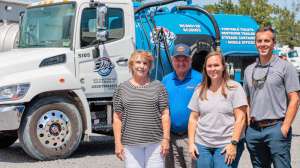
Tom “Slick” Nelson is the owner and quality control manager of Superior Sanitation in Spearfish, S.D. Kirby Hall is his assistant manager and helps plan logistics. Sean Schuft, senior technician, generally serves as site boss and Parker and Garrett Nelson are driver/technicians that service restrooms.
COMPANY HISTORY
Nelson was working for another pumping company when he decided to go out on his own in 1996. He worked in the industry five years when he started Superior Sanitation. His territory is a 75-mile radius of Spearfish, basically a collection of 8-10 small towns with fewer than 100,000 total population. Currently, his business is roughly 50 percent septic pumping, 33 percent portables and the remainder drain cleaning. Superior employs two full-timers and 8-10 seasonal workers.
THE MAIN EVENT
The Fourth of July Black Hills Roundup Rodeo is one of America’s longest-running, first held in 1919. Belle Fourche, known then as the West’s biggest shipping point for range cattle, has always hosted the event. This annual gala attracts current and former residents, students and members of local families from all over. It has grown to include fireworks displays, a mile-long parade, carnival rides and midway games, street dances, class and family reunions and three days of professional rodeo. Top-ranked cowboys converge from across North America, Canada and Australia to compete for top prize money. This main event is preceded by a local rodeo and a 4-H Ranch Rodeo.
Superior Sanitation holds the contracts for all these events. The smaller rodeos and the parade take place during the last week of June, while the main event takes place over the Fourth of July weekend. This year was Nelson’s 20th handling portable sanitation for these events.
THE JOB
Setup days start with a safety meeting between 7-7:30 a.m. Nelson and Hall go through what needs to be done for the day with technicians.
Creating the optimum scenario for rodeo service requires preparation. Equipment and supplies are loaded onto vehicles and everyone goes over placement plans the night before. But, says Nelson, since the crews have handled this event for so long, “We pretty much know where everything goes.” Crews usually clean units at the yard before delivery, then freshen them up on site if necessary.
MAKING CONNECTIONS
The City of Belle Fourche was Superior’s first portable sanitation customer. The company didn’t have any units then, but the city called and asked Nelson to bid on supplying portable restrooms for use in the parks, on the sports fields and at the rodeo grounds arena. He won the bid and bought 24 units.
BY THE NUMBERS
Over the years, event producers have requested additional units, usually 2-4 more each time. Superior now supplies 56 units between the carnival, the parade and the rodeos in Belle Fourche.
The majority of these are red, white and blue Five Peaks Technology Aspen units that Nelson purchased especially for the Independence Day theme. Also included are three ADA units: one PolyJohn We’ll Care III unit and two Satellite Industries Freedom 2 restrooms.
The restrooms are clustered in groups of three and four along the parade route, on the carnival midway and on the rodeo grounds. There are three separate lineups for this large parade. One group for local dignitaries, who share breakfast beforehand, takes four units. Two float lineups each get two units, and four more are stationed at Hermann Park, where evening concerts are held.
The carnival spreads out along three blocks of one of the town’s main streets, with five units positioned at each end of the area.
Since all three rodeos use the same arena on the west end of town, they’re all served by the same units. Eight restrooms are placed in an adjacent camping area, where horse trailers and campers all pull in. Four units are placed near the concession stand and two behind the chutes for the rodeo riders. The remaining 20 are placed throughout the rodeo grounds for spectators.
LET’S ROLL
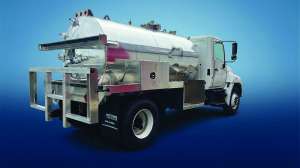
Superior has a three-truck fleet. The one most commonly used to service the rodeo is a 1997 GMC 2500 extended cab pickup. It sports a Dyna-Vac Equipment slide-in vacuum unit with a 300-gallon waste/150-gallon freshwater stainless tank and a Conde 6 pump from Westmoor Ltd. If things get busy, this rig may be joined by a 2007 Chevy 4500 cabover with a Presvac 750-gallon waste/250-gallon freshwater stainless steel tank, also with a Conde 6 pump, or a 1989 International 4900 with a Presvac 1,100-gallon waste/400-gallon freshwater stainless steel tank with MEC 6500 pump from National Vacuum Equipment Inc. Restrooms are transported on a home-built, 32-foot trailer that holds 14 units. Depending on what other jobs are going on, an 18-foot H & H Trailer Co. flatbed trailer may also be used. All vacuum trucks have dual-unit restroom racks.
KEEPIN’ IT CLEAN
Servicing starts at 6 a.m. The routine begins with a pump-out and freshwater refill. Tanks are charged with chemicals using a pre-mix in bulk 55-gallon drums. Then surfaces are cleaned. Because Superior’s territory is semi-arid, water conservation is an important practice. Crews wipe things down and don’t pressure wash unless it’s really necessary.
After cleaning, paper products are stocked and serve a secondary purpose for Nelson. Over the years, he’s adopted this rule of thumb: If you’re not sure how many units you need on a job, after the first day, judge how much paper you’re using. “A tank will only hold so much, so we leave enough paper based on that capacity. If your unit runs out of paper, it’s not because you don’t have enough paper, but because you don’t have enough units and this one’s getting overused.”
The full service run takes till about 8:30 a.m. Crews won’t go back that day unless they get a special call for an unusual mess.
ALL IN A NAME
“Our name is Superior Sanitation. Our motto is ‘A Class Above the Rest.’ We aim to please. If not, then I call my crew in the middle of the night to ask why something didn’t get taken care of,’’ Nelson says.
Continue reading for free