THE TEAM
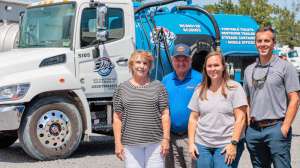
Tim Chutz owns and operates Waste Chasers, a jobsite services firm that offers portable restrooms and roll-off containers. This side of the business was aided during disaster relief efforts by two full-time staff members; portables driver Marcos Garza and customer service/dispatcher Tracy Wilson.
COMPANY HISTORY
In 2004, Chutz expanded a small jobsite cleanup and salvage company he’d bought into demolition and related services. He quickly came to specialize in hurricane and tornado recovery. “When I bought the company,” Chutz recalls, “it had a truck in Florida cleaning up from Hurricane Charley. I took over, got into it and took good notes. Once I’d spent six months doing that, I got to know people.” Chutz got three more post-hurricane Florida jobs that year. Waste Chasers also spent four months in New Orleans after Katrina, and four months in Galveston, Texas, after Hurricane Ike.
MAKING CONNECTIONS
Waste Chasers became the go-to cleanup crew and provider of portable restrooms and roll-offs after a mile-wide, EF-3 tornado (estimated to produce winds of 136 to 165 mph) roared through the historic town center of nearby Windsor, Colo., May 22, 2008.
“I was watching the news in my Longmont home, when all the sudden there were weather alerts,’’ Chutz says. “A tornado had been sighted south of Greeley, heading toward Wyoming. I followed the notices as the tornado grew and headed toward Windsor, where my business is.”
Chutz got a call from Wade Willis of the Windsor Park & Recreation Department asking for help. The town hall was disabled and torn up. Power and utilities were out. The call was a direct result of Chutz’s face-to-face marketing with the town in the past.
THE JOB
Chutz had trouble getting into Windsor because roads were debris-covered. Once there, he met with officials to ascertain their needs. “Then I called four or five guys I’ve worked with in Denver to get more trucks and some extra help.”
The beefed-up Waste Chasers crews started work that day. Before they could place portables, they had to help clear truck pathways. They moved in with grapple trucks, skid-steer loaders and chain saws to cut down trees and help power company crews move downed lines.
The government held impromptu meetings as one crisis after another arose in the developing emergency. Chutz was called in for his disaster recovery expertise. During the initial hours, his crews were continuously called away from restroom placement. They helped remove trees on cars where emergency vehicles needed to get through, and stabilized buildings on the brink of collapse.
“We got together with all emergency services and city planners and created color-coded maps,” Chutz says. “We had to methodically go through and clean up section by section, so we could get everything moved off the streets.” Contractors’ trucks were flooding in to repair houses. Emergency vehicles and utility trucks were working. Sanitation was a problem. “Crews needed restrooms, so I called Wade and told him they really needed portables. He invited me to bring in mine.”
MANAGING THE WORKFORCE
Waste Chasers crews stayed on location every day for more than three weeks, 12-13 hours a day. The biggest challenge was responding to multiple requests simultaneously, Chutz recalls. He managed the hectic schedule for two-and-a-half months by assigning tasks in manageable chunks: one crew assigned to town parks, the baseball field and municipal pool; another on streets and sidewalks, and so on.
Communication technology was critical. “When someone from the town called me, I’d call one of my three managers on the Nextel,” Chutz says. “It’s all about organization of manpower and machinery. At any one time, I had 30-35 people on the payroll.’’ He often worked from 6 a.m. to 10 p.m., then completed an activity log to stay on top of paperwork.
He arranged to be paid by the hour, billed daily. “I made sure that time sheets were turned in every day,’’ he says. “I wrote it up at midnight each night and turned them in the next day so the town knew what they were spending.”
As a hometown contractor, Chutz made some pricing concessions. “There were 3-4 times when insurance wasn’t going to pick up a cost, so we did some work pro bono. You’ve got to give back,” he says.
BY THE NUMBERS
After the public right-of-way work of the first few weeks, private right-of-entry work began. Residential home demolition didn’t begin until about two months after the storm. This allowed insurance companies to get adjusters into the area to approve and process claims. Portable restrooms and roll-off containers were moved in for house tear-down and selective demolition work.
Waste Chasers initially had about 40 standard restrooms placed in the affected areas, so workers wouldn’t have to walk 3-4 blocks. The company has a total inventory of 300 restroom units; 250 are Five Peaks Technology K2 units, 30 are PolyPortables Integra units and 20 are PolyPortables ADA and Enhanced Access restrooms. The company lost about 25 of its fielded units to the storm’s violent winds.
Chutz also has about ten 8-yard roll-off trucks. These mostly stayed in place for private construction, not being big enough for heavy-duty municipal cleanup. His big grapple trucks have 60-yard containers that can be rolled and compacted to haul such heavy loads. His individual steel roll-off containers range from 10 to 30 yards and were also used for residential demolition and reconstruction.
KEEPIN’ IT CLEAN
“Normally we service typical jobsite portables weekly,” Chutz explains. “But in this situation, so many different crews were using them, the driver serviced everything at least every other day.” By the height of the cleanup, Waste Chasers had positioned 50 units in Windsor. These all ended up within about a six-block area, the most heavily damaged Cornerstone Neighborhood.
Portables for the immediate cleanup were removed by September. A few were left at the town’s baseball field, fire museum and a few other public areas. Private home construction throughout Windsor kept 15-20 units on site through the first quarter of this year.
ACT LOCALLY
Chutz knows the power of public relations. “I try to localize, because you get to know people and to understand their needs. Nobody’s big enough to take care of every place that’s affected by one of these storms, so I like to concentrate on an area where I can monitor the progress and see things coming back.”
He’s always willing to participate in activities like Habitat for Humanity, providing free trash containers and portables. Waste Chasers also participates in green recycling initiatives such as landfill diversion and educational school programs. “It’s about giving back to the communities that support us.”
Continue reading for free