Fifteen years ago, Lafayette, La.’s, Party Central event rental company was born. A dozen years later, sales manager Frank Gerami III noticed a growing trend in requests for restroom trailers. “We were using trailers every once in a while for weddings and corporate events, but we had to rent them from another company, Deluxe Johns.”
Doing some research, he discovered a much larger market than he thought possible. About a year after Party Central started offering trailers, he looked at actual orders and realized it would pay to bring the business in-house.
“We ended up acquiring the assets of Deluxe Johns. We never really intended to get this deep into single portable units, but he wanted to sell us his whole inventory in addition to the trailers.” What Gerami couldn’t know at the time was how that acquisition would change the entire company, including opening up a new channel of business: disaster recovery services.
The acquisition prompted the launch of Event Solutions Sanitation Services as a separate company. That move led to a streamlining of operations through the introduction of electronic asset management technology. Several extreme hurricane seasons in a row prompted unplanned but profitable diversification into disaster recovery work. The result is a diverse but focused pair of companies that thrive on referral business and service efficiencies.
SISTER ACT
“It’s worked out great, complementing our sister company in many ways,” Gerami reports. “We can do more turnkey events like festivals, corporate fundraisers and barbecues. Any event that uses Party Central’s products is often in need of portables and hand-wash sinks. Our customers are really pleased. We can now provide more services, and that’s one less person they have to talk to.”
Customers especially like knowing they have the option of high-end, air-conditioned trailers for weddings and nicer events along the muggy Gulf Coast.
Not surprisingly, Party Central is one of Event Solutions’ biggest clients on the events side, Gerami says. “They already have their foot in the door with the customer, so referrals to us for any portable sanitation need is a no-brainer.” Event Solutions also gains referrals from equipment on location that bears company logos, Web site and phone contact information. Inside the trailers, brochures are displayed, and the company monitors lead generation.
“We keep track of how many brochures get taken so we can anticipate whether there might be a call. When we get a call from a new customer, we ask people how they heard of us. They almost always remember, and that lets us know if our advertising is working.”
DRIVING BUSINESS
Events business includes festivals, corporate events, weddings, golf tournaments and other sporting events, and concerts. Of course, the Gulf Coast offers up plenty of Mardi Gras festivals, making spring a busy time.
Executive trailers account for 40 percent of sales volume, with portables making up the remaining 60 percent. The company maintains construction and industry-related business routes consisting of an average of 300 single units at any one time, and extending about 60 miles around Lafayette. Gerami makes these sales mostly through cold calls to residential, commercial and industrial clients, including oil and gas refineries and manufacturing plants. The single units are working constantly, while trailers are usually sent out for brief stints at special events, typically for 2-7 days.
“We’ve had some longer-term contracts for disaster recovery jobs, where they’re out for a couple months cleaning up after hurricanes,” Gerami says. Since the 2005 Atlantic hurricane season, emergencies and disaster recovery have accounted for about 25 percent of billings.
The devastation of Hurricane Katrina was Event Solutions’ first foray into disaster work. The company got on federal, state and local government-approved vendor lists. “To maintain that approved status, we have to keep up with regulations, but it’s mostly paperwork,” Gerami explains. “Everything else we do anyway, such as holding certain licenses and maintaining an agreement with a couple public and private treatment plants for disposal.”
The company has since provided portable sanitation for cleanup efforts for hurricanes, including Gustav and Ike, all along the Gulf Coast.
BUILDING THE FLEET
As the company has moved further into the disaster recovery niche, its vehicle fleet and equipment inventory has grown to meet its diversifying needs. The portable restroom inventory consists of 350 PolyJohn Enterprises Corp. PJN3 Standard units, 10 PolyJohn Comfort Inn wheelchair-accessible units, four PolyJohn We’ll Care ADA-compliant restrooms and 10 Fleet Series flushable VIP portables.
These are joined by seven restroom trailers: three Wells Cargo Comfort Elite III models; one Wells Cargo Comfort Elite II model; and three ACSI trailers, one each 16-foot Advantage Plus, 24-foot Advantage Plus, and 24-foot Prestige Plus. Two Wells Cargo Comfort Elite Shower Plus trailers round out the main equipment.
This is supplemented by 20 PolyJohn Bravo two-sink hand-wash stations; five PolyJohn Applause high-capacity double sinks; and five PolyJohn four-person wash stations. When needed, Event Solutions can also provide 15 PolyJohn 250-gallon wastewater holding tanks and five 1,000-gallon freshwater tanks for long-term use.
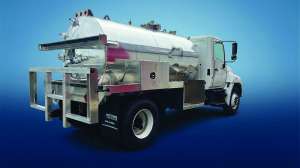
All service vehicles are dual-service, equipped with rear racks for unit pickup and delivery. They also carry a complete set of tools and parts for doing field repairs.
The newest is a 2007 International 4300 with a Best Enterprises stainless steel 1,500-gallon (1,100 waste/400 freshwater) tank and a Conde (Westmoor Ltd.) SDS-12 pump. A 2006 Isuzu NRR diesel is mainly used for special events delivery and service. It sports a six-unit hauling bed and a lift gate accommodating two portables. The service vehicle has a 1,100-gallon polyethylene tank (750 waste/350 freshwater) from Crescent Tank tied to a Masport HXL3F pump. A 2001 Ford F-350 with a 300-gallon (200 waste/100 freshwater) Best Enterprises stainless steel tank and Masport HXL3F pump rounds out the fleet.
SERVICE DATA SOLUTIONS
All this equipment has required a streamlining of management, which prompted the adoption of The Service Program by Westrom Software. It handles nearly all aspects of a service business — scheduling, route planning, dispatching and invoicing — and generates necessary paperwork.
Route data feeds in through a truck-mounted GPS system provided by Sprint. Nextel phones allow voice truck tracking and identification of location units. Drivers manually enter service information on a form, which is given to the office manager at day’s end. The information is then entered into the computer system.
The company is looking into a mobile module for the software that will enable drivers to use a PDA to enter data on site and immediately update service information. All data is eventually fed through the software to QuickBooks for billing and financial management.
TRACKING POTENTIAL DISASTERS
During hurricane season, Event Solutions management monitors approaching storms. When one looks threatening, they begin mobilizing according to what they hear on The Weather Channel. Employees are instructed to secure their own homes and families before reporting for duty.
“We pre-plan technology needs, since we know when storms are going to hit,” Gerami explains. “Computers get backed up to external drives and taken outside of where we think the disaster will happen.”
Equipment is prepared for response and battened down. “We try to become as self-sufficient as possible, loading up extra fuel, spare parts and tires, preparing for every possible scenario.” Then it’s moved out of harm’s way so if a call comes in, they can respond immediately.
“Sometimes we might move the equipment on location, in case we can’t get there after the storm due to debris covering the roads. In that case, we do everything we can to position it where it will be safe from the storm’s battering.”
Event Solutions has an action plan that instructs employees where to go, what to do and when to do it in different situations, so everyone’s on the same page. There is a checklist developed for operations divisions. Each secures its own property, charges cell batteries, and brings adequate supplies for units in case trucking and shipping is down.
Everyone knows specific job responsibilities. The company is also purchasing satellite phones so crews can stay in constant contact even if cell networks go out.
“Our disasters have all been weather-related so far,” Gerami admits. “There may be other types of emergencies we’d get called for in other parts of the county, such as flood or fire, and we’d definitely respond.
“Delivering quality service does become challenging in extreme physical conditions, but that’s what we pride ourselves on,’’ Gerami continues. “When people need us the most, that’s when we feel the best in all of us comes out.”
Continue reading for free