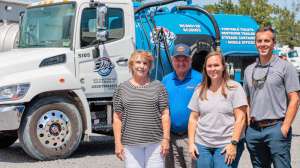
What do you get when a registered nurse becomes a portable restroom operator? Restrooms that gleam like a hospital operating room. And that emphasis on cleanliness that starts with owner Susan Taylor is helping Taylor Services Restrooms 2 Go build a solid clientele in its home territory around Macon, Ga.
To drive home the importance of clean restrooms, Taylor rides with new employees to personally emphasize the company’s way of doing things, such as fully evacuating waste tanks, thoroughly scrubbing units, using fragrance sprays during wash-downs and installing new scent discs.
“Then we reinforce the training by making them ride with veteran drivers for a few weeks before we turn them loose,” says Taylor, who has operated the business with her husband, Tim, since 2006. “We also do random inspections periodically and address anything that’s missed. It’s a big commitment on my end.”
GOODBYE TO NURSING
Taylor didn’t know a vacuum pump from a distribution box when her husband met a septic pumper who was planning on selling his business and retiring. Tim Taylor was running a dry-cleaning business at the time, but did landscaping, excavating and small demolition work on the side.
“This man was willing to get us going and show us the ropes,” Taylor says. “We already had a head-start because we owned some heavy equipment.”
Then the couple attended their first Pumper & Cleaner Environmental Expo International, where they took certification courses. At the same time, they realized that many people in the septic pumping business were also portable restroom operators.
“Long story short, we came home with 12 standard restrooms and one handicapped-accessible unit,” Taylor says.
Then the transition from nursing to portable restrooms began in earnest. At the start, Taylor worked three days a week at the hospital and two days running restroom routes with her mother, Katie Barker, who still handles the company’s bookkeeping. In the meantime, Tim Taylor kept one foot firmly planted in the dry-cleaning business.
GROWTH CURVE
After a year, the company grew enough to justify hiring an employee — and Taylor felt comfortable enough to quit her nursing job altogether.
“It was scary in a way,” she recalls. “I’d been a nurse for 20 years and had all that job security. But we were lucky to get enough good customers to get us up and running, and after that we figured we were too far in to quit.”
With an emphasis on clean restrooms and superior customer service, the business continued to grow. In the company’s second year in business, it generated 10 times the sales compiled in the first year, and 2009 sales were up about 40 percent over 2008. Today, about 85 percent of the portable restroom sales come from construction sites and the balance from special-event rentals.
The business also is a total family affair, with Tim Taylor handling septic pump-outs and installations; daughter Hannah, 24, covering marketing and community relations; and son Matthew, 21 driving routes. Two other daughters, Sage, 17, and Mesa, 16, work in the yard and help out with odd jobs during summers. Youngest son Cade, 12, is “being groomed for future use,” Taylor says with a chuckle.
“I couldn’t do it all without Tim,” Taylor says of her husband, who recently sold the dry-cleaning business. “He’s so much more than just my right-hand man. We cross over and help each other out.”
QUALITY UNITS COUNT
Taylor believes growth is fueled, in part, by maintaining an inventory of newer, well-kept units outfitted with extra creature comforts. The company owns about 500 standard restrooms — mostly Vantage units from PolyPortables Inc. — along with eight handicapped-accessible units (six made by PolyPortables and two manufactured by PolyJohn Enterprises Corp.).
For special events, Taylor Services also owns a family-friendly Boudoir unit, made by PolyPortables. It features a flush toilet, built-in sink, hand sanitizer and a baby-changing table. The company also bought two pink Vantage units especially for women, with special features such as an upgraded waste tank, a hand sanitizer, a toilet-seat cleaner, coat hook, mirror and small shelves.
“Extra features bring in repeat business,” Taylor notes. “People notice those things, and anything that helps you stand out from the competition helps. And when you follow that up with attention to detail when cleaning and servicing units, it helps even more. People think guys on construction sites don’t notice things like that, but they do.”
For weddings and upscale special events, Taylor owns a 22-foot-long luxury restroom trailer made by Ameri-Can Engineering. It features four stalls, two vanities and a mirror in the women’s section; two stalls, three urinals, one vanity and a mirror for the men; heating and air conditioning; simulated hardwood floors; crown molding; and a CD/stereo system with MP3-player connections.
“The comments people make when they come out always amaze me,” Taylor says. “They grab their friends and say, ‘You’ve got to go in and see this.’ They just can’t believe it — they’ve never seen anything like it.”
For the company, the trailer was a substantial, but worthwhile, investment. Demand for such a unit is greater for Taylor Services because of its location near Georgia’s metropolitan areas where there is a bigger pool of potential customers.
IN THE GARAGE
“If you’re trying to branch out, you can’t have all your eggs in one basket,” she explains. “You need different avenues to pursue, and the special-event market is a good one. I wanted to take portable sanitation to a new level. If we can rent it out once or twice a month, it pays for itself within two to three years — as long as you’re charging what the service is worth.”
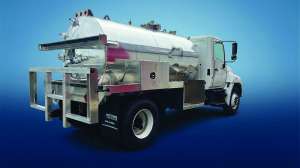
Taylor also relies on a fleet of trucks: a 2006 International 4300 with a steel 1,100-gallon waste/400-gallon freshwater tank and a pump from Masport Inc., built by Crescent Tank Manufacturing; a 2006 Ford F-550 outfitted by Satellite Industries Inc. with a steel 650-gallon waste/300-gallon freshwater tank and a Conde (Westmoor Ltd.) pump; a 2005 GMC 5500 equipped with a Progress aluminum 1,100-gallon waste/400-gallon freshwater tank and Masport pump; a 2002 Freightliner vac truck with a steel 3,600-gallon tank, outfitted by Transway Systems Inc.; a 2000 International 4800 with a steel 1,100-gallon waste/400-gallon freshwater tank and Masport pump, built by Keith Huber Inc.; a 1999 Ford F-450 with a 750-gallon steel tank and a Conde pump, built by Lane’s Vacuum Tank Inc.; a 1999 Ford F-350 outfitted with a Masport pump and an aluminum slide-in unit (300-gallon waste/150-gallon freshwater tank), built by Imperial Industries Inc.; and a 1987 Ford LN800 with a 2,300-gallon steel vacuum tank and Wallenstein pump.
LEARNING THE ROPES
Taylor marketed the company through the usual channels, with ads in local newspapers and the Yellow Pages. But she also knocked on doors and talked to contractors, leaving behind business cards and brochures to keep the company’s name in front of those prospective customers.
Taylor says she is conscious about ethically introducing her business to potential new customers without bad-mouthing competitors. She tells them Taylor Services is available to provide great service, and asks them to keep the company in mind if they ever need a backup provider or become unhappy with their current level of service.
“I don’t try to undercut competitors and steal their customers,” she notes. “I wouldn’t want them to do it to me. It hurts the entire market.”
Besides good old-fashioned sales work, Taylor embraces non-traditional forms of marketing, too, as evidenced by a YouTube video that promotes the company’s services. Created in 2008, the video is narrated by Taylor and gives viewers a nice look at the luxury restroom trailer.
The infomercial video was part of a service offered by Yellow Pages and was shot by an independent filmmaker. Taylor likes the medium because it communicates the luxury trailer’s benefits better than print media. While the video hasn’t generated a barrage of leads, it has prompted several customer calls, she says.
Taylor also has bartered services for advertising. For instance, when a local radio station held its annual chili cook-off, she exchanged restroom services for radio advertising.
“I’m not afraid to try anything, especially if it involves bartering services,” she says. “It’s all about name recognition — making it more likely that people will give you a call down the road when, say, their daughter is getting married.’’
THE PRICE IS RIGHT
Taylor learned early on that it’s paramount to stand firm on rental rates that are high enough to cover costs and generate a profit — even when competitors undercut on price.
“It really distresses me when companies put out a restroom at a loss,” she says. “It costs a certain amount of money to put a restroom out there … for too many operators, it’s just a hobby. I like what I do, but it’s a business, not a hobby.
“To pay decent wages and keep up equipment, you have to maintain a certain price, and it’s hard to bring the market up when you’re the only one doing it. If you play into (price cutting), no one comes out ahead.”
For other operators just starting out, Taylor suggests cultivating a solid relationship with a restroom vendor. “Find a sales rep that you can develop a good relationship with and work well with,” she advises. “Then if you ever need units in a hurry, they’ll do what they can to help you out.”
WOMEN’S WORK
You might assume a female operator would find it difficult to work in a male-dominated profession. But that hasn’t been the case, according to Taylor. “If anything, it helps,” she says. “When I pull up on a jobsite and there’s equipment or vehicles blocking the way, I can get it moved so much quicker than guys can. It’s a chivalry thing — guys are more willing to help out a woman.”
Taylor says she’s heard being a female-owned business poses an advantage for obtaining certain contracts, but notes she hasn’t received contracts because of it. A local utility urged her to get certified as a woman or minority-owned business, but she already had a contract with the utility. She said the certification may come in handy down the road, as many companies and government entities have set-aside programs for businesses with those certifications.
All in all, Taylor says she’s glad she made the switch from nursing to portable sanitation. She finds it satisfying to provide a vital and much-needed service, as well as provide gainful employment in the community. And she expects the company to keep growing.
“We pour everything we make back into the company, which is what you have to do if you want to grow,” she says. “I’m not one of those people with grand ideas about making a killing in this business. Our goals are long-term. We want to pay a decent wage … not get rich quick. We want a company that can prosper and support our family and our employees.”
And supply restrooms as clean as an operating room.
Continue reading for free