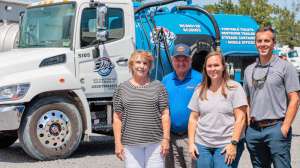
Building a diverse base of services requires a keen eye for spotting new opportunities, a knack for great customer service and a drive to succeed — not to mention a good relationship with a local banker, says Mike Thornton, the owner and president of Martin’s Sanitation Service Inc. in Paris, Ky., near Lexington.
Thornton knows about diversification firsthand: Since 1995, when he bought a septic service business from friend and mentor Gayle Martin, the company has expanded into portable restroom rentals, sewer line cleaning and inspections, transporting sludge for rural wastewater treatment plants, residential plumbing and even producing vinyl graphics for contractor vehicles.
Today, portable sanitation is the dominant service sector, providing 50 percent of the company’s business volume. But other areas have come on strong, with 25 percent of the revenues in cleaning wastewater treatment plants and grease traps, 15 percent municipal sanitary sewer line inspections and cleaning and 10 percent plumbing.
Martin’s recently acquired another portable sanitation company that more than doubled its restroom inventory. And despite all his business dealings, Thornton also manages to find time to serve as mayor of Paris.
During the last 15 years, the company averaged 25 percent sales growth annually, grew to 21 employees and built up a sizable fleet of equipment and vehicles. “Believe it or not, even through this recession, we still posted a 22-percent growth in gross sales last year,” Thornton says.
STARTED AS FARMER
Thornton started out as a tobacco, grain and cattle farmer, and figured that pumping septic tanks would be a good supplemental side business. “I thought running a truck three or four hours a day to get a little extra revenue would give me an opportunity to be more active on the farm,” he says. “Looking back, that was a mistake. I wish I would’ve concentrated more on the business.”
At first, Thornton didn’t take Martin seriously when the pumper said he was retiring and wanted Thornton to buy the business. At the time, Thornton worked for the city’s wastewater treatment plant, and knew Martin well because he took his waste there.
“I figured he was smarter than that,” Thornton says wryly. “How was I going to buy a business as a farmer who could barely make ends meet? But the more I thought about it, the more sense it made — and Gayle is a very good salesman. He’s also been a great mentor and is still active in the company.”
Thornton says he gradually became aware of the business’s potential when he started hauling sludge from package plants — small, rural wastewater aeration treatment plants — to larger plants that could process it. “That’s what really grew the business,” Thornton notes. “We went from running trucks two to three hours a day to four or five hours a day. So I started concentrating full time on the company, doing door-to-door sales.”
Shortly after buying Martin’s, Thornton quit his job at the wastewater treatment plant, and by 2000, he sold off his farm to concentrate solely on growing the business. About that time, Thornton seized another opportunity. He learned that under new regulations, the city would only accept new sanitary sewer lines for subdivisions if they passed an inspection. So the company took a gamble and entered the market for televised camera inspections and cleaning. That required a sizable investment: 1999 Vac-Con combination vacuum truck with a 12-yard debris tank.
“We spent a ton of money in 30 days without knowing how much work was going to be there. But in 2001, the new regulations went into effect and that side of the business took off as well. New construction has tailed off since then, but we make up for it by doing maintenance work for municipalities that are required to inspect a certain number of feet of sewer lines per year.”
MAKE FRIENDS WITH THE BANKER
The new venture underscored how important it is for expansion-minded businessmen to develop a strong relationship with a local bank, Thornton says. He notes that a local banker has stood behind him on every new venture, as long as he produced a solid business plan and could show how Martin’s would make things work.
“A lot of it comes down to being absolutely upfront and honest with your bank,” he points out. “We haven’t been a 100-percent success story. But instead of waiting until money was tight, I went to my banker whenever I was behind the eight ball and told them about cash-flow issues.
“You have to make them buy into it, just like your employees buy into your company, because at the end of the day, it’s their money,” he adds. “In a sense, we wash their trucks every week for them. We’ve been very fortunate to have a banker that’s always stood behind us.”
When Thornton eyes a new market, he says he dissects it into what he calls blocks. One is recognizing a need, which he says often comes from employees who pass on information they hear, say, at a local disposal plant. The second block is determining what equipment and how many employees are needed. “The next block is what kind of price can we charge to be competitive and profitable,” he says. “It’s like the movie Field of Dreams; if you build it they can come. It’s a simple principle we’ve used. But anyone can buy equipment; the key is providing great service.”
In 2002, recognizing another community need, Thornton bought 28 single-unit portable restrooms at the Pumper & Cleaner Environmental Expo International. The business now is split roughly in half between construction sites and special events.
“I had no idea how quickly it would grow,” Thornton says. “We’ve suffered some because of the construction downturn. But we were still up 2 percent in sales revenue on portables last year (2009) over the prior year, and we’re up 8 percent (so far in 2010).”
Thornton says he can’t emphasize enough how important it is to excel at customer service. “You need to keep a keen focus on your particular area’s needs, but then you must out-service your competitors. Again, anyone can buy equipment, but service is where you stand out.”
EQUIPPED FOR SUCCESS
Today, Martin’s owns 1,000 single restroom units: about 50 percent of them are made by PolyPortables Inc.; 45 percent made by Satellite Industries Inc.; and 5 percent are Tuff Jons from T.S.F. Company Inc. The company also owns 25 handicapped-accessible units, made by PolyPortables and Satellite Industries; three 18-foot trailer units manufactured by Advanced Containment Systems Inc.; two 26-foot Presidential units from ACSI; one trailer each from Comforts of Home Services Inc. and Olympia Fiberglass Industries.
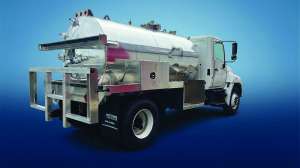
In addition, the restroom end of the business also relies on the following trucks (all with steel tanks): a 2010 Peterbilt 388 with a 5,000-gallon waste/250-gallon freshwater tank, built by Pik Rite Inc.; a 2002 Peterbilt 330 with a 4,250-gallon waste/250-gallon freshwater tank from House of Imports Inc.; a 2000 Peterbilt 379 with a 3,600-gallon tank built by Andert Inc.; 2006 and 2007 Ford F-350s with 600-gallon waste/300-gallon freshwater tanks built by Satellite Industries; a 2002 Dodge 3500 with a 300-gallon waste/150-gallon freshwater tank built by Imperial Industries Inc.; 2005 and 2006 GMC 5500s with 1,000-gallon waste/300-gallon freshwater tanks built by Crest Manufacturing; and a 2005 Chevrolet 5500 with a 1,000-gallon waste/300-gallon freshwater tank, also built by Crest.
Martin’s also owns a 2008 combination vacuum truck built by Aquatech (a division of Hi-Vac Corp.), aimed at handling increasing sewer-related work in the city of Lexington; and a camera inspection truck outfitted by CUES Inc.
PLUMBING? WHY NOT?
In 2009, Martin’s started a plumbing division. Why? Because Thornton noticed that often enough, technicians arrived at homes to find the problem was a kitchen or bathroom drain, not the septic tank. Then the company would call plumbers for help.
“Then the one or two reputable plumbers we refer business to got too busy, so I felt it was time to branch into hiring a master plumber and doing the work ourselves,” Thornton explains. “We started with one or two calls a week and now run two trucks and two crews seven days a week.”
Thornton also is expanding into another market: vinyl lettering and signage for contractor vehicles. He bought equipment to design and produce vinyl letters when he found it expensive to get his own equipment lettered. He plans to focus harder on the signage service later this year after Martin’s moves into a new 50,000-square-foot facility on a three-acre industrial site.
Thornton is quick to point out that he’s had failures along the way to developing a large, well-rounded company. But along with a strong drive to succeed and a passion for what he does, Thornton says taking calculated risks is essential to growth.
It’s hard to say what’s next under Thornton’s aggressive stance on diversity. But you can bet there’s something new and profitable on the horizon.
Continue reading for free