THE TEAM
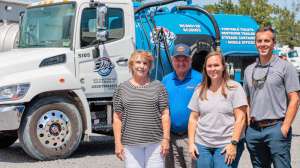
Paul Cooley’s company, Cooley Pumping, in Grundy Center, Iowa (population 2,500), provides septic, drain cleaning, and roll-off services, in addition to renting portable restrooms, which accounts for 50 percent of its work. The portable sanitation staff includes Bruce Keller, Cody Heasley, Justin Miller, as well as seasonal workers Ben Dinsdale and Brett Bengen. The septic crew of Brian Hall, Ryan Rekers, Marc Mahood and Gary Poppen get involved with shuffling portable restrooms around in the heat of the season. Cooley’s wife, Deb, has been temporarily helping out with billing in addition to her full-time job as an accountant.
COMPANY HISTORY
The septic business was started by Cooley’s grandfather, Leo Hopkins, in 1953. In 1993, while still in college, Cooley bought it from him. In 2000, Cooley added portable restrooms. “People were calling wanting to rent restrooms, so I finally decided to get into it,” he says, thinking it would be a small sideline. “I told my wife I’m just going to buy 16 for weekend parties and celebrations.” But that operation took on a life of its own, and today his inventory stands at 850 units.
MAKING CONNECTIONS
Shortly after purchasing his first restrooms, Cooley contacted Monsanto Co. to discuss providing restrooms for the farm workers working in the company’s farm fields. Because he was new to the industry, they agreed to try him out by giving him half their business. But in a bold move, Cooley said no. “I told them if I can’t have it all, I don’t want any,” he says. Fortunately the gamble paid off and he got the contract, which required him to quickly purchase and assemble another 135 units. Monsanto Co. has been a customer ever since, along with six other large agricultural companies.
THE MAIN EVENT
Many of the fields around Grundy Center are planted in April with seed corn; that is, corn destined for future planting rather than processing for the table. This corn is grown as a hybrid between two varieties. To promote cross-breeding, the tassels of one variety are removed so they can be pollinated by the other. Detasseling machines get only 60 to 90 percent of the tassels, so human labor is required to finish the job. Thus, in June and July, the fields are full of students, migrant workers, and anyone needing a temporary job. Cooley Pumping provides restrooms for the workers.
BY THE NUMBERS
Cooley Pumping provides 350 units to numerous fields in a 50-mile radius of Grundy Center. In addition, the company delivers, sets up and services another 150 units owned by one of the customers. Some fields require two, three or four units, but most only one. Small banks are also provided at customer plants.
Cooley’s units are blue PolyJohn Enterprises PJN3s, all with built-in sinks. It is a legal requirement that farm workers wash their hands with soap and water both before and after using the restroom. This is for their own health, to remove crop protection products from their hands, as well as the safety of the crops.
LET’S ROLL
This year, delivery and setup of units started in mid-June, taking three technicians nearly 10 days. Drivers found locations using GPS technology and field maps provided by customers showing where units were to be placed. The company maintained strict records for tracking units. “Once we set it there, we’ll document which restroom is in that field, the date it was set, and exactly where,” Cooley says.
Units were delivered using Ford F-350s and F-150s with hauling trailers. They were removed in early August.
KEEPIN’ IT CLEAN
All units were cleaned once a week. And since they are in hundreds of locations over a wide area, it took about a week to get to them all.
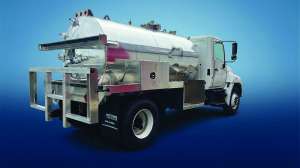
The company has two 2009 Dodge 5500s built out by Imperial Industries Inc., both equipped with 700-gallon waste/400-gallon freshwater aluminum tanks and Masport Inc. pumps. The vehicles are four-wheel-drive so they can maneuver in muddy terrain.
Servicing these units requires a lot of water, not only to refresh sinks and holding tanks, but because units get dusty and muddy and have to be hosed down. “It takes us an extra five or ten minutes,” Cooley says. On occasion, the crew will have to return to the yard to pick up more water. This heavy water usage is the main reason Cooley chose lighter aluminum tanks.
Pumping is sometimes difficult because paper towels get thrown into the tanks as the units do not have wastebaskets. Waste is hauled to area sewage treatment plants.
Besides wearing company shirts with logos, service technicians are required to wear full safety gear at customer plants — steel-toed shoes, long pants, glasses, hard hats, and safety vests. Drivers are encouraged to wear this gear in the fields as well.
NO VACATION
The company goes into over-drive during mid-summer as they try to keep up with regular work and service these field units. In addition, they work a number of special events, including RAGBRAI, an annual seven-day bicycle trip across the state that attracts 30,000 riders, for which Cooley provided 350 units in four communities along the route. “It gets pretty crazy,” he says. “We really put in some long hours.”
Continue reading for free