For years, tough but friendly competitors Jeff Bellino and T.J. Troiano would bump into each other and joke around about buying each other’s portable sanitation companies.
“We directly competed against each other, and a couple times we’ve even upset each other,” Bellino says. “But we never cut each other’s throats. We’d just kid around and tell each other that if one of us bought the other guy out, we wouldn’t be in this situation.”
But it was no laughing matter when Bellino’s company, Royal Flush Portable Restrooms in Scarborough, Maine, literally went up in flames. And the kidding took a decidedly serious turn after Troiano, co-owner of Troiano Waste Services Inc. in South Portland, and other local portable restroom operators came to Bellino’s aid after the disaster.
In the aftermath of the fire, a business merger made more and more sense to Bellino and the Troiano family (the company operates a portable sanitation and septic division called Associated Septic Services Inc.). And after months of negotiating, the two companies merged. Under terms of the agreement, Bellino became a part owner of Associated Septic and assumed responsibility for day-to-day operations of the division, which now does business under the Royal Flush name. The merger capped a most unlikely chain of events — and offers an interesting glimpse into how head-to-head competitors worked to forge a mutually beneficial partnership.
SURVIVAL MODE
Selling Royal Flush wasn’t exactly on Bellino’s mind in the wake of the October 2008 electrical fire, in which a wooden storage building burned to the ground. Instead, he was in survival mode, trying to figure out how to keep servicing customers after losing $250,000 worth of supplies, tools and equipment, not to mention all business records. The only good thing was that most of Bellino’s restrooms were out in the field and his four service vehicles weren’t parked in the building.
“It was devastating,” Bellino recalls. “It was a whirlwind — a wide range of emotions. I knew I’d survive, but didn’t know in what form. All I had was the truck and the toilets. I lost all my day-to-day operating stuff.”
But the Troiano family, A-1 Environmental Services in nearby Wells and other local operators rallied around Bellino (a story on the fire response appeared in the February 2009 issue of PRO, which can be viewed at www.promonthly.com). They provided supplies, trucks and manpower so Royal Flush could keep servicing its routes. The Troiano family also offered Bellino rental space in a storage building they owned — and inadvertently started the wheels of a business partnership rolling.
“I started borrowing some toilets, and they started storing unused toilets in the facility I was renting from them,” Bellino explains. “I needed toilets, and they didn’t need as many. But I didn’t want to put out toilets with Troiano decals on them, so they let me put my decal over theirs. Then one day, T.J. told me, ‘This is ridiculous.’ And that set up our talks.”
FORGING AN AGREEMENT
The more Troiano and Bellino examined the possibility of merging, the more sense it made. For starters, Troiano had recently assumed new responsibilities that increasingly were pulling him away from the portable restroom side of the business. So it seemed logical to bring Bellino on board to run the division, which would be strengthened by the addition of Royal Flush’s restrooms and trucks.
Another factor involved simple mathematics: Out of the 1,000 or so Royal Flush accounts and some 4,000 to 5,000 Troiano accounts, only 80 overlapped. “That made a merger seem even more sensible,” Bellino says.
But that didn’t mean things would go like clockwork by any means. Both men had strong emotional ties to their businesses. “They’re our babies,” as Bellino puts it. Moreover, Troiano candidly admits that mergers aren’t on a list of his favorite things.
“I’m not a huge fan of mergers, because business philosophies usually differ,” he says. “But Jeff and I have the same business philosophy: It’s not about the bottom line; it’s about keeping customers happy. Even if you end up losing money on a call, the customer will probably refer you or use you again because you went the extra mile. So you do whatever it takes to satisfy and retain customers.”
Troiano and Bellino agree that a successful merger depends on one thing: unflinching candor.
“We had to be brutally honest with each other,” Bellino says. “That meant if I had a concern, I had to tell T.J. up front that I wasn’t comfortable with it … that this is my fear or concern.”
“Absolutely,” Troiano agrees. “We had to sit down at the table and agree that there’d be no hard feelings if things didn’t work out.”
IRONING OUT ISSUES
Both contractors relied on attorneys and accountants, who were invaluable in working out details and pointing each in the right direction. But sometimes, the competitors found it more useful to sidestep legal advice and instead find common ground on their own.
For example, a major hot button in the negotiations centered on an employment contract for Bellino. His attorney said it should be a long-term contract, while Troiano and his attorney didn’t feel one was even necessary.
“I was afraid I’d get bought out, then get let go,” Bellino says. “I wanted some security that I’d remain on board, even though I knew they wanted me and were asking me to come and work with them.”
“I don’t believe in employment contracts,” Troiano says. “I didn’t feel we had to guarantee employment when we obviously wanted and needed him.”
Defying their attorneys’ advice, Troiano and Bellino sat down in a tavern and, over a few beers, hammered out an agreement they both could live with.
At times, sheer trust won out over legal advice. At one point, when the parties were trying to determine who would be liable for any Royal Flush bills that would emerge after closing on the purchase, Troiano said Bellino’s word that he’d pay them was good enough.
“I wasn’t worried because Jeff said he would pay them,” Troiano says.
In another instance, when the parties were going over the final draft of the purchase agreement with the attorneys and accountants, Troiano stopped and said a handshake on some items would be good enough. “I didn’t think we needed to get every single thing down in writing … there has to be a certain amount of trust,” he says.
DETAILS, DETAILS
After about nine months of negotiating, the two parties closed the at the beginning of this year and began the real work of merging companies. This involved a host of issues, including:
Notifying customers with a letter that explains the merger. “We had to assure them they were going to get the same service, if not better,” Bellino says. In addition, invoices initially included the names of both companies to minimize confusion, and for a while, office staff used the names of both companies when answering the phone.
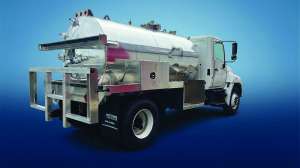
Re-lettering trucks with the Royal Flush name. The fleet now includes 2002 and 2003 Isuzu NQRs equipped with Tugger units from Keith Huber Inc., featuring steel 800-gallon tanks (550 gallons waste/250 gallons freshwater); a 2004 GMC C5500 rigged with a Keith Huber Princess system and a steel 900-gallon tank (600 waste/300 freshwater); 2005, 2006 and 2007 GMC C5500s, each with steel 1,050-gallon tanks (750 waste/300 freshwater), built by Crescent Tank Mfg.; a 2006 Chevrolet C5500 with a steel 910-gallon tank (660 waste/250 freshwater), built by Dyna-Vac Equipment Inc.; a 2008 Kenworth T-300 with a steel 1,050-gallon tank (750 waste/300 freshwater), built by Crescent Tank; 10 slide-in units with 400-gallon tanks (300 wastewater/100 freshwater), made by Pik Rite Inc.; and 11 Explorer trailers made by McKee Technologies Inc. A 2007 Chevrolet C7500 septic pumping truck, equipped with an aluminum 2,500-gallon tank built by KeeVac Industries Inc., rounds out the fleet.
Putting new decals on the restrooms. After the merger, the company owns about 1,200 restrooms, mostly made by PolyPortables Inc. and Five Peaks Technology. Until all the new decals were in place, the company did its best to deliver Royal Flush-labeled restrooms to old Royal Flush customers to minimize confusion.
Combining routes for maximum efficiency. The company uses Summit ERIT Route Management software made by Ritam Technologies LP. “It’s been a key tool in making the merger successful,” Bellino says. “At first, routes overlapped to the point that our drivers were waving at each other on the same roads.”
Determining the best supplies to use, such as bathroom tissue. Royal Flush used one-ply paper and Troiano uses two-ply. “We both liked each brand for particular reasons,” Bellino says. One-ply paper from Reliable Brand bathroom tissue eventually won because it offers 2,000 sheets per roll compared to 300 per roll for two-ply, Bellino says.
A HAPPY ENDING
So far, Bellino says the merger has been a success, and he’s grateful to Troiano for helping to make it happen.
“It’s been awesome,” Bellino says. “Everything is blending together really well. It’s been easy because even though it’s difficult, T.J. has relinquished his duties and given me the freedom to make decisions. He always says, ‘It’s your baby — run it like it’s your own.’”
It’s not often that something good comes from a disaster. But in this case, something greater than the sum of its parts emerged from that fire: a stronger company, more customer service capability and a larger fleet of equipment. Not to mention one less competitor to butt heads with.
Continue reading for free