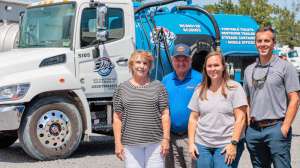
Portable sanitation provider Robert Millett will tell you prayers he said 24 years ago to “make some money’’ have been answered.
Millett’s business, High Sierra Toilet Co., in New Braunfels, Texas, has enjoyed a steady upward climb, and he expects to gross $2 million this year serving customers across the wide open plains surrounding San Antonio.
How has Millett grown from running a single service truck and 26 restrooms in 1986 to 11 portable sanitation rigs, 2,500 restrooms and 22 employees today? Finding growth opportunities — even during these challenging economic times — requires providing memorably good service and going where the customers are, the industry veteran will tell you.
The leader at High Sierra employs many techniques to stress good service and follows up to see that his workers are providing it. He has also shown a knack for cherry-picking lucrative customers, including United States military bases that have provided a consistent revenue stream.
ARMED FORCES WORK
John Owen, High Sierra’s general manager, says one of the company’s major goals has been to secure contracts with several military bases located in the area around New Braunfels and San Antonio. Over the past 15 years, High Sierra provided sanitation services to Fort Sam Houston, Lackland and Randolph Air Force bases, all near San Antonio. At the present time there are contracts with Lackland and Randolph.
Owen’s mother, Billie Joyce, (who died in 2005) was Millett’s wife and an active partner in the business. She and Millett realized securing contracts with the government would require providing the best possible service and maintaining quality equipment.
“The government was looking for private companies for these contracts,” says Owen, “and High Sierra was ready to take up the charge.” Gaining the contracts and working within federal government and military guidelines meant several requirements for High Sierra, including obtaining proper insurance, special screening and background checks.
Typically units are placed in areas such as rifle ranges and where there are tents for housing troops. Millett says they keep as many as 100 standard restrooms on a base, and service is provided weekly the majority of the time, and sometimes twice a week. Hand-wash units are requested in some instances. Contracts, which are for five years, specify that sanitation will also be provided for special events on the base.
Restrooms are cleaned with disinfectants and deodorant products from Walex Products Company Inc. Units placed by the company will last for the length of the contract.
Unlike many typical portable restroom placements, graffiti and damage are not a concern at the military bases. “If someone got caught, that person would be in a world of trouble,’’ Millett says. “The military will not stand for that. There are military police all over those bases.”
In other situations, graffiti and destruction are a problem, particularly on a construction site, where people will mark up the unit or make cuts with knives or tools. When units are delivered to a project, the driver will have the contractor inspect and note that there is no graffiti or damage to the restroom. Damage costs are charged back to the customer.
High Sierra also takes steps to prevent graffiti, such as spraying a non-stick cooking product on the units that magic marker will not penetrate, and uses products from Arrow Magnolia International Inc. and Phillips Distribution Inc. to remove markings. Units that have been cut or damaged beyond repair are disposed of, although, High Sierra is looking for a “greener” method to deal with this issue.
Fortunately many of the towns and counties have gotten strict about the graffiti problem and those who are caught face multiple charges.
TRACKING THE FLEET
Whether serving a military base, a construction or commercial site, a private event, or one of the many towns and cities in the region, High Sierra has always been open to new technology to maintain high standards. The addition in 2008 of a FleetMatics GPS system to every truck and pump, has proven to be valuable, particularly when fuel costs are high.
Owen says that when they installed the GPS system, the technicians were comfortable with the program, with a couple exceptions, and those folks did leave the company.
The computer system is always being monitored during the workday, Millett says, displaying the location of each rig and when pumps are turned on and off. This technology has given management a better handle on day-to-day operations. If there is a question about a service vehicle’s location, the technician is only a two-way radio call away to give a quick explanation. The system meant a substantial financial investment, but the monthly cost is minimal, according to Millett.
New technology aside, Millett says quality service is the sure ticket to a satisfied client. “Our service techs are provided with long rubber gloves and long-handled brushes to clean without coming into contact with waste. This is the most important thing of all,” he says.
Millett and Owen backstop technician training with periodic field checks, and feedback to drivers when necessary.
“We will sometimes go out and check on the restrooms on a jobsite to make sure they have been properly cleaned, and that there is toilet paper and hand sanitizer,” Millett says. “When we pick up a unit and bring it in, we can look inside and tell whether the driver is giving proper care.”
Face-to-face meetings with employees and regular tailgate sessions with crews reinforce service priorities, Millett says.
“Once a month we have a meeting with the group. They are part of a team. If one guy slacks off, others will monitor and even talk to him. We’re in business, and if they are going to have a job, if we’re going to have a company, they have to work together. They want to keep the company standards.”
Other issues are discussed in these meetings, including driver safety, for instance. There is a $50 award for an Employee of the Month who has shown good attendance and contributed in some way to the betterment of the company. On occasion there might be two or even three recipients, depending on performance.
BUILT FOR SERVICE
High Sierra operates on a 3-acre site in New Braunfels. There is a 1,800-square-foot office building and a 1,200-square-foot shop where workers perform limited preventive maintenance and store equipment out of the hot summer sun.
Portable sanitation inventory is mostly bought in aqua color, including nearly 1,400 Satellite Industries Inc. Tufway restrooms, more than 900 PolyJohn Enterprises Corp. PJN3 models, 89 Satellite Freedom 2 ADA units; 3 flushable Satellite Maxim 3000 units and 11 PolyJohn Poly Lift units. A variety of hand-wash stations, SaniStands and holding tanks come from PolyJohn.
Millett says the company does not offer executive trailer units, but has found its flushable Satellite restrooms are popular when there’s a VIP event.
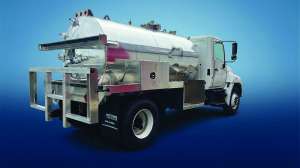
The High Sierra fleet includes 11 International service rigs, all built out by Lely Manufacturing with 1,000-gallon waste/500-gallon freshwater steel tanks and NVE (National Vacuum Equipment Inc.) pumps. There are four delivery trucks, a 2002 Nissan, a 1998 International, a 2008 Chevrolet and a 2007 Chevrolet, plus two trailers that haul 10 units each, and a lowboy trailer that carries 18 restrooms.
Technicians, who are provided uniforms, are tasked with keeping their rigs clean and ready to hit the road.
TAKING CARE OF BUSINESS
Continuing efforts to advance customer service and build on better technology help High Sierra maintain a steady growth, Millett says.
“The longer we are in business, the stronger we become,” he says. “We have a better relationship with our employees, we value our equipment, and we know how to take care of our customers.”
Continue reading for free