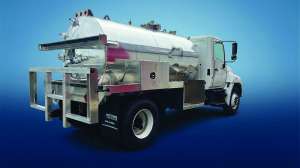
For portable restroom contractors, the truck is so much more than a way to get around. It’s the workhorse of the company, the office on the road. Many operators spend at least as much time in their rigs as they do at home, so there’s no lack of opinions on trends they’re seeing in new models. Not surprisingly, some of these revolve around emerging technologies associated with pollution restrictions. For others, onboard computers look attractive as functionality increases and size decreases.
Allan Baird is no fan of the pollution abatement systems on cab-and-chassis being sold today.
“They’ve been causing us a lot of breakdowns,’’ Baird reports. “And any time we have a breakdown, that costs us time and money because we’re not productive. I guess the regulations were put in too fast, too stringent, and they’ve never tested and proven this new stuff. I’m not against saving our planet, but they haven’t had the time to prove new things,” he says.
His operations manager, James Baxter, agrees. “It’s hard to believe that it’s eco-friendly when you have to burn twice as much fuel to get the emissions they’re after,” he observes. “Who wins? Nobody wins. Most of the vehicles are probably fairly well-equipped for the needs we have. But when it comes to new technology, you don’t just think it up and throw it out on the road, and we’re the guinea pigs.”
Asked what he thinks truck manufacturers should do to remedy the situation, Baxter says, “If you have to meet certain government regulations, do so, but make sure you have the bulk of the kinks out of the system before you put it out into the marketplace. For instance, we have one truck that’s a year-and-a-half old, and we’ve put three complete new fuel injectors in it. Fortunately, it was under warranty, because you just can’t afford to keep doing that kind of maintenance.”
Derek Tenney manages the portable restroom division of Tenney & Sons Inc., also known as Leesburg Septic Tank Cleaners.
“Definitely, we’d like to see something with flexible fuel — that can run on regular or biodiesel,’’ Tenney says. He reports that he filled one of his trucks with biodiesel without knowing it — when their fuel provider switched over. He soon found out. While he got improved mileage from the biodiesel, there were issues because the truck wasn’t set up to handle the change.
“We found our injectors weren’t set up for it. Luckily, we got it out of there before it could ruin the injectors,’’ he says. “You want to be eco-friendly any time you can, and the extra mileage sure doesn’t hurt.”
He also looks for amenities like air conditioning, a good radio and comfortable seats. “As long as it’s overall a good work truck.”
Baltimore-based contractor Charles Stone says hybrid technology would be a plus in new trucks, mostly to reduce fuel costs. But he finds the environmental benefits attractive, as well. What he’d really like to see, though, is a built-in computer in each cab.
“It would be great to have a way to send orders to the driver, do electronic dispatch as opposed to talking on the phone,” he says. “I’d like to be able to use any kind of software you use in the office. Built-in GPS would be another helpful feature.”
Continue reading for free