THE TEAM
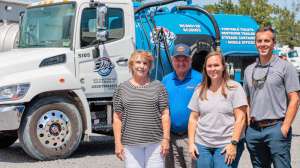
Lynn Boyett employs 16 people to help run his business out of a 4-acre facility in Pensacola, Fla. He operates under the name Boyett’s Septic Tank Service & Portable Restrooms, although the legal name is slightly different — Boyett’s Vacuum Pumping Inc. The company has a full-time mechanic, a full-time yard worker and two office workers. The others help out in all lines of business, the bulk of which is portable sanitation, followed by commercial vacuum truck work and septic service. Boyett’s wife, Debbie, oversees the financial aspects, and Boyett works in the office in a “master coordinator” role. “I’m the organizer,” he says. “I answer the phone most of the time. Everybody hands everything to me and I dispatch it out. That’s where I make the most money for the company.”
COMPANY HISTORY
The company was started as a sideline business in 1955 by Boyett’s father, Leonard, who worked on U.S. Navy helicopters. By 1957 the business grew to the point that the elder Boyett went full time with it. Lynn Boyett, born in 1957, worked in the business his whole life, buying out his father in 1981 and growing the inventory to 3,000 units.
MAKING CONNECTIONS
Boyett’s is working primarily with two companies employed by BP for the Gulf oil spill cleanup. Eagle-SWS is a first response team for disasters. Boyett’s has worked with them on a number of fires, hurricanes, plane crashes and other disasters since being hired to clean up after a train derailment a decade ago.
When Moran Environmental Recovery LLC came into town, they went to the Chamber of Commerce for a list of various contractors. It didn’t take them long to select Boyett’s after checking references and getting referrals. “Our reputation is everything, that’s what we build our business on,” Boyett says. “If somebody asks us to do something and we say we’re going to do it, we don’t make any excuses; we’re going to go do it.”
THE MAIN EVENT
On April 20, 2010, methane gas from an underwater well being drilled by BP in the Gulf of Mexico shot to the surface, causing an explosion that killed 11 workers on the Deepwater Horizon oil rig, creating the largest marine oil spill in the industry’s history. On July 15, after releasing nearly 5 million barrels of crude oil, the wellhead was capped.
The incident has had a profound effect on marine and land animals, wildlife habitats, as well as the tourism and fishing industries. Numerous workers — paid and volunteer — have been working around the clock on land and sea to contain and retrieve the oil, clean up the beaches, and rescue wildlife.
THE JOB
The company is providing portable restrooms and sinks for the cleanup workers along 80 miles of the Florida coastline around Pensacola. The sinks are not used for cleaning wildlife, but to wash oil off the workers’ hands.
Boyett’s is also providing greywater pumping services in camps where workers are being fed, and pump-out services for the buses that transport them to designated locations. These services are expected to be needed for up to two years.
LET’S ROLL
Four days after the explosion, the company began supplying restrooms and sinks — approximately 200 orange and blue Satellite Industries Inc. Tufways and 250 PolyJohn Enterprises Corp. dual-station Bravos. The numbers change constantly, as conditions warrant, a lot of which has to do with the wind. “When it blows to the south, that’s when the oil comes here,” Boyett says. The 10-unit flatbeds attached to their International 4300s were custom-built to have side tailgates, facilitating curbside deliveries when needed.
Restrooms and hand-wash stations were dropped off at six staging areas along the coast. From there, SWS and Moran grab what they need each day, taking them to cleanup areas along the shore, or putting them on barges or ships working in the Gulf. They are usually returned to the staging areas for servicing and redeployment.
One of their three Wells Cargo C.O.G. restroom trailers is stationed on Pensacola Beach, outside of Jimmy Buffet’s Land Shark open-air bar, but it is not part of the cleanup job. Boyett’s has 16-foot and 31-foot Comfort Elite trailers and a 24-foot ADA Comfort Elite trailer from Wells Cargo.
KEEPIN’ IT CLEAN
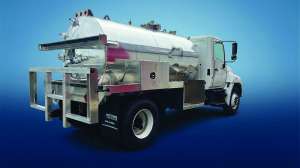
Boyett’s provides daily pumping of greywater from four worker feeding areas. They use two 2007 International 7400 vacuum trucks with 4,200-gallon aluminum tanks from Presvac Systems Burlington Ltd., both with Battioni pumps.
Portable restrooms and sinks also are serviced seven days a week, most at the staging areas. In other cases, the company is notified where to find the equipment that day. “They call us at 5 or 6 in the morning to tell us where they’re at,” Boyett says. “You chase them down, basically.” Remarkably, no units have been lost.
It takes four service technicians 10 to 12 hours to make the rounds using the company’s newest vehicles, 2010 and 2011 International 4300 models from Best Enterprises Inc., both with Conde pumps (Westmoor Ltd.). The stainless steel tanks hold 1,500 gallons of waste and 500 gallons of freshwater. Waste is disposed of at the local wastewater treatment facility.
Three evenings a week the company pumps out 10 to 30 buses at the bayou staging area.
IN IT FOR THE LONG HAUL
Whether it’s customers, employees or suppliers, Boyett treats people in a way that keeps them around. He doesn’t believe in price-gouging in a time of crisis. “I’m not here to just knock it out for a couple months and then they throw us out because we’re too high. We’re here for the long term and to do the job right. That’s why people use us, and then use us again,” he says.
He has no trouble keeping employees because he pays above-average wages and treats them well. He also likes to have long-term relationships with his suppliers. “I just don’t believe in shopping around every month,” he says. “These people will come back and help you when you need help.” For example, the soap the company normally uses in its sinks was ineffective against oil, so Boyett called the supplier, explained the problem, and within 24 hours they sent him a product that worked great and cost about the same.
ESSENTIAL SERVICES
Boyett is well aware that while his business has benefitted from the oil spill, many others have not been so lucky. “I know a lot of people have gone out of business, the poor fishermen and people like that,” he says. “I wish it never happened. But it happened so you have to deal with it. And we’re just trying to do our part. We just make sure we do our job the way it’s supposed to be done.”
Continue reading for free