THE TEAM
Northern Disposal & Sanitation is located in Katrine, Ontario, Canada, about 150 miles north of Toronto. Serving clients in Northern Ontario and the District of Muskoka resort region, the company provides a range of services, including portable restrooms, waste disposal and septic service within a 40-mile radius. The company has three employees, including husband-and-wife owners Katy and David McGregor.
COMPANY HISTORY
The company was founded in 2006 as a disposal service offering roll-off containers to local businesses and contractors. Northern Disposal purchased a septic service business in 2007 and added portable restrooms to its offerings later that summer.
BY THE NUMBERS
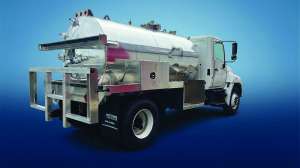
The company offers more than 100 restrooms from PolyJohn Canada, the majority of which are PJN3 models, with additional Fleet Series and Comfort Inn wheelchair-accessible units rounding out the stock. The company has two vacuum trucks, one for septic and one for portables. The septic truck is a 1997 GMC TopKick outfitted with a 2,200-gallon steel tank from Vacutrux Limited with a Wallenstein pump (Elmira Machine Industries Inc.). The restroom truck is a Ford F-550 with a flatbed-mounted 350-gallon waste/200-gallon freshwater steel PickupTanx 550 galvanized Vacutrux tank and Wallenstein 151HRVO pump. The flatbed trailer also transports roll-off waste bins and can carry up to six restroom units.
THE MAIN EVENT
The 2010 Subaru Ironman 70.3 Muskoka was held Sept. 12, 2010, in Huntsville, Ontario. The event attracts as many as 1,300 contestants and 3,000 spectators. As the event title suggests, the grueling race spans 70.3 miles, starting and ending at the Deerhurst Resort. The race includes a 1.2-mile swim, a 56-mile bike ride and a 13.1-mile run.
THE BID
As a former sales coordinator for the Deerhurst Resort, Katy McGregor had her eye on providing roll-off bin and portable restroom service to some of the higher profile events hosted there. The company had already worked on dozens of smaller contracts including local fairs, golf courses and weddings.
Through her contacts at Deerhurst, McGregor heard about plans to host an Ironman event in the area. She quickly called Mitch Fraser, series director of Trisport Promotions Inc., the company responsible for staging the Subaru Triathlon Series.
“You can put an ad in the newspaper or in the Yellow Pages, but we’ve always felt that face-to-face contact helps us to prove ourselves and keep us ahead of the competition,” McGregor says.
Fraser told McGregor that he would be happy to meet with her at Deerhurst in January 2008 while he discussed plans for the race event with the resort owners. Coincidentally, the meeting took place at the same time as the 2008 Canadian Pond Hockey Championships hosted at the resort.
“We’d won the restroom contract for 10 portable toilets for the hockey championships, so this was the perfect way to show Trisport that we could handle a larger event,” McGregor says. “After meeting Mitch, we were invited to submit a proposal, but we found it was a lot of work to prepare the bid, considering the route of the event hadn’t been settled yet.”
Because of the size of the contract, Northern Disposal proposed a three-year agreement comprising restroom services and waste disposal service, which Trisport accepted.
WORKING THE FIRST IRONMAN
The Ironman contract involves the main event and one small event, held in July and requiring about a dozen restrooms. For the main event in September 2008, Northern Disposal supplied 50 units, 30 located at Deerhurst. Additional units would be located in Baysville, Dwight and Dorset, other towns on the route. Some restrooms would be stationed at rest stops along the highway, with two units per stop.
“I drove around with Mitch and his crew in August for a two- or three-hour tour of the race route,” McGregor says. “They weren’t yet sure where they would locate the rest stops, so I would make suggestions to choose a flatter spot, or to move it away from the highway where it would be safer.”
McGregor recalls facing the first race with considerable anxiety. “We were ready, but I spent so many hours looking at the map and making sure everything was prepared, because you have only one chance to shine after the race starts,” she says.
FAST FORWARD TO 2010
At the 2010 Subaru Ironman 70.3 Muskoka, the McGregors continued to follow the successful template they’d developed to cover the events in 2008 and 2009. “The only difference in 2010 is that we also purchased a dedicated Explorer Toilet Transporter from McKee Technologies, through our restroom supplier, PolyJohn Canada,’’ McGregor explains. “It’s a three-axle, 20-unit vehicle that we can hook onto our extra Chevy pickup truck. You require a special license to drive the flatbed, but anyone with a regular license can drive a pickup, so I can make deliveries on my own when it’s necessary.”
The team also must handle additional engagements, which, during last year’s Ironman event included a local fair, two weddings and multiple highway construction contracts employing about one-third of the company’s units.
“Every customer is important,’’ McGregor says. “My skills developed in the hotel business were really helpful on an event like this. The parameters of events change and you have to prepare and adapt. Nothing’s written in stone the night before the event.”
RAPID TEARDOWN
During the race, the company has little contact with the event. When the McGregors get the call that the last racers are completing the course, rapid-fire removal of the restroom units begins.
“We have only 18 hours to remove everything, so our main initial focus is targeting the highways, getting as many of those units out of the way as the roads re-open,” McGregor says. “I get inside the units, remove the paper and garbage, then Dave pumps them out.”
The event generates less than 700 gallons of waste, which is disposed of at a transfer station in Huntsville before the rest of the units are retrieved.
“Some people at Deerhurst linger after the event, so we need to keep some of those units in place until they leave,” McGregor says. “The resort wants to see all of the restrooms removed from their parking lot by the start of the next business day, so we take all of those next.”
The team then moves back to the race route, working into the night. Only a few restroom units located in sheltered and safe areas, such as municipal parking lots, are left for pickup the following morning.
THE FINAL ANALYSIS
“I realize that the restroom contract is only a small part of what it takes to make the Ironman a successful event,” McGregor says. “But when our services are performed well, the event organizers are free to look after the main event, and that inspires confidence in our company to deliver.”
Continue reading for free