Back in February 2006, a semi-retired Brian McNamara heard opportunity knocking and wasted no time answering the door — and stepping smack dab into another full-time career. Within five months, Northeast Sanitation Corp. in Sudbury, Mass., morphed from nothing more than an idea into a full-service portable restroom outfit.
Since then, NSC has enjoyed considerable growth, aided by the acquisition of two more portable sanitation businesses. And the decisive McNamara says he expects further expansion and revenue growth. The key to the company’s quick success? Great employees and a simple but effective business philosophy: Do what you say you’re going to do.
“We don’t mess around,” McNamara says when asked how he took a company from concept to corporation in just five months. “I thought I saw a good opportunity in the marketplace, and so far, it’s proven to be just that.
“Our motto is, ‘The difference is in the details,’ ” he continues. “Whether it’s delivery, service or professionalism, it’s all about how you treat people … that’s what forges relationships. If you say you’re going to do something, do it. If you can’t, don’t be in business.”
MAN WITH A PLAN
McNamara spent most of his career in heavy civil construction and residential development. Working in New England, where the construction season is short and lousy weather is a fact of life, taught him how to make things happen fast. He eventually went into semi-retirement as a real estate developer. But while building a home in early 2006, a brush with unresponsive portable restroom service spurred his second career.
“They never came when they said they would,” McNamara recalls. “I’d have to call them three or four times to get service. So I started thinking that if they have this much market share and provide this level of service, there’s definitely a niche to be exploited.”
McNamara started by doing research on the Internet to determine the level of competition. Then he learned about the Pumper & Cleaner Environmental Expo International —which by chance was being held the following weekend.
“I went to the show, which was a great experience,” he says. “I found out about all the players in the industry, and ended up ordering 120 restrooms.”
By March, NSC was incorporated. And by July, the company was up and running. Growth occurred quickly, thanks to McNamara’s widespread network of construction industry contacts.
Revenues quickly grew. “We’re probably four times bigger now than the year we started,” he says. McNamara says a fundamentally sound business plan was critical to the company’s fast growth. That included forecasting sales revenue and net-profit goals, and asking friends and business associates to “shoot holes” in his business premises.
“I’d recommend that anyone start with a sound business plan,” he notes. “You can’t run blind. You’ve got to have forecasts, then be sure you hit the numbers. It’s not easy, but if you stay focused on your plan — which is your road map to success — you’ll succeed.”
Currently, construction-related rentals generate about 75 percent of the company’s sales revenue; the remaining 25 percent comes from special events. McNamara says his business plan calls for a 70/30 split after five years, so the business is on track. “We have to rely mostly on construction because in this area, there are only so many special events,” he says.
GROWTH THROUGH ACQUISITION
Acquisitions also keyed the company’s growth. One was a sole proprietor who wanted to get out of the business. That company’s territory was just outside NSC’s geographic base, so the acquisition made sense. In the second purchase, an operator went out of business, so NSC purchased the company’s assets, McNamara says.
Growing via acquisitions was part of McNamara’s business plan, not just happenstance. Without them, he knew he couldn’t generate the level of net income he envisioned in the plan. He says he looks for several key factors to determine if another company is a good fit for NCS:
1. A certain level of gross revenue.
2. Route density. “If you’re driving all over the place and your prices are too low, you’re not making any money,” he explains.
3. A geographic location that meshes with the NSC business plan.
4. The average price per ticket. “You can always try to rectify low prices if a company is undercharging, but that doesn’t work if the region (customers) won’t support it,” he says.
5. Similar corporate cultures. That factor didn’t come into play with the first two acquisitions, because no new employees were involved.
“But as we continue to look at bigger and bigger acquisitions, we need to make sure that cultures match,” he says. “Fortunately, I don’t think most business cultures are that far apart. Most people want to go to work and do the right thing — be safe, do the job right and go home to their families.”
NSC is dramatically expanding its geographic scope by acquiring a company on Florida’s eastern coast. The deal should be completed early this year. McNamara says he isn’t daunted by expanding operations so far away from the company’s current regional base. “As long as numbers don’t lie, you can run a business (remotely),” he notes. “If something goes wrong, you can hop on a plane and fix it.”
McNamara says he also surrounds himself with good people, which make him confident about long-distance acquisitions.
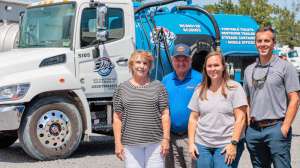
“It’s a team effort — everyone pulls their own weight and is eager to help each other out. I’m not saying it’s Utopia, but we have a great team,’’ McNamara says. He notes he is especially reliant on two vice presidents, Michael Byrne and Dennis Lavoie.
WEBSITE BUILDS BONDS
At first, McNamara relied on established business contacts — the “golden Rolodex,” as he puts it — and word-of-mouth referrals. But three years ago, he realized the company also required an Internet presence. The current website was revised about a year ago, and he says it’s a continual work in progress.
“In today’s world, people want to know you have a website,” he adds. “Everyone should have one that shows their products and explains what they do. But you also have to deliver on what you say on the website.”
To keep the website interesting, McNamara posts a weekly blog that talks about a wide array of issues, from strategic placement of units on construction sites to how many restrooms a customer might need for a wedding or party.
“We aim for information people can use,” he says. “At the same time, we’re also always looking for creative ideas to have some fun with it, too. We ask our drivers for ideas, and they’ve come up with topics like how to protect units on site, putting stone pads in front of units when it’s muddy, placement of hand sinks and so on. It’s all aimed at benefitting the end-user.”
IMAGE IS MARKETING, TOO
NSC also emphasizes less subtle forms of marketing, like new, clean and well-maintained trucks; uniformed, clean-cut drivers who are courteous and professional; and use of new technology, such as global positioning systems, which helps improve customer service.
“We purchase anything that makes us more competitive in the marketplace,” he says. “We try to stay ahead of the curve on that because it saves you money in the long run.”
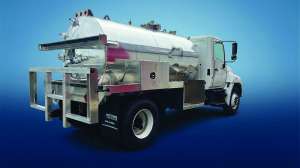
The NCS fleet includes a 2006 Ford LCF with a 350-gallon waste/150-gallon steel tank, made by Best Enterprises Inc.; a 2007 International 4300 with a 1,500-waste/500-gallon freshwater aluminum Progress (Progress Tank LLC) tank; a 2008 Hino 268 with a 1,500-gallon waste/500-gallon freshwater aluminum Progress tank; a 2008 International 4300 with a 750-gallon waste/350-gallon freshwater flat steel tank from Crescent Tank Mfg.; two 2010 Hino 268s with Progress aluminum tanks (one 1,150-gallon waste/350-gallon freshwater and the other with a 1,500-gallon waste/500-gallon freshwater); and a 2007 Ford LCF flatbed truck for deliveries. All of the trucks use Masport Inc. pumps.
NSC also owns 1,100 standard portable restrooms, mostly Integra units from PolyPortables Inc.; 60 handicapped-accessible units (30 made by Satellite Industries Inc. and 30 made by PolyPortables); and two restroom trailers, a 15-footer made by JAG Mobile Solutions Inc. and a 24-footer manufactured by Comforts of Home Services Inc.
The upscale JAG trailer has four 18-inch, flat-screen televisions. Customers who run charity events or weddings often burn their own DVDs with photo slide shows and play them continuously on the TVs.
“We’ve gotten lots of positive feedback about the TVs. I’m not sure it makes us more money, but you know people talk about it,’’ McNamara says. “New equipment is a great marketing tool. We wash and clean trucks every day. We want to create the perception that we’re the best company out there … when people see our trucks, they remember us.”
GPS technology helps improve customer service. NCS uses a system made by Navtrak Inc. that provides detailed information, from how fast technicians drive to the duration of a service call to the exact time the vacuum power on trucks is turned on and off. If a customer questions whether a technician made a service call, NCS can e-mail them a GPS report that proves they did.
If there’s any question at all in a customer’s mind, though, McNamara follows the premise that the customer is always right, which means a technician will go back and re-service the units in question again. Most times, however, the report does the trick, and customers realize later on that, for example, a landscaping crew came on-site unbeknownst to them, which explains why units were full or dirty so soon after being serviced.
BRIGHT FUTURE
McNamara is optimistic about NSC’s future. He says the company’s business plan calls for 40- to 50-percent annual sales growth while maintaining current profit margins, largely through acquisitions and setting up satellite offices — and, of course, by continuing to provide great customer service.
“I always tell our guys they should clean restrooms as if their own kids are using them,” he says. “If you do that, they’re pretty much clean enough for anybody.”
Continue reading for free