QUESTION:
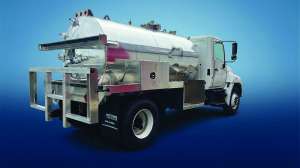
I guess I learned a lesson, but you’re going to have to tell me what lesson I learned. I bought a used pump truck in another state. I picked up the truck, brought it home and went to work. After six weeks of operation – without anything really appearing to be wrong – the tank collapsed. I called the seller and he has no idea why the tank collapsed and, of course, he has no plans of giving me my money back. I don’t think I did anything wrong or different than I normally do while pumping. Some people said the type of steel used for the tank could have been the problem. Isn’t steel steel? What’s your opinion on my dead tank?
J. G. Garner
Houston
ANSWER:
You are partially right. Steel is steel, but there are many grades of steel. The most common type used in building vacuum tanks and the type that I recommend is designated as ASTM A36. Generally it is simply called A36.
For background, the ASTM designation refers to the American Society for Testing Materials. In the beginning days of steel manufacturing, ASTM was established in 1898 and began setting standards for steel in 1901 with the standard for steel rails. In 1981, the European community recognized ASTM as the standard so steel designations would be the same internationally.
A36 steel is composed of the following: 98 percent iron, 1.03 percent manganese, 0.25-0.29 percent carbon, 0.28 percent silicon, 0.20 percent copper and less than 0.10 percent phosphorous and sulfur.
As for strength, A36 steel has a yield tensile strength of 36,300 psi and an allowable bending stress of 22,000 psi. The experts report that A36 steel has properties allowing it to deform as stress is increased beyond the normal yield strength. That is one of the reasons it is commonly used in construction. When there is an emergency, the deforming process allows buildings to stand longer after yield strength limits have been surpassed.
COMMERCIAL QUALITY
When manufacturers are “cooking” a batch of steel and it goes through hot rolls to create plate, the steel is tested to see if it lives up to the A36 specification. Sometimes the steel fails to make the grade of A36. The steel does not meet specifications in terms of thickness, width, surface, chemistry or physical properties. Do they throw these sheets of steel away or melt it down again? No. They sell it.
It is sold at a discounted price compared to prime steel (A36) and it may be suitable for some other applications. It is either called commercial quality (CQ) plate or secondary steel. For some manufacturers, the savings in price on CQ plate are a great temptation.
Many years ago we tried it in our shop and one of our tanks simply cracked. Not just a tiny crack, but a 3-foot long crack right in the middle of the sheet. That was the last time we bought CQ plate. This doesn’t mean every CQ plate is going to crack, but the problem is, you never know what you are getting. All you know when you buy CQ plate is that something is wrong with it and it does not meet the A36 rating.
How can you tell the difference between the two types of plate? Not by looking. The A36 plate will come from the steel warehouse with papers certifying it as A36. The CQ plate will have no such papers.
If CQ plate is used in a vacuum tank, it could collapse because of weak spots in the steel that are unable to withstand the power of the vacuum. The steel might also have been called 1/4-inch plate but not have been that thick. So with CQ, anything is possible.
OTHER COLLAPSE CAUSES
There are other possible reasons for the tank collapsing. Perhaps there was an undetected indentation, taking the tank out of round. This would be the weak spot in terms of the vacuum strength. The tank only needs one weak spot to collapse.
It could be that the tank was simply too thin and/or too old to handle the amount of vacuum you were putting on the system. And of course, you could have had the perfect storm and had all three of these factors happening at once on your tank.
The lesson you’re looking for is simple: Before you buy a used vacuum truck, become as familiar as possible with the tank. Who built it? What is it made of? How old is it? When you can’t get these basic answers, proceed cautiously.
Continue reading for free