But leveraging the popularity of an athletic program in a smaller college town (population about 55,000) isn’t the only reason why the company has grown considerably since it was established in 2010. Other factors include effective marketing campaigns, branching out into septic system services to increase and diversify its business base, winning large special-event and commercial contracts for restroom rentals and service, investing in productivity- and profitability-enhancing equipment and a strong emphasis on customer service.
“The bottom line is you need to clean the restrooms, be professional and be fair,” explains Aricca, 46. “It’s a pretty simple plan. By doing those things, growth just followed. We always try to put ourselves in our customers’ shoes and act accordingly.”
FATE COMES CALLING
The couple never planned to enter the portable sanitation field. But a series of serendipitous events led them there anyway.
It started when a friend of Matthew’s told him a local portable restroom operator had retired and sold his business to a company about 50 miles away. Knowing how much Manhattan residents prefer local service, the couple sensed an opportunity.
“I Googled portable restrooms and found out that Satellite has a manufacturing plant about an hour away,” she recalls. “I thought it was quite a coincidence that they were so close … so I called and talked to Gene, who just happened to be driving near Manhattan on I-70. He was here in a few hours.”
After Clay piqued their interest by talking to them about Satellite products and the industry in general, Aricca called a local high school that was in the middle of a major renovation project.
“I asked if we could rent them some on-site units and the athletic director asked me, ‘How soon can you get here?’” she recalls.
About two weeks later, the couple owned a used vacuum truck with a slide-in tank and 14 Satellite restrooms.
“We didn’t even have name for the company yet,” she says.
Shortly after that, Cat Cans landed a contract to supply restrooms to a large annual country music festival in Manhattan and bought 100 more restrooms.
“That event was pivotal to our growth,” she notes.
The following year Cat Cans won a bid to supply restrooms to Kansas State football games and the business was really off and running.
“After people saw our service was local, it was easy to market the business,” she says.
STEADY GROWTH
With Matthew, 47, (a Kansas state grad with an agronomy degree) already running a plumbing business, Wallace Plumbing Service; Aricca still working as a regional sales coordinator for a national insurance company; and two young children, the Wallaces tried to manage growth.
“We tried not to outkick our coverage, so to speak — grow at a steady and manageable pace,” Aricca says.
Matthew delivered, cleaned and picked up restrooms in and around plumbing jobs. Whenever their restroom inventory would fall to just three or four units, they’d order another 14, she says.
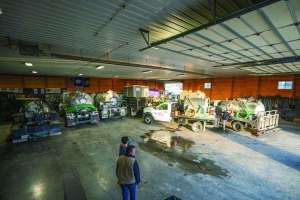
Today the company employs 14 people (including 11 full-time route drivers), owns 13 vacuum trucks and an 8,000-square-foot facility.
Early marketing efforts centered on “pounding the pavement” and letting prospective clients know that a local restroom company was now up and running, Aricca says. In December 2010, she made Christmas cookies and candy and handed them out to local building contractors to develop more brand recognition.
The grassroots marketing worked. In 2012, the company was awarded another major contract to supply and service restrooms during construction of a $1.25 billion bioagriculture research laboratory in Manhattan.
“That led to almost 11 years of rentals, with about 100 restrooms at the peak, with cleaning three times a week,” Aricca says.
STARTING WITH SEPTIC
In 2012, the company took a big step toward diversification by buying a septic tank pumping service from a local operator who had retired after more than three decades in business.
“Matthew always said that if we wanted to grow even more, septic service would be the next phase because it was a logical extension of a complementary service,” Aricca explains. “It also gave us a residential customer base, so if construction ever faltered, we’d be diversified enough to keep going. It also was a very minimal investment, so it made sense for a lot of reasons.”
To grow the business, Aricca relied on something called Every Door Direct Mail, offered by the U.S. Postal Service.
EDDM allows companies to target prospective customers in specific ZIP codes with direct marketing materials delivered by USPS mail carriers. In this case, Aricca developed a newsletter that introduced rural residents to the company’s service and the Wallace family, printed on colorful cardstock to attract attention.
The cost? Only 0.8 cents per mailer, she says.
“We obtained so much business from that,” she notes. “It was very inexpensive to do, plus it allowed us to reach very targeted audiences. It was a very fast and effective way to build name recognition.”
NOW ADD INSTALLING
In 2015, Cat Cans further diversified the business by acquiring a septic system installation business. The owner didn’t want to run the company anymore, but agreed to work for Cat Cans to manage installations, she says.
“We acquired his phone number and his book of business,” she says. “We wanted to do it because we were giving away a lot of business to other installers. We’d pump a tank and find collapsing walls or system failures, then would have to call an installer, which probably cost us about $100,000 a year in revenue.
“Now we’re a one-stop shop for customers — a company that can pump tanks and repair, maintain and install septic systems,” Aricca says.
Developing a great business reputation also contributed to further growth in the restroom end of the business. In 2018, a woman who was running a portable restroom business after her husband died asked the Wallaces if they’d be interested in buying the company.
“She saw we were growing and were professional,” she notes.
It was a fruitful acquisition because the company was renting restrooms to Fort Riley, a United States Army base located about 15 miles southwest of Manhattan.
“That opened the door to the Fort Riley market, which worked out great,” she says. “I think it helped a lot that people knew the business was acquired by a local, family-owned company, which is more attractive to them than if a big corporate pumper would’ve bought it.
“And I think the lady who owned the company and her family found a lot of peace in that, knowing we’ll take care of their customers the same way they took care of them.”
EQUIPMENT CORNER
The company now owns about 1,250 standard restrooms from Satellite, about 100 units from J&J Portable Sanitation Products, 450 from PolyJohn Enterprises Corp. and about two dozen from Armal. The company also owns about 56 handicapped-accessible restrooms; two six-person urinal stations that are ADA-compliant; and 11 standard units with lift kits for high-rise construction projects, all from Satellite.
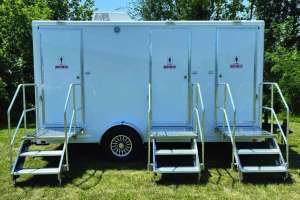
Cat Cans also has invested in six single-user restroom trailers, 27 holding tanks, 180 hand-wash station and a pair of two-person restroom trailers, all from Satellite.
In addition, the company also owns a nine-stall restroom trailer from Advanced Containment Systems Inc., an eight-stall luxury restroom from Satellite Suites and four 14-restroom and two 20-restroom capacity flatbed trailers for delivering restrooms, built by Liquid Waste Industries.
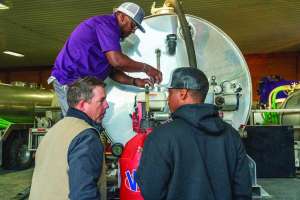
To service restrooms, Cat Cans relies on 10 vacuums trucks: a 2007 Ford F-750 built out by Stephenson Specialty Trucks with a 1,500-gallon waste/500-gallon freshwater aluminum tank from Arthur Custom Tank; a 2018 Dodge 5500 built out by FlowMark Vacuum Trucks repurposing a 1,000-gallon waste/350-gallon freshwater steel tank from Progress Tank; a 2011 Dodge 3500 outfitted by Satellite Vacuum Trucks with a 370-gallon waste/270-gallon freshwater aluminum slide-in tank; a 2011 Dodge 4500 with a 400-gallon waste/200-gallon freshwater aluminum slide-in tank from KeeVac Industries; a 2007 Chevrolet built out by Progress using a 500-gallon waste/120-gallon freshwater aluminum tank from Arthur; a 2015 Freightliner outfitted by Progress utilizing a 1,500-gallon waste/500-gallon freshwater aluminum tank from Arthur; a 2020 and a 2021 Chevrolet 5500 with a 1,500-gallon waste/500-gallon freshwater stainless steel tank from Best Enterprises; a 2021 International built out by Robinson Vacuum Tanks with 1500-gallon waste/500-gallon freshwater tank; and a 2007 Freightliner equipped with a 1,500-gallon waste/500-gallon freshwater aluminum tank from Progress Tank.
All the trucks are equipped with Masport pumps except the 2018 Dodge 5500, which carries a Challenger pump from National Vacuum Equipment.
To handle septic tank services, the company owns a 2021 Freightliner that features a 4,000-gallon steel tank from Stephenson and an NVE 4310 blower; a 2014 Peterbilt built out by Satellite Vacuum Trucks with a 2,000-gallon aluminum tank and a Masport pump; and a 2019 Peterbilt outfitted by FlowMark with a 4,000-gallon aluminum tank and an NVE blower.
To install septic systems, the business relies on two Bobcat E42 mini-excavators, a Bobcat E10 mini excavator, a Bobcat T595 skid-loader, a 2005 Freightliner M2 106 dump truck built out by DTI Trucks with a steel 35-cubic-yard dump trailer from Valew, a 2009 Chevrolet 2500 service truck and a 2018 RAM 5500, both outfitted with a custom bed from CM Truck Beds and a 2015 Dodge RAM 3500 with a Pronghorn custom bed.
SUCCESSION PLANNING
The Wallaces expect more growth in the coming years. As Aricca puts it, “We’re all gas, no brakes — no slowing down.” In fact, the couple recently purchased another portable restroom business with rental volume similar to Cat Cans, so the restroom end of the business now will easily double, she says.
“It’s an exciting time for growth and opportunities,” she says.
At the same time, the couple also is planning an exit strategy with the help of an Illinois business consulting firm that reached out because of the company’s sterling online reviews.
“They help companies improve profitability and do succession planning,” Aricca explains.
A couple of key employees currently are taking on bigger management roles and eventually might be interested in buying shares in the company.
“When we’re ready to walk away, they’ll hopefully be ready to step in as owners, not owner-operators,” she says. “They can reap the benefits of us being owner-operators. They’ll have the knowledge and ability to get in a truck when needed, but there’ll also be a team in place that will ensure the business runs like a well-oiled machine.”
If Aricca has one regret, it’s that she and her husband spent so much time working in the business, not on it. Much of that, of course, was out of necessity; finances often were tight in the early years, making hiring people difficult, plus many business owners tend to be Type A personalities who like to do things themselves.
But the consulting firm taught the couple one thing that other portable restroom operators might take note of: It’s okay — if not even beneficial — to give up the it’s-easier-for-me-to-do-it-all mentality and train high-potential employees to assume larger managerial roles.
“The consulting firm helped us realize we can take a step back and entrust people to run things,” Aricca says. “It’s better to work to live, not live to work — take time to enjoy the perks that come with running your own business.”