
Building a successful business takes years. What starts as an idea grows into reality through the painstaking process of forming a business plan, purchasing equipment and creating and implementing a strategy. Even though a business may take forever to create, it can be gone in a flash.
“We ended up having a shop fire,” says Chase Johnson, founder and owner of Executive Sanitation in Kensington, Minnesota. “We had like 60 toilets alongside the building, and they all melted.”
It was September 2020 when the fire ripped through Executive Sanitation’s shop space. Johnson was renting the space for equipment while he was in the process of building a shop for his expanding business. “We lost our pump truck, restroom trailer and kind of had to start from scratch,” Johnson recounts.
A family trait
Executive Sanitation was the first business Johnson built from the ground up, but it wasn’t the first he helped build. His father and uncle started an excavation business where he worked during his teenage years. In 2006, Johnson’s parents purchased Johnson Jet Line,
a commercial sanitary and sewer cleaning service. Johnson was instrumental in helping his family grow the business into what it is today. He eventually bought out his parents and became the owner.
“I helped them kind of grow that business up, building different relationships with more and more cities across the state and getting municipalities on maintenance contracts,” says Johnson.

Johnson’s connections through municipality contracts led him to a business in the portable restroom industry. “They wanted me to get into portable restrooms because the service they were getting at the time was not good,” says Johnson. “They said they would go with us for service because they know the customer service that we provide.”
Johnson took the suggestion seriously and attended the WWETT Show to conduct research. “I was just scoping out all the different restrooms, luxury trailers and trucks, and I was pretty blown away with all the different options at that time,” says Johnson. “I made the decision to start up Executive Sanitation.”
A bright idea
Johnson started Executive Sanitation roughly a decade ago. His first clients were municipalities that needed portable restrooms in areas like city parks, beaches and at community events. Johnson entered the industry hoping to change people’s perceptions of portable toilets.
“They always assume the worst because they’ve had a bad experience at some point,” says Johnson. “I’m going to try to change that. I want everyone to have an enjoyable experience, as enjoyable as you can have anyway in a porta potty.”
Johnson went into the WWETT Show with a plan. He wanted his portable restrooms to stand out against competitors. He knew he wanted people to feel safe and clean after they used one of his restrooms. He used the show as an opportunity to see the variety and options available. His past experiences with portable restrooms gave him a bright idea.

“When you go to events or street dances at night, it’s a struggle to see at those places,” says Johnson.
At the WWETT Show, Johnson saw a portable restroom equipped with a solar-powered LED motion-detecting light. Johnson purchased 28 Satellite Industries portable restrooms and added the light to each one. The lighting pushed up the ticket price of each toilet by roughly $50, but Johnson said it was worth it to stand out.
The lighting was the first of its kind, according to Johnson. When other options came onto the market, Johnson gave those a try too. “The light was LunarGlo. They were a small company that was willing to work with us,” says Johnson.
About three years into business, Johnson’s inventory was up to about 100 Satellite Industries portable restrooms. He was impressed with LunarGlo’s light and slowly started the process of putting those in the units.
Initial costs vs. long-term investment
Johnson’s prior experience in family-owned businesses taught him important lessons in where to cut costs and where to invest when starting a new company. After researching options, he knew he didn’t want to buy a pump truck only to need a bigger one within a short time frame.
“Most companies start with just a slide-in portable toilet truck where they can haul just a couple of toilets with them and a small slide-in tank,” says Johnson. “I went kind of the bigger route with the best truck I felt was out there on the market, and that was a PortaLogix truck.”
Johnson bought a PortaLogix with an 800-gallon wastewater tank and a 300-gallon freshwater tank. It hauled six standard portable restrooms on the flatbed. The truck was bigger than Johnson needed in the beginning but he was confident his company would grow into it, which it did within a couple of years.
Up in flames

By 2020, Executive Sanitation had expanded significantly. The company was providing portable restrooms and a luxury restroom trailer to communities across central and west-central Minnesota. The company had outgrown its space and was renting a shop while a new space was being built. But in September 2020, the company went up in flames.
A fire destroyed about 60 of Johnson’s portable restrooms, the majority of the units that weren’t in use. It also totaled a Satellite Industries luxury two-stall restroom trailer and the PortaLogix truck, a major blow during an already tumultuous time. Increased demand for portable restroom units during COVID made it nearly impossible to replace inventory.
“Lead times on everything were just crazy,” says Johnson. “That’s the reason why I wasn’t in my new shop — everything got delayed with materials.”
Replacing supplies can always be a challenge but restocking certain supplies during the COVID-19 pandemic was a nightmare. Executive Sanitation lost the majority of its toilet paper and hand sanitizer, which might normally be easy to replace; however, at that time, those supplies were worth their weight in gold.
“At that point in time, sanitizer was super hard to get. Everybody was stealing it, out of all the restrooms,” says Johnson.
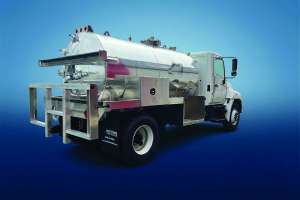
Additionally, pump trucks were on a lengthy backorder. Johnson was able to get his hands on a Robinson Vacuum Tank 200-gallon aluminum wastewater tank slide-in unit with a 100-gallon freshwater aluminum tank. Johnson put that on a 2019 Chevrolet one-ton truck. “It was way undersized for my business,” says Johnson. “For moving my porta potties around I used a snowmobile trailer or utility trailer.”

Supplies and equipment were in short supply, but customers were not, and it stayed that way. Johnson built his business on high-quality customer service and his customers stuck around. “They were very understanding and very loyal and supported us,” says Johnson. “The community really supported us. So, that was the easiest part to bounce back.”
Ensuring insurance works for you
Executive Sanitation’s insurance policy didn’t stand by the company as well as its customers. Only after the fire did Johnson realize his policy wasn’t enough to cover his losses. “I kind of had to take a step back and slowly start building back up again,” says Johnson.
The loss was a costly learning lesson that forced Johnson to reevaluate his insurance policies for all his businesses including his newest company, Jet Line Sales & Service, a sewer equipment sales company he started in 2021. Johnson encourages every business owner to evaluate their policy before disaster strikes.
“The biggest advice I would say is just ask the questions to your agent.
I had a good agent; it wasn’t anything with the company. It’s just asking the questions and going over the scenarios together,” Johnson advises.
Johnson suggests posing specific questions to agents like: “If I’m hauling 20 toilets to this event and we get in an accident; will my truck be replaced? Do I have rental coverage? Just every little scenario that you can think of that could go bad. Ask those questions and just see if your coverage is the right fit.”
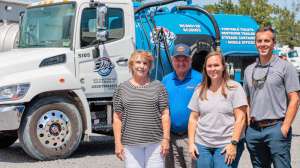
He also adds that bringing on employees can have a big change on the way insurance policies are written. As his company has grown, he’s made sure the policy has grown with its people. Today, Executive Sanitation has five team members, including: Chase Johnson, president/owner; Mark Lang, vice president/head of operations; Michael Peterson, route driver; Tim McCluney, route driver; and Amy Thompson, office administrator.
He encourages company owners to plan for today and tomorrow. He says get an insurance policy that works with your company’s current goals and be sure to update the policy as the business grows.

Expanding into events
After the company’s first luxury restroom trailer was lost in the fire, Johnson replaced it with a JAG four-stall. About one-third of Executive Sanitation’s business is municipal contracts, one-third special events and one-third contractors. By 2025, the company was serving enough special events like weddings to require a second trailer.
Johnson didn’t have to go far to find a new trailer, in fact picking up the trailer was about a 10-minute drive. He purchased a Voyager ADA-plus one trailer. “I know those guys really well. One of their factories is like seven miles from our shop,” says Johnson.
Based in the state filled with ice fishing shanty trailers and a pretty good claim to being the, “ice fishing capital,” the team at Voyager Mobile Restrooms understands how to build light trailers. “They have several conveniences that set them apart. Plus, having a light enough trailer to be able to pull with a half-ton pickup is nice too,” says Johnson.
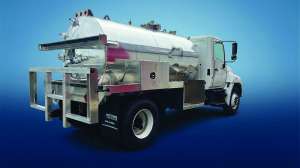
In addition to the two portable restroom trailers, Executive Sanitation now has roughly 350 portable restrooms and 20 Satellite Industries hand-washing stations. In spring 2021, the company was finally able to receive a replacement for the pump truck lost in the fire. The company now runs a 2021 PortaLogix on a 2021 Ford F550 with an 800-gallon aluminum wastewater tank and 350-gallon aluminum freshwater tank.
With three ever-expanding businesses, Johnson stays busy but he always makes sure to scale his growth with customer service. He doesn’t believe in sacrificing quality for quantity, a value he’s retained from the beginning. He says the only thing that has changed is his attention to detail on the company’s insurance policies.
Continue reading for free