I asked friend and PRO columnist Jeff Wigley why he thought the folks that make up the portable sanitation industry are so friendly and down to earth. Jeff said a small group of individuals and companies who invented the portable restroom and grew the industry into the billion-dollar business were always generous helping each other. It’s like they were a team building something important together.
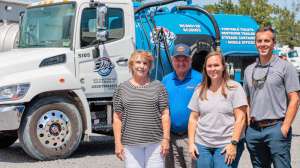
“Everyone had to kind of learn as they went along and that tradition continues today. It’s hard work, the camaraderie. We’ve learned it’s not just us against the world,” Wigley says about what he saw when he started his own fledgling business, Pit Stop Sanitation, with his wife, Terri, in 1995. “You can pick up the phone and talk to folks and they’ll help as much as they can. It’s a really neat feeling.”
Active for many years with the Portable Sanitation Association International, the Wigleys were lucky to befriend hundreds of portable restroom operators. They’d been helped by great people as they grew Pit Stop. And they’d heard many colorful stories about pioneers of the industry and the multigenerational small businesses responsible for advancing portable restroom service.
So when Jeff retired in 2017, he made it a personal mission to start telling the stories of important and interesting figures from PSAI and the portable sanitation industry as a whole. He started in 2021 writing history columns in the PSAI newsletter, tied to the trade association’s 50th anniversary.
“It kind of developed momentum on its own,” Jeff recalls. “The more I would talk to people I didn’t know, the more I got into the history of it.”
SUPPORTS SCHOLARSHIPS
That’s when Jeff and the PSAI decided to create a more permanent record of the portable sanitation industry — from its inception during World War II to where it is today, providing products that give dignity to construction workers and allow all of us to enjoy proper sanitation at events large and small.
The result of two years of research and writing is the new book, PSAI Through the Decades: A History of Portable Sanitation. For the 200-page book split into 30 chapters on a variety of themes and topics, Jeff interviewed more than 70 people, from representatives of the earliest restroom companies to the leaders of the industry today.
All net proceeds from the sale of the book will go to the PSAI scholarship program — which annually awards scholarships of $2,500 to $5,000 employees, spouses or children of PSAI member companies.
Jeff’s aim was to chronicle important stories about the industry and elaborate on the people who made it happen beyond the names listed on PSAI meeting records over the years. “So many people who did so much for the industry and they’re reduced to their name on a piece of paper,” Jeff says. “I tried to add a little more than the names.”
It wasn’t always easy. Much of the early history of portable sanitation is sketchy and proving the details has been a major challenge. Of those interviewed, “quite a few would have been family members of someone who is no longer with us,” Wigley says. He said part of the motivation for the book was recalling how many industry pioneers have passed away in recent years. “The number of people we’ve lost is tremendous. Let’s get this down on paper while we can.”
MANY STORIES
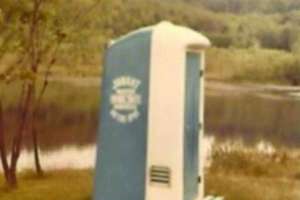
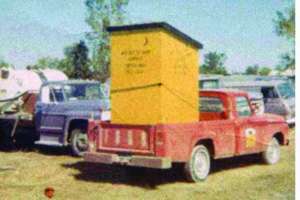
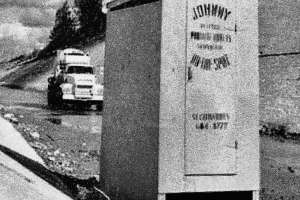
The book covers how the portable restroom industry began to the best of the writer’s knowledge: That’s when an entrepreneur named M.C. Nottingham built wooden boxes holding buckets for waste containers and placed them in Long Beach, California, to be used by longshoremen during WWII. It follows the advances from wood to fiberglass to polyethylene restrooms, and the constant improvement of vacuum trucks to haul the waste.
Chapters are dedicated to a variety of industry leaders and companies, fathers and sons in multigenerational businesses, women in the industry, international trade associations, and reflections from PSAI leaders of the past.
Here are a few of Jeff’s favorite excerpts from the book to whet your appetite to learn more:
The first truck
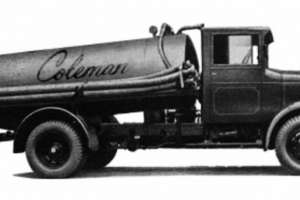
The first truck was invented in 1896 by German engineer Gottlieb Daimler. In 1898, Daimler and his partner, William Steinway, founded Daimler Manufacturing. Here’s a fun fact: Daimler’s partner in the truck manufacturing was the same William Steinway known for Steinway & Sons pianos, and both companies are still producing their products — trucks and pianos — 125 years later. … The early tank trucks were either round or rectangular and were slightly tilted toward the rear of the truck. Without pumps, gravity was the only force to unload the tank.
Restroom trailers originated in Indiana
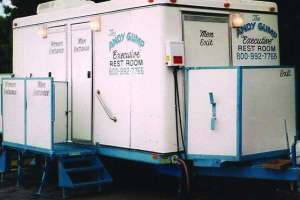
There is a debate as to which company marketed the first restroom trailer, Ameri-Can Engineering or Olympic Fiberglass Industries. But the late Ron Bird of Ameri-Can told a fascinating story about the two companies: “I met Bill Adams with Olympic for the very first time at the Pumper show (Pumper & Cleaner Expo) one year in the late 1980s. As we began our conversation, we both related that our companies were based in Indiana. … We each shared information about the community in which we lived and we both started to stare at each other. With each local fact that we shared, we could not believe the coincidences. Finally, we determined that we lived five houses away from each other on the same street in Lake Manitou, Indiana. Now that is a coincidence.”
You ought to be in pictures
Jeff knew George Rice, founder of A-Throne Company of Long Beach, California, for many years. George passed away in 2020, and Jeff asked his son, Mike, to tell a story about his father that Jeff would not have known. He was stunned that he’d never heard about one of George’s pastimes:
Although he rarely, if ever, shared this with those of us who knew him. George had an impressive movie and acting career for someone who did it as a hobby. Among his credits using his stage name of Warren Rice were roles in Arachnophobia (1990), Dutch (1991), Home Alone 2: Lost in New York (1992), and Baby’s Day Out (1994). From 1984 to 1989, ‘Warren’ also appeared in several episodes of Michael Landon’s Highway to Heaven.
MORE TO DOCUMENT
Jeff hopes the book motivates longtime PROs to go through storage boxes in their attics and basements in search of photos and documents that can expand on the history of the industry.
“There’s so much I still don’t know,” Jeff says. “I hope this is the beginning and not the end of people looking for history. Tell me about those stories and I’ll be happy to write another article.”
There is one big takeaway for Jeff after finishing the project. “I’m more proud of our industry than before I started it. (Writing the book) reinforced that we’re a very giving, caring industry as far back as I can trace it.”