
In our last column, we discussed the rationale and the research needed to diversify your business. This month’s question deals with a more specific path to diversification: adding fencing and barricades to your company’s product offerings.
Question: We want to expand our portable restroom operation and we would like to know more about fencing and barricades. Can you give us an overview of these products and suggestions as to how to get started?
Answer: “Research, research, research” continues to be our recommendation to virtually all questions that we encounter as PROs. We suggest that after the overview of these products, you continue to analyze your entry into this marketplace with potential customers while also being mindful of the financial ramifications that will accompany your decisions.
Standard fencing - construction
Temporary fencing is a necessary component on most construction job sites, especially when post-driven fences are not an option. The ability to secure the perimeter of a job site, thereby protecting the necessary and valuable tools, equipment and supplies is of paramount importance. Fencing is easy to install, maintain and remove after completing the project. In addition, fencing provides a safety barrier to those outside of the work area.
Most temporary fence sections are 6 feet tall and either 10 or 12 feet wide. Made of galvanized welded wire and tubing, these products are designed for durability and longtime use. The average fence section weighs somewhere in the range of 40 to 50 pounds. A standard 36-inch base stand connects fence sections together. Each connection base is secured by a counterweight, either a removable T-post (preferred), a sandbag, a concrete block or a water-filled plastic cube.
An optional plastic or fabric windscreen is available to provide additional privacy and security to the job site. Protection from the wind and control of dust and debris is another advantage. Windscreens also provide the appearance of a cleaner area to the general public outside of the construction area.
Gates are another consideration for PROs looking to provide fence service. The standard opening for most vehicles is 10 feet. Larger trucks and equipment require 24 feet or wider.
PROs can take advantage of existing unit hauling trailers and flatbed delivery trucks to transport fencing and accessories.
Professionally installed and secured, fencing for construction use provides a long-term, low-maintenance revenue stream.
Standard fencing – special events
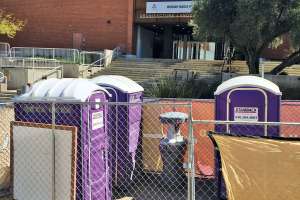
Used in conjunction with event units and associated equipment, fencing can effectively control crowds. If the same vehicles and trailers that are used to deliver units are used to deliver fencing, then additional trips may be required. This should be taken into consideration when calculating customer pricing.
Standard barricades – special events
The most common type of barricades for crowd control at events are interlocking steel structures roughly 8 1/2 feet long and 40 inches tall. Weighing 35 to 45 pounds, these structures have either bridge or flat feet that support each section. Typically, the feet can be removed so each barricade can be stored flat and stacked for transport.
ASK YOURSELF
Do you want to serve both construction and special events, or do you just want to concentrate on one market segment? Construction projects will require that fencing remain on site for prolonged periods of time. More fencing inventory will be required to serve a growing number of customers. Event fencing can be rented much more frequently but is more labor-intensive.
Do you want to be a participant in the market or do you want to become dominant?
What do you do when you do not have enough product to complete a job? Are there existing companies providing these products and services in your area that you can refer to? Can you work in partnership with these competitors?
How much revenue must be invested to establish the initial size of your fencing business?
In your local area, are there additional business permits, insurance requirements, safety training or required certifications?
Will you be able to use the same yard for this new equipment? Is there enough room for more equipment and possibly vehicle storage?
We strongly recommend advertising your business by having small metal signs with your company information affixed to each section of fence.
BEYOND THE BASICS
Road construction barrels – Primarily used in conjunction with roadwork projects, these orange and white round plastic barrels feature a reflective disk on the top. A rubber disk is at the base of the barrel and serves as a counterweight. The barrels may remain in place for some time or may be required to be moved frequently. Most companies rent these to the road construction company and it is their responsibility to move and to maintain until completion of the job. Damage and loss of barrels is common. Clear, pre-negotiated and well-enforced damage and loss policies are highly recommended.
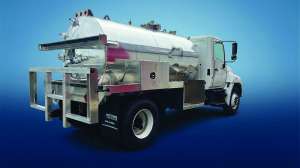
Plastic Water-filled Barriers – Construction sites and road projects use these types of barriers for traffic control. Water supply is a major consideration and expense. Some companies will purchase dedicated water tank trucks to fill these barricades.
Financial analysis and in-depth research are even more crucial with these more diverse business offerings.
FINAL THOUGHTS
Fencing and barricades offer opportunities for the PRO to become more of a total solution for the customer. Research, planning and financial tracking are the keys to success in diversifying your business. With this strategy in mind, be creative, work hard and you will succeed!
Continue reading for free