But the decision to retire was much more abrupt, says Shepard, who was signed as an undrafted free agent by the Philadelphia Eagles in 2013, then went on to play for the Tampa Bay Buccaneers, the Carolina Panthers and the New York Giants.
“I was going to sign with the Baltimore Ravens for the 2020 season, just as my parents were about to get the company up and running,” explains Shepard, who played college football at Louisiana State University. “I was scheduled to head out to Baltimore on a Monday, and the Friday before that I started questioning if I really wanted to keep playing football.
“On Saturday, I decided I didn’t want to play anymore and called my agent to tell him I was done,” he says. “He asked me, ‘You’re really going to retire to drive a poop truck?’”
Three weeks later, Shep Boys officially opened for business. Shepard says he drove routes for about a year to fully immerse himself in the business and learn the industry from the ground up.
“I was very eager to learn,” Shepard says. “I became totally immersed in the portable toilet space. The rapid growth of the company was the only thing that forced me out of the truck and into the office.”
MAKING A PLAY
Shepard already was familiar with the business world, having invested in trucking companies his parents owned and operated, most recently one called Shep Boys Trucking. As his NFL career wound down, he asked a family friend, Jon Farley, a third-party waste broker, for some career guidance.
“I wanted to do something comparable to the companies my parents had run,” Shepard says. “Jon told me to think about starting a port-a-potty company, which would be cheaper to start up than other things I was considering.
“He told me people are peeing and pooping every day, so there’s always a need for the service,” he continues. “It’s been a very sound investment — as recession-proof a business as I’ve seen. I’ve already been approached twice about selling the company, which tells me we have something really good going on.”
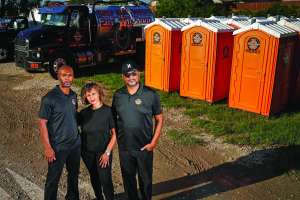
Shepard and his parents, who are co-owners of the company, started out with 125 restrooms, one vacuum truck and three employees (the three Shepards). Three years later, the company runs five service vehicles, employs 14 people (including four contract workers at the moment), owns about 700 restrooms — mostly from Satellite Industries — and serves customers within about a 150-mile radius around Houston.
Monthly construction rentals generate about 80% of the company’s sales with special-event rentals contributing the remainder, Shepard says.
GROWTH STRATEGIES
To quickly scale up the business, Shepard concentrated on the lowest hanging fruit: monthly construction rentals, particularly for highway projects. Referrals from Farley bolstered the efforts.
“That’s where we could obtain the highest profit margins and the best residual income,” he says. “We might have 75 cans on one highway project and those units will be there for years.”
He also capitalized on another advantage: significant financial resources built up from playing in the NFL.
“It’s a very capital-intensive business to start, so it helped that I had the capital to invest in the company,” he says.
Several other factors also drove growth. Early on, Shepard says he talked to about 100 reputable portable restroom operators to identify core best practices for success. Providing consistent and dependable service topped the list.
Shepard also decided to not be a low-cost provider in order to gain market share. He looked at the most respected and top-performing service providers in the Houston market to create a template for pricing.
“We want to be a high-end company,” he says.
MORE KEYS TO SUCCESS
To minimize overhead, Shepard hired an accounting firm, a mobile mechanic service and a mobile tire-repair service rather than hiring employees to perform those tasks.
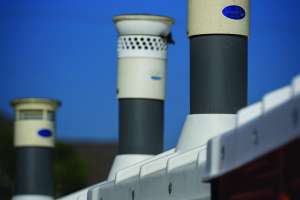
Furthermore, he sought to differentiate Shep Boys from competitors by adding extra restroom features such as industrial-strength mirrors and solar-powered lighting and ventilation units from LunarGlo.
“We love them – they’re a great marketing piece,” he says. “We lose a little bit on the bottom line because they add about another $100 to the cost of each restroom. But we’re trying to create a different experience for our customers — one where people walk into a restroom and love it. That enables us to charge a little more.”
The company also uses deodorant disks from Walex Products Co., with scents such as coconut, cinnamon and strawberry.
“People are really surprised at how good our restrooms smell,” Shepard reports.
To attract and retain quality employees, the company offers quarterly job reviews and a technician rating system that incentivizes good performance, he says.
“We give them gifts like good seats to a Houston Rockets basketball game or a weekend stay at a nice hotel in Houston,” Shepard explains. “We also award cash bonuses at the end of the year, based on the job reviews. And those bonuses get bigger as employees build up time and experience with the company.”
WORKING SAFER
The company also provides extensive safety training required to work at refineries and chemical plants, which Shepard would like to add to the company’s customer base.
“We tell companies we’d like to work for them and they tell us what training we need,” he explains.
Safety training is important for working in refineries and other plants because companies have to submit health, safety and financial records to ISNetworld, an online software platform that allows companies to see what businesses are qualified, in order to minimize potential liabilities.
“Anyone with a score of 2 or higher is a no-go,” Shepard says. “You have to score a one.”
Sometimes the training is done at the Shep Boys shop and other times it’s done at a specific plant. Some courses last up to a week and employees have to pass a test at the end of the training.
The training is expensive. But it’s money well spent if it helps the company acquire lucrative restroom-rental contracts. Some refineries, for example, have hundreds of restrooms on site, he says.
EQUIPMENT INVESTMENT
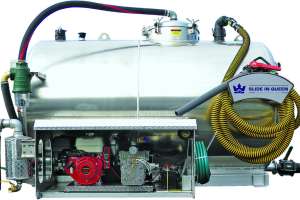
To service restrooms, the company relies on: a 2019 Ford F-750 with a 1,400-gallon waste/600-gallons freshwater aluminum tanks from Amthor International; a 2020 Ford F-550 with an 800-gallon waste/400-gallon freshwater aluminum tank from Amthor; a 2023 Mack MD6 truck with a 1,500-gallon waste/500-gallon freshwater aluminum tank built by Amthor; a 2023 Mack MD6 chassis with a 1,500-gallon waste/500-gallon freshwater aluminum tank built by American Tank Co.; and a trailer that carries an 800-gallon waste/400-gallon freshwater tank from Amthor. The trucks and the trailer are equipped with Masport pumps. A Ford F-250 dually pickup truck tows the trailer.
“We thought the tanker would be good for emergencies if something ever happened to a truck,” Shepard notes. “But over time, as we earned more business, we’ve built a full route around it.”
The company also owns roughly 700 restrooms, mostly new units from Satellite Industries, plus a mix of quality used restrooms; 100 hand-wash stations from Satellite; two restroom trailers made by Satellite Suites; and about 50 holding tanks and 25 water tanks for construction trailers, also from Satellite.
BUSINESS EDUCATION
Listening to Shepard talk business, it’s easy to assume he earned a business degree. But he didn’t. Instead, he soaked up information and strategies while in the NFL and relied on portable sanitation industry mentors to increase his business acumen.
“During every year in the NFL, I developed relationships with owners of teams,” he explains. “I’d ask them about everything from stadium operations and leasing rights to employee benefits and 401(k) retirement plans.
“I love to ask questions and learn,” Shepard adds. “I essentially received a crash course in business.”
Two industry mentors also helped him devise effective business strategies: Doug Card, the owner of Smooth Move Services, a Houston-based portable restroom rental company, and its parent company, Houston Waste Services; and Reagan Swinbank, a partner in Sprint Waste Services (bought by GFL Environmental in 2022).
“Doug told me to not disrupt the market by being a price low-baller — that only hurts everyone in the long run,” Shepard says. “He said I should instead be confident in our services and charge accordingly. He also gave me advice on everything from routing systems to how to operate and run a successful portable restroom company.
“Reagan taught me not to chase every portable restroom rental,” he continues. “Instead, he told me to chase margins — enter the market for disaster work with FEMA (Federal Emergency Management Agency) and the American Red Cross.
“They’ve both helped me create a 5- to 10-year vision for growth,” Shepard concludes. “Without mentors, you’re just walking in blind.”
EAGER FOR GROWTH
Looking to the future, Shepard remains offensive minded, with long-term plans to gain more work at refineries and petrochemical plants as well as contracts with FEMA to provide restrooms during natural disasters and other emergencies, Shepard says.
“Scared money doesn’t make any money, in my mind,” he says, noting the company’s aggressive growth plans. “We want to be a regional company that serves all the states along the Gulf Coast from south Texas to Tampa, including Alabama, Mississippi and Louisiana, plus Georgia.
“We can make the same amount of revenue with 500 restrooms at industrial plants as 3,000 restrooms on construction sites,” Shepard says while explaining why the company wants more industrial work.
To enhance those growth plans, the company has been granted state and federal certifications as a women’s business enterprise, a disadvantaged business enterprise and a minority business enterprise.
“Those certifications are huge for us because they allow us to compete with the big companies,” Shepard says. “There aren’t enough minority-owned companies to hire, so oftentimes we’re asked to bid on contracts.”
Whatever happens, it’s clear that Shepard is relying on a thoughtful, carefully considered and strategic game plan, not a desperate Hail Mary heaving toward the goal line. And he’s certain he will succeed.
“We’re going to be one of those companies with 10,000 or 20,000 restrooms someday,” he says. “I have all the confidence in the world in what we’re building.
“I’m a competitor and I’ll do whatever I have to do to win.”