COMPANY HISTORY
Handi-Can Toilet and Fence Rentals was founded in 1993 and is located in Spruce Grove, Alberta, about 15 miles west of Edmonton. Owner and president Jeff Huston purchased the business in 2003.
“I had been in sales with several companies, but I was looking for a recessionproof business that I could own and operate,” he says. “Edmonton is always under construction, and it’s become known as Festival City, so there’s always a market for outdoor facilities.”
Expanding from the original three employees, six vacuum trucks and 600 restrooms, the business has grown. It now employs as many as 20 people during the busy summer season and offers 10 service trucks, more than 1,200 restrooms, about 80% from PolyJohn Canada and the remainder from Satellite Industries. The business operates out of an 8,000-square-foot building, purpose-built for the operation.
Handi-Can’s business skews about 80/20 between construction and events, with summer always the busiest season.
A LONG-TIME PARTNERSHIP
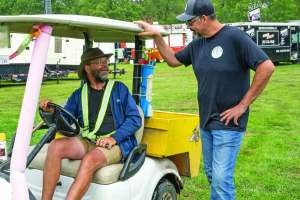
Handi-Can already enjoyed an existing service contract with the Edmonton Folk Music Festival when Huston bought the company in 2003. “We continued that relationship the following year and Handi-Can has been handling the festival contract every year since,” says Huston. “I have always liked to be personally involved in the setup and teardown of the equipment.”
THE MAIN EVENT
The Edmonton Folk Music Festival is an annual four-day outdoor music event inaugurated in 1980, and held the second weekend of August. Staged at Gallagher Park in Edmonton, the festival draws folk music performers and fans from around the world, counting as many as 20,000 daily visitors, held from Aug. 10 to 13 in 2023.
The event features six stages, dozens of food vendors and a beer garden. The event has featured many popular folk performers, but some of the more familiar names have included k.d. lang, Joni Mitchell, Blue Rodeo, Steve Earle, Van Morrison, David Byrne and The National.
BY THE NUMBERS
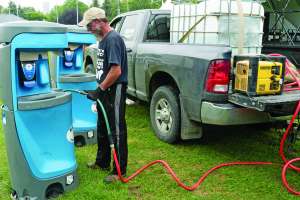
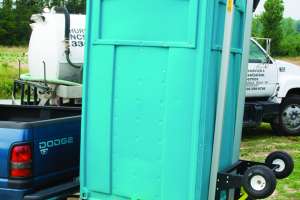
Handi-Can brought 200 restrooms to the event, all from PolyJohn Canada. About 10% of the restrooms were accessible units. The contractor placed one Forest River Century II double unit washroom trailer backstage to serve performers. In addition, 15 hand-wash stations from PolyJohn Canada were placed at the site to serve performers and food service workers.
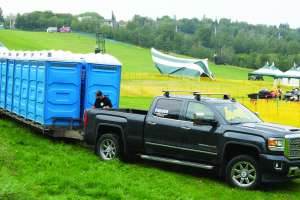
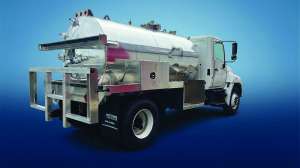
The service fleet included seven Dodge trucks ranging from 2012 to 2022. They feature steel tanks — 350-gallon waste/200-gallon freshwater — by Vacutrux and Wallenstein pumps from Elmira Machine Industries. Restrooms were hauled by a number of transport trailers, including a 12-unit Explorer from McKee Technologies, and several home-built trailers carrying 8 to 14 units.
LET’S ROLL
The drive to the downtown festival takes about 45 minutes. “It’s a ski club during the winter,” Huston says. “The hills make for good viewing of the stages, but we have to select our locations carefully given the slopes. The festival site has no paved roads, and most of the setup requires driving across open ground, so you want to be careful not to rip up the grass. About 40% of the time we set up during wet weather and the 2023 event was no exception — it was made more challenging by torrential rains.”
The site is locked in by residential neighborhoods, with narrow roads and lots of street parking. A nearby community recreation center and playground also require a watchful eye as the team minimizes disruption to residents.
“The organizers don’t want the restrooms being placed too early on a busy site where everyone else is setting up,” Huston says. “Anticipating the rain, we delivered most of the units on Monday, and worked within the festival schedule to set them up over the next few days. Most were set up by Tuesday, but we finished the last few placements on the morning of the 10th, so the festival could open on Thursday at 4 p.m.”
KEEPIN’ IT CLEAN
Handi-Can usually assigns from six to 10 team members to service the event.
“We do the service in the morning, starting at 7 a.m. and usually finish by 10 a.m.” Huston says. “Saturday and Sunday are full days for the festival, so the Sunday morning service is generally the most challenging. We typically have one pumper and a few staff members monitoring the units during the entire event to refresh the supplies, perform spot cleaning or handle any emergencies that may arise.”
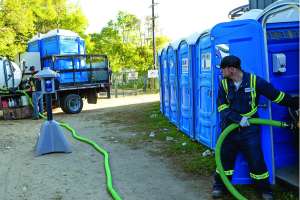
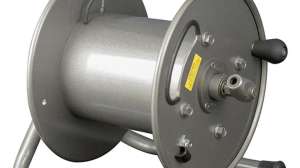
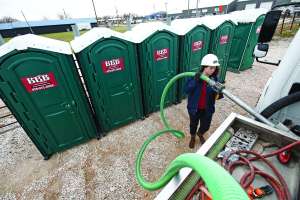
With limited access to the site, the team is often required to sling suction hoses over and under event fencing to service the units. “We sometimes use 100-foot hoses and move them in teams to quickly pump out the units,” Huston says. Handi-Can typically uses deodorizers and treatments from Walex.
In previous years, Handi-Can was able to access the same sewage access point used by food-service providers, located near the grounds. This year, new regulations closed off that access point to the contractor.
“In the interest of efficiency, we partnered with a septic pumping company to provide two 3,000-gallon trucks,” Huston says. “That allowed us to offload the waste and get back to work, while the septic trucks hauled the waste away.”
WRAPPING IT UP
It takes two to three days to remove all the equipment following the event. Huston says the company takes a lot of pride in working this contract: “It’s one of our favorite events to service, because the people attending the festival are always respectful, happy to be served and treat our equipment well.”