Will a proposal to upgrade construction site restrooms in British Columbia generate more revenue for Canadian PROs? Or will the province requiring flushing and other comforts for larger construction sites prove a burden too difficult for PROs to satisfy and too expensive for their customers to afford?
Perhaps a bigger question: Will Canada’s efforts to upgrade portable sanitation regulations gain support in the larger U.S. construction market? And if construction customers demand and receive mandates for these amenities, will the same hold true for special event service? This could have a dramatic impact on the industry.
But let’s not get ahead of ourselves. What happened in Canada’s westernmost province to spark these questions? Last October Premier David Eby — responding to demands for better portable sanitation service by the B.C. Building Trades Council — committed to a requirement for restrooms with flushing toilets and hot and cold-water hand-washing at construction sites employing 25 or more workers. The union representing 40,000 workers had started a public relations campaign calling the condition of many drop tank restrooms unsanitary and undignified.
At a union convention, Eby said construction workers should have the same access to hygienic bathrooms as workers in other fields. Media outlets said this response prompted a standing ovation.
“If we want people to work in the trades, if we want to show people that this is a great way to support your family and build your community, the basic ability to go to a bathroom that doesn’t stink, that isn’t a mess, where you can flush a toilet, is a basic requirement for a decent job site,” he said.
BETTER CONDITIONS
The trade group had just reintroduced a Get Flushed campaign that started during the COVID-19 pandemic, calling on the government to raise standards for portable sanitation.
“Enough is enough,” said the group’s executive director, Brynn Bourke, in a press release. “Nearly every other industry from film to events and tourism has found a way to bring clean, flushing toilet facilities to mobile sites. ... Construction workers have been faced with unsanitary and undignified washroom conditions for too long. We need the provincial government to step in.”
The trades group argues upgrading to plumbed flush toilets with other amenities can be done because it has been the rule in the eastern province of Quebec since 2015. Additionally, updated service requirements — including employing flush restrooms and hot running water whenever practical — have been in place for some time in Ontario.
What is the specific ask from the B.C. Building Trades Council? The group would like the following included in formal legislation:
- Supply plumbed washroom facilities — including the option of portable plumbed washrooms
- Provide access to hand-washing facilities close to washrooms
- Ensure washrooms are properly cleaned, disinfected and maintained
- Equip washrooms with proper heating and illumination
- Place washrooms within appropriate walking distance for workers. (No more than 200 feet, according to a 2021 recommendation.)
DEFINE “FLUSHING” TOILET
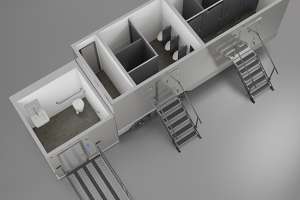
What constitutes a “flush” toilet? That is unclear in the current discussion in British Columbia, but B.C. Building Trades, on its Get Flushed website, seems to be calling for restroom trailers based on its example of how flushing toilets could cost about $1 a day to serve a site with 100 workers. They argue that a deluxe restroom trailer with multiple toilets on men’s and women’s sides would cost nearly $3,000 per month, or 97 cents per worker per day.
The B.C. government hasn’t introduced any formal legislation to require flushing toilets as promised by Eby.
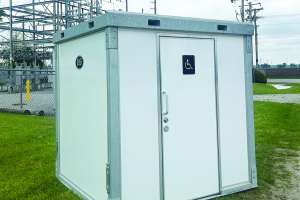
But in Ontario, acceptable restrooms not connected to a municipal sewer may include those “equipped with a trap or positive seal separating stored waste from the bowl,” according to regulations. These would appear to describe the common plastic units provided by the industry with a flap that allows waste to enter the holding tank where it can’t be seen by the user. Quebec also allows this type of unit where it is not “reasonably practical” to connect the restroom to a municipal sewer system.
Ontario also qualifies its requirement for hot and cold water sinks as only if “reasonably possible.” The regulations also call for an open-front toilet seat, a self-closing door that can be locked from the inside, adequate natural or artificial light, adequate ventilation and heating “if that is possible.” Regulations say one stand-alone sink may serve two restrooms if they are located in the same project area.
ON ONE HAND
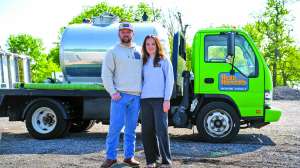
I reached out to one B.C. restroom operator who voiced frustration over the proposal for flushing toilets. The PRO with 20 years in the industry says Eby’s promise to require the upgrades came with no timeline for legislation. It left construction customers confused over if this is a mandate and restroom companies worried about the future of their equipment inventories. Should they buy what PROs know as the simple plastic flusher units or budget for more restroom trailers to satisfy requirements that might come down the road?
This contractor may reflect a concern of other contractors in not wanting to send his restroom trailers onto construction sites when they have typically been reserved for special event work. “I don’t want my nice trailers being thrashed on a construction site,” he says. “Typically construction workers are not easy on them, and I’m not going to put my nice assets out to be ruined.”
Rather than forcing PROs to provide restroom trailers or flushing units in general, this PRO suggests construction clients need to adjust their mindset and spend a little more money for higher quality service of basic restrooms. “I guarantee everyone will cut corners and skirt the rules, just like it’s being done in every industry,” the PRO says. “Every construction site is trying to minimize their costs. Instead of having 20 restrooms on site, they have 10 and wonder why they’re full to the brim every time we go to service them.”
If the government is going to tighten restroom rules, the PRO would prefer to see the restroom-to-user ratio changed or construction customers increase the number of services from once to twice or three times a week. Those changes alone would greatly improve cleanliness and reduce complaints about portable restrooms in general. “We take care of our units and service them well. If you take care of the guys and have enough units, it’s never been an issue,” he says. The PRO says raising the industry standard from one to two units for 10 workers on a construction site would make a significant difference without requiring flushing toilets.
ON THE OTHER HAND
I understand the perspective of small businesses that have a negative knee-jerk reaction to regulation in general. Companies in the wastewater sector certainly already have plenty of rules to follow, and it can seem like the list gets longer every day. But I also recognize there is always room to raise standards for portable sanitation, and regulations like the one proposed for British Columbia can provide enhanced revenue opportunities for PROs.
After all, moving from a drop tank to a plastic flushing unit or a restroom trailer is an upsell to a pretty significant customer base for most portable restroom contractors. So is the prospect of increasing the number of hand-wash stations, lowering the ratio of restrooms to workers and cleanliness standards that push clients to add more service calls. Customers might complain about the changes at first, but the added cost may be justified in the long run if it keeps their workers happy on the job site.
And the portable sanitation industry has its reputation to consider. PROs are constantly criticized when restroom users have a bad experience. Many of you believe this criticism should first be directed at customers looking for cut-rate service; that the negative perceptions heaped on the industry are the result of poor service driven by the clients who ignore the sound recommendations of restroom providers.
Maybe government regulation can be a positive thing if it forces construction companies — and other users of your services — to adhere to more rigorous cleanliness standards. And if a trend toward stricter regulation of job site restrooms in Canada is successful, maybe U.S. states and local health departments will follow suit, raising the standards for hygiene across North America.
Continue reading for free