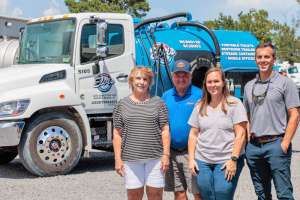

Virgil Elvis founded Elvis Service Co. as a plumbing business in Myrtle Beach, South Carolina, in 1956. He and his wife, Rebecca, represent the company’s first generation.
Septic installation and repair became a natural extension of that work, followed by pumping. With waste-handling equipment already in place and relationships established among construction customers, portable restrooms became another opportunity to serve a growing local market.
According to the family, Elvis was among the first portable restroom providers in its part of South Carolina. Before molded fiberglass and plastic became common, some of their early units reportedly had wooden structures. They later drove to Virginia to bring back three fiberglass units at a time.
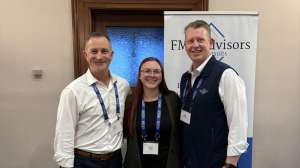
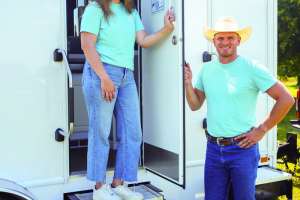
Phil and Denise Elvis represent the second generation and remain the legal owners but are largely retired. Day-to-day leadership now falls to their daughter, Morgan Elvis, the company’s informal “inside boss,” and Matthew Haselden, Morgan’s brother-in-law, its “outside boss.”
Morgan and Matthew have “spent approximately 15 years helping move the company forward. They stepped into larger roles shortly after the recession, when the operation had slowed down with the economy.

Today, Elvis employs around 50 people, has several thousand portable restrooms in inventory, deploys around 30 restroom trailers, including VIP units and completes thousands of service stops each week.
The company’s portable restroom routes generally extend within about a two-hour drive of its Myrtle Beach location with construction and special events being two of Elvis’ largest portable sanitation markets.
The company also provides septic pumping, drain cleaning, restaurant grease services, container rentals, temporary fencing and ancillary services. The divisions overlap in customers and administrative support, but each maintains its own routes, service territory and dedicated equipment.
For this third generation, the challenge is to continue growing the operation without losing the family culture, personal relationships and service standards that built the Elvis name.
Here are five principles helping them do it.
1. Growth from a foundation of trust
For Elvis, plumbing led to septic work and pumping. Relationships with contractors supported growth not only on the portable restrooms front, but also opening opportunities for other construction-related services like restaurant accounts for grease-trap pumping led to drain cleaning, jetting and a used cooking oil collection and recycling business.
The service lines may be connected commercially, but they remain distinct operationally. Matthew says each one grew from existing capabilities, existing customers or both. The underlying strategy is straightforward: Establish trust with one service, recognize customer needs and determine whether Elvis is equipped to fill them.
That structure allows Elvis to deepen relationships and keep employees productive without treating its equipment as interchangeable or asking one division to work outside its expertise.
2. Protect the name while adapting the operation

Customers throughout the Myrtle Beach area recognize the Elvis name. The company’s longevity provides an advantage that its leaders say cannot be purchased through advertising.
It’s a family business through and through. Morgan’s 90-year-old maternal grandmother still comes into the office five days per week to help organize paperwork.
Matthew is straightforward when describing the company’s values: Operate like a family business, do the right thing every time, be kind to people and love people. That philosophy frames how the company approaches employees, customers and industry relationships.
They are unwilling to pursue growth at the expense of the service their customers have come to expect. At the same time, Morgan and Matthew can no longer be personally involved in every route, delivery, repair or customer issue.
Growth on the portable restroom side has only increased that sense of responsibility and the shift places greater emphasis on training, delegation and quality control.
“You are so used to being hands-on with everything,” Morgan says. “Then you have to learn how to navigate the day to day without having your hands in every task.” She says the goal is to “keep the family atmosphere but continue to grow at the same time” and continue to instill the values that brought the company this far.
“There is a lot of pressure,” she continues. “Especially at our ages, to take something that has excelled for so many years and not only grow it but protect the name.”
3. Match the restroom fleet to the work

Seven decades is a long time to watch portable sanitation equipment evolve. Matthew says Elvis eventually had to destroy and dispose of approximately 1,000 older fiberglass units that were no longer suitable for the company’s operation or market.
Today, Satellite Industries is the company’s primary source for standard units and restroom trailers. Elvis also uses PolyJohn units.
“With portable toilets, you want your equipment to match, especially at events,” Matthew says. “Keeping everything consistent is important.”
That consistency is particularly valuable for the company’s event business. Elvis serves weddings, corporate and sporting events, concerts, festivals and other special events where customers want a trailer option.
The lineup includes two-stall and ADA-accessible models, larger eight-, nine-, 10- and 11-stall units, and modular restroom trailers. The company will coordinate interior themes and decorative touches to help the restroom area complement the event setting.
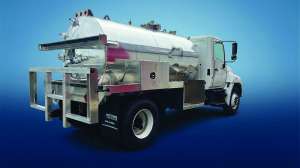
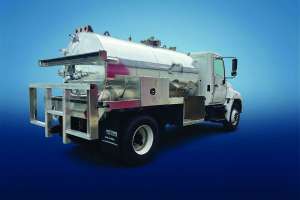
The same fit-for-purpose philosophy applies to the service fleet. Elvis has purchased approximately 15 to 20 specialized vehicles from Integrity Tank Sales & Service in North Carolina. Matthew notes Chad Davis at Integrity Tank has been a huge resource for upgrading styles and capabilities of their service trucks.
The company also installs pressure washers on portable restroom service trucks. Combined with a scrub brush and sanitation chemicals, the system allows technicians to thoroughly clean units in the field rather than automatically returning them to the yard.
Elvis has worked with Walex Products Company for approximately four decades and buys toilet paper from Morcon by the 53-foot tractor-trailer load.

4. Hire people the team wants
The expectation at Elvis is that route drivers understand the customer’s experience belongs to them, not only to a salesperson, dispatcher or the company name printed on the truck.
They want drivers to put a dependable face to the service. Drivers are encouraged to introduce themselves, hand out business cards and provide cellphone numbers when appropriate. Matthew learned the value of making those types of connections while pursuing new accounts. The hardest customer to win was often not someone especially devoted to a competing company. It was someone loyal to a particular service driver.
Elvis also gives employees a financial reason to take ownership of their routes. Drivers can accept overtime opportunities, and monthly incentive arrangements are tied to the number of units or accounts serviced. “Every person is their own business,” Matthew says. “If they want to work harder and can do more, they can earn more.”
For building the team, Elvis uses FirstChoice Hiring to distribute employment advertisements, but an office interview alone does not determine whether a person is right for a position.
Promising applicants may be paid to spend as long as a week working alongside several trusted employees. “We will pay you to come in for a week, but we are not going to promise you a job based on sitting across the desk from us,” Matthew says. “That does not tell us how things are going to go in the field. We let the team help with the decision because we are not the ones who will be in the field with that person every day.”
The candidate must be able to pull their weight, make the team’s workload easier and contribute to a positive environment. Management then asks the drivers a straightforward question: Do you want this person working beside you?
Referrals from current employees carry weight. A person who has already worked with a candidate for several years can provide far more insight. Matthew describes that type of recommendation as “basically a five-year interview.”
The result is low turnover and a workforce that includes employees with decades of company experience.
5. Make relationships more important than rivalry
Since approximately 2013, Elvis has acquired four portable sanitation operations, with at least one former owner joining the team after selling the company.
Matthew views those transactions as more than financial deals. He believes they were made possible by the way the companies treated one another before an acquisition was ever discussed.
“We are happy and thankful for the continued relationships with them, even going as far as having one of the previous owners come and work with us,” he says.
Elvis has also developed relationships with regional operators serving neighboring territories with some overlap. Those companies may exchange referrals and, when circumstances require it, help one another with equipment, services or driver support.
“The more you are an asset to a competitor, the less compelled they are to do something against you,” Matthew says. “The more value I add to another company, the more reason we all have to be fair and upright with each other because there is more to lose.”
This goes for customers, too. The company’s history shows a repeated pattern: Establish trust with one service, recognize another need and determine whether Elvis is equipped to provide a practical solution.
Carrying the name forward
For Morgan and Matthew, leading a third-generation company means balancing dual responsibilities.
They want to prepare the operation for the future through better systems, specialized equipment, dependable people and new opportunities. At the same time, they are tasked with protecting a family name that took decades to build.
Morgan’s father regularly reminds the family how dramatically the business has changed. She says he would give anything for Virgil to drive through the yard today and see what grew from the small plumbing company he started 70 years ago.
Morgan says that growth would not have been possible without help. “You do not get to our size without the proper people and the right help along the way,” she says. “It really takes a village of good vendors and good employees to do what we do every day. No generation could have dreamed this is where we would be today.”
Continue reading for free