What happens when a job looks perfect on paper but turns out to be a bust in practice? Unfortunately, that’s a scenario some people find themselves in.
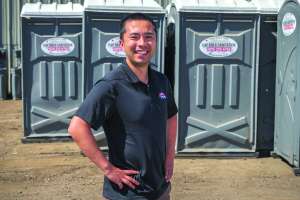
31-year-old Daniel Tom had his sights set on becoming a physical education teacher. He attended San Jose State University and majored in kinesiology. During his junior year, he started working part time as a customer service agent at a family-owned portable restroom company in Hayward, California.
“My aunt actually worked there at the time and she got me the job,” Tom recounts. “I worked two or three days a week and stacked my school schedule the other days.”
Part-time paycheck to full-time career
The job was meant to be temporary, a way to earn income while planning for his real future. After graduation, Tom enrolled in a teaching credential program, a requirement for future educators in California. In preparation for the program, he started substitute teaching.
“Those two days were the hardest days I’ve ever had in my working career, like up to this day, and I just knew that it wasn’t something I could do for the rest of my life,” Tom recalls.
Tom dropped out of the teaching credential program and approached his boss about going full time. “I told the owner that I wanted to learn anything and everything,” Tom says. “I just wanted the opportunity to move up.”
Tom learned about accounts receivable, outside sales, dispatch systems and the various processes involved in the industry. He quickly worked his way up to dispatch and eventually began managing all the drivers. Many of the drivers didn’t speak English, so Tom learned Spanish in order to better communicate.
When a family business becomes a corporation
After eight years of working at the locally owned business, Tom had earned a spot as the operations manager. He was running the day-to-day operations, which included 30 trucks, 60 employees and 5,000 portable restroom units. The company serviced the entire San Francisco Bay Area. Tom was comfortable in his position, but it wasn’t meant to last. The family-owned company was sold to a corporate chain. The transition was jarring for Tom.
“All I had ever known at that time in my career was what it was like to work for a small, family-owned business,” Tom says. “All of a sudden it was a big corporation with 20,000-plus employees and multiple layers of supervision.”
Just like two days of substitute teaching taught Tom that teaching wasn’t his future, a few days at a corporation showed Tom he was better suited for a career at a locally owned company. Tom explored joining other family-owned portable restroom companies and even looked at opportunities with different industries.
“I just love the small-business environment so much more,” he says. “I just thought, I’d rather stick with what I already know and have experience in rather than starting from scratch in a brand-new industry.”
Idea to enterprise
After years of building a business for someone else, Tom was ready to do it again, but this time for himself. “My career was training me for this,” Tom says. “Scaling a company in the portable restroom industry in the Bay Area was what I had spent the last eight years doing. I felt like if the goal was to do it again for myself, I’d be able to replicate at least enough results to be somewhat successful.”
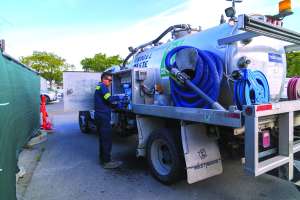
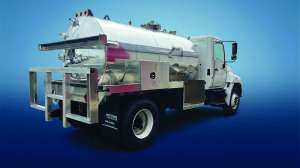
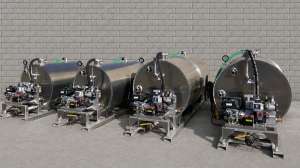
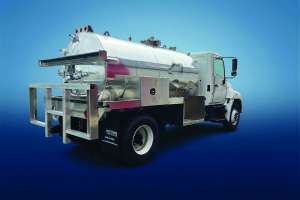
Tom knew the Bay Area market inside and out, and he knew there was room for more business. He found a business partner/investor. They ordered 112 Satellite Industries Axxis portable restrooms, 18 Freedom ADA-compliant portable restrooms and 56 Satellite Industries sinks. They also ordered two Isuzu NPRs and installed stainless steel slide-in tanks from Best Enterprises with a 600-gallon wastewater/380-gallon freshwater capacity.
Finding a business location was the biggest challenge. San Francisco real estate is rare and extremely pricey. Tom found a 10,000-square-foot yard to sublet; however, it didn’t have power, water or even a building. They managed to store the trucks and toilets on the lot and add a storage container, but it was less than ideal.
Getting up to speed
Tom had nearly a decade of experience within the industry, but there was one area of operations where he was very much a beginner.
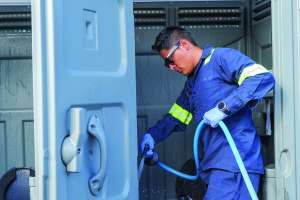
“When I started Bay Area Sanitation, I’d actually only cleaned one toilet. My job was more routing, hiring and firing, pricing, logistics, ordering supplies, ordering toilets and forecasting for the year,” Tom says.
He went from having a team of drivers to relying on himself. But he says the only way to learn was to get his hands dirty, literally.
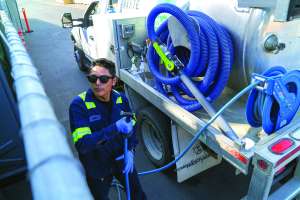
“The very first time I went to empty the truck at the dump station, the secondary trap of the tank was full. I didn’t know that you’re not supposed to turn the vacuum on because, in reverse with that full, it will spray out the top,” Tom remembers. “So, I was with the guy who’s inspecting the truck for the permit and I turned the vacuum on and it sprayed all over both of us.”
It was a mistake that Tom would never make again, but he says he made plenty of others in those first few weeks. While Tom was new to operating the truck, he knew enough about the operations to set himself up for success on the streets of San Francisco. He ordered Isuzu because the trucks were short, making them easier to maneuver on the steep, narrow streets. He also installed back-up cameras and large windshields to increase visibility. Tom was also very strategic about the tank capacity. In California, if the tank is over 1,000 gallons, it requires a commercial driver’s license. However, Bay Area Sanitation’s tanks are only 980 gallons, which don’t require a CDL to operate.
Faced-pace growth
During the first year of business, the truck also served as Tom’s office. “I would pull over, work for a couple hours, put all of my orders in, all the requests in, do quotes and estimates, and then keep moving from there.”
With Tom’s experience and connections, it didn’t take long for business to take off. By the third month, Bay Area Sanitation was already ordering more portable restrooms. About six months in, they were up to 500, and by the end of their first year in business, the company had roughly 1,000 portable restrooms and handwashing stations.
Tom hired the company’s first driver just a month into the venture. “I was spending more time cleaning toilets than anything else and in order to grow the business, I had to figure out how to get help doing that,” Tom says. “It’s the most time-consuming thing and I’m not able to put in orders or answer phone calls if I’m always running the vacuum truck.”
Tom soon added a second driver who focused on deliveries and by the end of 2023, he added an employee to customer service.
The future is gold
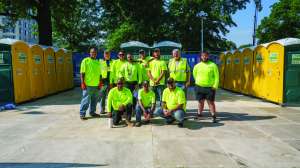
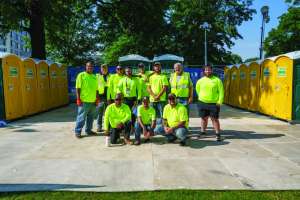
Today, Bay Area Sanitation has 20 employees including three office personnel and four yard employees. The rest are drivers. The company has 1,800 Satellite Industries Axxis portable restrooms (300 have interior sinks), 70 Satellite Industries Freedom ADA units and 200 Satellite Industries Tag 4 handwashing stations.
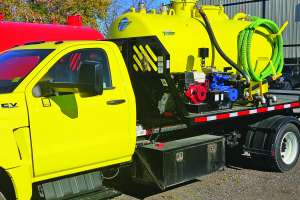
The company operates eight Isuzu NRR with Best Enterprises slide-in stainless steel tanks with 600 wastewater/380 freshwater capacity; one Isuzu NPR HD built by FlowMark Vacuum Trucks with a 700 wastewater/299 freshwater capacity; two Ford F-550s built by FlowMark with 700 wastewater/299 freshwater tank; two Laxi-Taxi eight-unit transport trailer by F.M. Manufacturing; one McKee Technologies - Explorer Trailers with eight-unit transport trailer; one custom-built 10-unit transport trailer; and one Hino 268 flatbed for pickup and delivery that holds 12 units.
About 90% of the company’s business comes from long-term rentals and construction; events make up the final 10%. Bay Area Sanitation is now at its third location, located in Union City, California. Unfortunately, they’re still paying the lease on the second location, a lesson that Tom says he learned the hard way.
“We signed a three-year lease but we outgrew it in a year and a half,” Tom says. “We really should have thought, ‘Hey, is this going to be good enough for us three years from now?’ We should have paid a higher premium and gone year-to-year rather than sign three years up front.”
For Bay Area Sanitation, the third location is the charm. The new space finally has a warehouse and office building, making it the first location where office staff can come to work instead of working remotely. There is also room enough to store equipment inside and service vehicles.
A decade ago, Tom believed he would spend his career encouraging students to be physically active. Today, he’s proud to be a member of the portable restroom industry and loves encouraging people to look at the industry differently. He has a YouTube channel, youtube.com/@danielhtom, where he shares about the industry.
“I’m probably one of the more passionate people that you’ll see from the industry,” Tom exclaims. “I like the challenge of trying to elevate what people think about porta potties because they kind of have a bad stigma. I do what I can to show people what the work we do is actually like. It might seem silly because they’re just porta potties, but that’s what I do day in and day out.”