

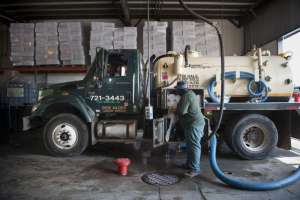
About 10 years ago, Johnny On the Spot (JOTS), a portable restroom operator based in Old Bridge, New Jersey, retooled an existing on-site transfer station so it could send waste directly into a local municipal sewer line. The result: A dramatic dip in operating expenses, such as fuel and labor costs; reduced dumping fees; and less wear and tear on vehicles.
While former JOTS owner Jesse Thompson declined to disclose exactly what the company invested in revamping the transfer station, he says it paid for itself after just 22 months in operation. (Thompson recently sold the firm to equity investors and remains a minority shareholder heading up merger and acquisition initiatives.)
The 4,800-square-foot transfer station was built on company grounds in 1999. Initially, waste dumped by route drivers drained into an 8,000-gallon underground holding tank that was pumped out daily into trailer tankers and taken to a regional sewage treatment center.
The company planned to eventually pipe waste to a regional sewage treatment plant. To do so, however, it needed a permit from a local township to use its sewage conveyance pipes, as well as approval from the sewage treatment plant. To optimize the odds of obtaining those permits, the company spent several years building good relationships with neighboring property owners, a strategy that included investments in landscaping. In 2005, JOTS applied for and received an on-site disposal permit.
“Building goodwill was important because the words ‘on-site disposal’ always raise eyebrows – people generally don’t understand it and don’t want it near them,” Thompson says. JOTS also hired a former executive director of a nearby waste treatment plant as a consultant. “He truly understood how benign and consistent our waste is,” Thompson points out. “He was with a treatment plant for a long time before he retired, and he really relaxed a lot of peoples’ minds.”
A central component of the system is a sewage-grinding machine called a Muffin Monster, made by JWC Environmental. Here’s how the system works: Waste gets dumped into the Muffin Monster, which shreds solids into confetti-sized bits, making it much easier to pump through pipes. After that, the waste heads into a 20,000-gallon dosing tank, where two powerful pumps push it about one-third of a mile to the closest municipal sewer line.
On its way there, the waste passes through a pump house, where it’s sampled three times a week to detect unwanted contaminants (such as petroleum and heavy metals) and measure the waste’s acidity. A meter also measures waste flow, Thompson says, so the township and treatment plant know how much to charge JOTS.
JOTS processes about 400,000 gallons of restroom waste a month (no septic tank waste is allowed). “The cost efficiencies are tremendous,” Thompson says. “It was very surprising to us what we were paying to transport waste. We still get (disposal) fee increases, but the system remains an incredibly productive investment.”
For more on Johnny On the Spot, check out the profile in the October issue.
Continue reading for free