Question:
I have been planning, or at least hoping, to get a new pump truck this year. With the economy somewhat stalled and somewhat scary — at least to me — I’m wondering if a new truck is such a good idea. Is there a formula or rule of thumb that helps in deciding these things? Should I wait another year and hope my truck survives or make the move and go into debt? What do you guys think?
Lawrence E. Wentz
St. Paul, Minn.
Answer:
First off, there is no real rule of thumb about how to handle your situation. Let’s explore your options to deal with an older service truck:
Limping through the year with your old truck
If your truck dies, you are going to be in the worst shape of your life. While waiting for a replacement truck, you’ll be losing business. As you lose business, you’re not going to need the truck as much, and you’ll have a much tougher time making payments because revenues are down. So this option leaves your business at risk should your current truck fail.
Purchase a new rig
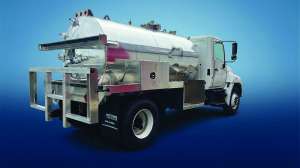
A new truck is big, bright and shiny and your competitors and your customers are impressed. That might help to pick up a few more jobs. It will obviously put more stress on you to produce. You will have a monthly payment and your other liabilities will stay the same. Consequently, your cost of doing business will go up. If you think you can make it up with more work or price increases, that’s fine. But it may be tough to raise prices during slow economic times.
Refurbish your current truck
What’s wrong with your current truck? Is it falling apart or is it aging and maybe needs a little help to keep pumping. The idea of refurbishing a truck is not bad. Most truck shops can examine a service vehicle to see what it needs to be brought up to near new condition.
If you have an older tank, it should be checked using an UT (ultrasonic testing) gauge. This is a simple test to find out the thickness of your steel tank. The gauge is placed on the shell or the heads in various places and digitally reads the thickness. If you originally had a 1/4-inch tank wall and your thickness is still in that range, you have a sound tank. The shop should be able to help you determine if the tank needs to be replaced.
Let’s assume your tank is still sound. What about the primary and the secondary? What condition are they in? You may need to replace them. The basket in the primary can rust away and the ball drops to the floor, so take a look. Maybe the basket is just hanging there and getting ready to disappear. It doesn’t take a lot of work to replace a primary and it doesn’t take much to replace the secondary.
Check all the valves, pressure relief, vacuum relief, the knife gates, and the four-way. If they are all functioning properly, you’re in good shape. Check hoses for wear or leaks. Do they seal when attached to the valves? If there are problems, replace damaged hoses.
How old is the vacuum pump? Has it been properly maintained? How well is it operating? We’ve discussed pump maintenance many times in the past, so we’ll assume your pump is still working well.
We’ve determined the vacuum system is sound and in good working condition. If your truck is aging, maybe what you need is a paint job. A paint job brightens everything and makes it all look brand new. And if you’ve got a few extra bucks, you can get yourself an attention-grabbing two-tone paint scheme or better graphics.
With a refurbishing, you may spend a fraction of the cost of buying a new truck. And you haven’t risked your business trying to make an old truck last another year. You will have what appears to be a brand new truck in excellent working condition.
Of course, the condition of the truck chassis is something you’ll have to get a mechanic to check on. But as for the overall performance of your vacuum system, you should have a truck that will perform well for years to come. Each operator can decide for themselves which option is best with each service vehicle.
Continue reading for free