The team
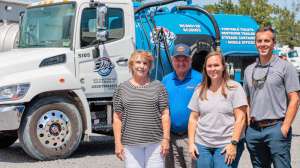
Waste Management of Wisconsin’s Port-O-Let division is managed by Dennis Lindquist from offices in Germantown, Wis. The division consists of 15 people, including Lindquist, full-time mechanic Rob Herriges and lead driver Ralph Tuttle. They operate 11 vacuum trucks, one flatbed delivery truck and 11 delivery trailers of various sizes. Port-O-Let has 4,000 Satellite Industries Tufway portable restrooms.
Waste Management entered the portable restroom business in Wisconsin in 1985 and since then has been providing services to the Experimental Aircraft Association’s AirVenture fly-in at Oshkosh, about 80 miles north of the Port-O-Let headquarters. The PRO provides services for large events throughout southeastern Wisconsin, including Milwaukee’s Summer-fest and all the ethnic festivals, PGA golf events and Alpine Valley music theater, but its biggest task, year in and year out, is the fly-in.
THE MAIN EVENT
AirVenture was held July 28-Aug. 3 in 2008 at the festival’s permanent grounds, which include, for the days of the event, the world’s busiest airport. “I like to say there are special events and then there is EAA,” says Lindquist. “It’s the world’s largest convention. There is nothing like it.” The numbers are impressive: 12,000 airplanes, 700,000 visitors, 1,100 portable restrooms, eight upscale restroom trailers, six portable showers and 1.4 million gallons of waste water pumped in one week. One other number is equally impressive: one. That’s the number of written complaints EAA gets each year about sanitation services at the event, Lindquist says.
The event is always a study in contrast, from homebuilt aircraft and biplanes to Concorde supersonic jets; from World War II fighters and bombers to state-of-the-art military craft from around the world. It draws air enthusiasts of every stripe, from regular folks to astronauts; famous aviators such as Gen. Chuck Yeager to celebrities such as actor/pilot Harrison Ford.
GET READY
Planning for EAA is a year-round task. Lindquist has been involved with the event for 19 years, the last 14 in his supervisory role. He says there are always small changes to the layout, especially near the flight line, but for the past seven years the overall layout has been consistent. That will change next year because EAA has major plans for upgrades at the site.
“From year to year, I have my notes. Obviously, you do forget things,” he says. “Once you start with the setting up, it just falls into place. Lindquist and Herriges go to Oshkosh in May each year, spending a weekend at their compound checking equipment and inspecting the grounds. They also check the spare parts inventory kept on site. They meet with EAA representatives and vendors in the months before the event, with the frequency of meetings accelerating as they get closer to July.
GET SET
Lindquist and part of his crew move in on July 4 for three weeks of setup, and if all goes smoothly, they get to go home the first Friday in August, a week after the fly-in ends. They arrive three weeks early to clean and repair the 1,100 portable restrooms they own and keep on site.
Also stored on site are six custom-built portable shower trailers manufactured by Miller Building Systems of Elkhart, Ind. The trailers range in size from 10 to 16 showers each. EAA is charged a flat rate for shower availability.
The individual restroom units and shower trailers are stored outdoors in a fenced compound.
The eight restroom trailers, built by Ameri-Can Engineering, are stored in Germantown and used by the company throughout the year. The 34-foot trailers have three toilets, eight urinals and two sinks on the men’s side and seven toilets and three sinks on the women’s side.
“We’ll have to do minor repairs. There might be a door-spring broke or cracked roof from sitting outside,” he says. Lindquist admits that is a lot of inventory sitting unused most of the year, but says it’s justifiable, given the size and importance of the event.
Setup is done in stages. The campgrounds are the easiest because little changes there from year to year. “When you get to the flight line, that’s where the changes are. One vendor might go for a larger tent than the year before or you might have more vendors,” he says.
GO!
Work begins at 6 a.m. and continues until it’s done. Visitors are usually on the grounds until 8:30 p.m. or so. Each restroom is serviced three times a day. It’s a constant process, though Lindquist says they get to take a break now and then to eat.
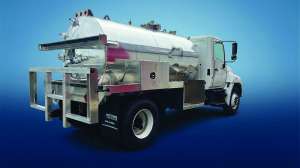
They have a fleet of 11 vacuum trucks on hand, with steel and aluminum tanks ranging in size from 750 to 1,500 gallons. There are Internationals, Sterlings and Fords among them from as wide a variety of builders. Their two newest are Freightliner M2 Business Class trucks. The 2008 model, with 1,500-gallon steel tank, was built by Glendale Welding Co. The 2005 model has a 750-gallon steel tank and was built by Keith Huber Inc.
Lindquist said wastewater is stored in a dozen holding tanks around the grounds ranging from 8,000 to 30,000 gallons. Lakeland Cartage Inc. of Port Washington, Wis., uses 5,000-gallon tankers to transfer the approximately 1.4 million gallons per event to the Oshkosh municipal treatment plant.
Crews have assigned areas, with Lindquist overseeing the portable restrooms and Herriges the restroom and shower trailers. Each crew is responsible for three-a-day cleanings in its area. Lindquist says the days generally run smoothly. They have two or three minor mechanical breakdowns per show, usually having to do with vacuum pumps. “Rob will have to come in and work his magic and get it going again,” Lindquist says.
And occasionally an airplane will be parked too close to a unit, and it’s not always easy to find someone to move it. Lindquist says they will add extra hose and pump anyway if they can; otherwise they notify EAA representatives and move on, checking back later.
LET’S BE SAFE OUT THERE
The biggest issue is safety. Lindquist emphasizes to his workers an important point: This is an in-the-air event. “Everybody looks at the sky, so they are not paying attention to what is going on around them on the ground. Our guys have to be very, very aware that these folks are not paying attention to their surroundings or any of the big trucks,” Lindquist says.
Drivers are uniformed and wear all appropriate identification and safety equipment, including vests, glasses and helmets. Lindquist says his crewmembers are approached by attendees, though usually with compliments, not complaints. “I’ve always told my guys, when somebody approaches you, positive or negative, let EAA know. They are the ones paying the bills,” he says.
TEAMWORK TIME
The goal is to get everyone done at the same time so they can eat together and get a good night’s sleep, because the night pretty much consists of take a shower, eat, go to sleep. “I tell the teams that if they get done, make sure you call me because I want to know who needs help,” he says. “I’m not going to leave one guy hanging out there by himself. The team won’t stay focused and one guy will get a real negative attitude.”
Lindquist has a partial crew on site for the first half of the convention. The others stay behind and run the company’s regular routes until Thursday, when everybody makes an appearance at EAA. “The big weekend is that second weekend,” Lindquist says.
LIVING ON SITE
Port-O-Let has its own fenced compound on the EAA grounds. It consists of a bunkhouse, several mobile homes and a storage area for its EAA-dedicated portable restrooms. The bunkhouse sleeps 10 and has air conditioning, a living room, kitchen, bathroom and showers.
Hourly employees get overtime for their EAA work and a per diem for being away from home. “Oh, they get quite a bit of overtime,” Lindquist said, laughing. The workers cook for themselves.
HAPPY LANDING
It takes a week to clean up and stow what takes three weeks to set up. As soon as the event is over, about half the crew goes back to Germantown to resume regular duties while the rest stay behind. After 19 years, Lindquist still looks forward to the event. He says it’s like a reunion now, with all the friends he’s made among vendors and EAA volunteers.
He says finishing another successful event provides a good feeling. “It’s really a natural high, if you will. It comes from within, knowing that you’ve done it safely with no injuries or accidents,” he says. “When it’s all over, it’s a total emotional drain after all the hours and the intensity of the event. Then it’s time for a long, long nap.”
WORDS TO LIVE BY
“Sanitation can make or break a special event, top to bottom,” says Lindquist. “We pride ourselves in the fact we give quality, quality service. That’s why they keep signing contracts with us.”
Continue reading for free