King City, Calif., lies in the heart of the lush Salinas Valley, a rich agricultural region where crops such as lettuce, tomatoes, broccoli, and artichokes give it the nickname “America’s Salad Bowl.” George Young spent 20 years working as a ranch foreman in the Valley, but in 1993 saw an opportunity to head in a different direction.
“One day I’m out in the field with my bosses,’’ he recalls. “And they go, ‘Man, somebody needs to start another (portable restroom) business down here.’ ”
Thus began A & G Pumping Inc., whose business today is 90 percent agriculture-related sanitation in a territory extending 100 miles north to San Jose and 100 miles south to Santa Maria. By law, farm workers can’t be more than five minutes from a restroom, so the company provides two- and three-unit trailers that move around with the crews.
CONTAMINATION CONCERNS
The most critical requirement for this niche market is to keep on top of the ever-changing food safety laws, which have greatly increased in light of recent salmonella and E. coli scares. This has affected every part of the company’s operation. “We have to have our standard operating procedures on how we clean the units, how we fill the waters, where we dump, and our training schedules,” Young says.
George and Angie Young started out by borrowing $5,000 for a down payment on a ’93 Chevy 1-ton pickup, which Southern California Tank & Fabricating outfitted with a 600-gallon waste/250-gallon freshwater steel tank. Angie Young took over from there, servicing privately owned units on nearby farms.
George Young kept his job, but at night started building two-unit trailers in his garage after purchasing 20 restrooms from PolyPortables Inc. As fast as he could build them he’d rent them out, and two years later he was able to quit his job and work full time for the business. They purchased another truck, a ’95 International and added septic service. In 1997, they hired their first employee, enabling Angie Young to run the office.
In addition to the trailered units, A & G provides freestanding units in fixed locations around the ranches for other types of workers. The company’s current inventory includes 500 trailer mounts and 1,500 unmounted units, almost all tan Satellite Industries Tufways. They also have 20 ADA units from Satellite Industries and 150 PolyPortables Inc. hand-wash stations. The company does not work many special events but did purchase one Presidential trailer from Advanced Containment Systems Inc. a couple years ago for weddings.
MANAGING THE TEAM
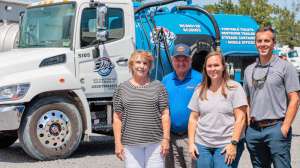
Today their foreman, Ramon Martinez, oversees 10 drivers. Israel Ornelas is their mechanic, son Cody Young runs the shop, and Frances Nichols handles office duties with Angie.
All drivers have certifications documenting that they’ve attended food safety seminars. “I make my drivers go so they are up to date on everything that goes on,” Young says. Prospective employees are thoroughly screened and then put on a two-month probationary period. “We are unique in what we do, and we are perfectionists,” Young says.
Drivers work alone and cover an average of 150 miles a day. They stay in touch via GPS units, cell phones and Nextel two-way radios.
The company holds safety meetings every two months to review procedures, go over new regulations, and find out how everybody’s doing. “We ask them what we can do to make things better, or if they see anything that needs attention. They are your outside eyes,” Young says of his technicians. Sometimes Young will jump in a truck and ride along with one of the drivers, or spot-check units after they’ve been cleaned. Once a year, the company hires a person to evaluate the drivers’ performance — everything from how they operate the truck, clean the units and communicate with clients.
“If you don’t have the key employees, you’re not going to have a successful business,” Young says. “And you have to treat them right.” Workers are paid well and given two weeks vacation and health insurance. Consequently, A & G has had little turnover.
DESIGN EVOLUTION
Young still builds his own trailers but has had to modify the design to conform to evolving food safety standards. Most of the trailers are outfitted with two portable restrooms, one for men, one for women. Between the units is a 30-gallon water tank for hand-washing, and soap and paper towel dispensers. In the past, graywater would go on the ground. Now the trailers are required to have a catch basin plumbed into a holding tank.
The company also has about 50 one-unit trailers with 15-gallon water tanks, and 50 three-unit trailers with 45-gallon water tanks.
Another new requirement is that the company name appears on the trailers, and the units must be inspected annually by the county. U.S. Occupational Safety and Health Administration laws are often posted, along with signs reminding workers that “All employees must wash their hands.”
“Washing the hands is a major, major issue here,” Young says. In fact, auditors train farm workers how to wash their hands and how to use the portable restrooms. Farm workers — who can’t eat, smoke or chew gum while on duty — must wash their hands before they start work and after every break. “We’re building units right now with 15 spigots on them,” Young says. Some ranches also require units to be furnished with hand sanitizers.
Water quality is also critical. Even though the company uses municipal water for the hand-wash tanks, a tester comes out once a year to take a sample at the faucet in their shop.
CLEANING STANDARDS
Servicing procedures have also changed with the new regulations. “We used to be able to go into the field and clean right next to crops,” Young says. “Now the trailers must be a minimum of 20 feet from a field.” Some counties require 200 feet. Trailers are either pulled out of the field by the foreman or taken to a yard at night. Drivers contact the foreman before their arrival to coordinate.
Trucks are washed every day, and freshwater tanks cleaned weekly with bleach to prevent bacteria growth. The waste and freshwater systems on the trucks are kept separate. “All my trucks have two water pumps. That way we’re not using the same hose to clean that we use to fill the freshwater tanks, so there’s no contamination,” Young says. The driver’s side services the restrooms; the passenger side the sinks.
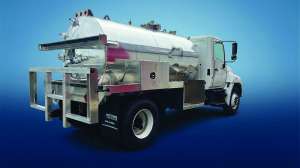
The company has 12 vacuum trucks, two of which are 2008 Peterbilts outfitted by West-Mark Inc., with polished stainless steel tanks. The others are 2001 to 2009 Internationals with steel tanks built by Southern California Tank & Fabricating and Best Enterprises Inc. The tanks are all 1,500 gallons (1,100 gallons waste/400 gallons freshwater) and have Conde pumps. A & G also has a 2008 Peterbilt septic truck with a 3,600-gallon aluminum tank. A 2009 Peterbilt flatbed, a ’97 3-axle lowbed and a ’91 water truck round out the inventory.
GOOD VISIBILITY
Competition in the Valley has gotten much tougher over the years. “When we started our business there were only four of us, now there’s 30,” Young says. Without lowering rates, the company has remained competitive based on quality service, industry expertise and a willingness to keep up with and conform to changing legal requirements, Young says.
They’ve also developed ways to keep their name in front of customers. Young calls all his clients monthly or bimonthly to make sure they’re happy with the service, and to see what else they might need. He’s also not shy about calling on ranchers who haven’t been using his service. He’s very active in community activities such as the King City Young Farmers, Little League, 4-H, Pop Warner, and serves as assistant fire chief. “The more you do for your community, the more you get back,” he says.
Drivers wear company-supplied uniforms — jackets, shirts, and hats, all with company logo.
And over the last couple years the company has been painting its trucks — green cabs and black fenders — for a unique look. “This also gets back to food safety,” Young says, “because we would be getting complaints saying, ‘Hey, your truck’s out cleaning in the field’ (which is illegal). And I’d say, ‘No, it’s not my truck.’ All the trucks you see are white, so that’s why we decided to change our colors. So now I look different than everybody.”
SAFEGUARDING PUBLIC HEALTH
Everyone who works in the agriculture industry is being asked to do their part to ensure food safety. Segments of the industry have been devastated in recent years as food poisoning outbreaks and deaths were traced to unsafe food handling practices. Laws understandably have been tightened.
A & G takes this mandate seriously but Young does not see it as a burden. Rather, it’s an opportunity. “It’s good for our industry because now that’s just more services you have to supply. It’s better for the industry, and it’s better for us.”
Continue reading for free