Who can forget the story of the tiny lizard that was flushed down the toilet, only to turn up years later as a 16-foot alligator in the sewer of a major metropolis? Nothing more fun than a good old fashion urban legend. It turns out the portable sanitation industry also has its myths.
Well, not as bone chilling as a monster alligator roaming beneath the streets, but just as important to pumping professionals is that some persistent “legends” circulating through the industry are untrue and might be costing contractors through unnecessary spending on equipment.
Over the past few years we’ve collected some of these pumping myths. A few of them cropped up recently, so we decided it’s a good time to debunk them again. Just like urban legends, enlightened portable sanitation contractors are going to think we made these up, but this is the kind of stuff that couldn’t be made up. For everyone’s benefit, let’s review a few favorite vacuum-pumping myths:
Aluminum is a better insulator than steel
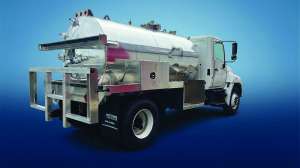
When asked why he bought an aluminum tank for his new vacuum truck, one contractor replied, “It keeps the load warmer in winter.” What? We’ve heard a lot of reasons why aluminum tanks are a smart buy; lighter weight, brighter shine, etc. Until recently, we hadn’t heard of its insulation benefits.
Actually, that load in 25-degree weather in a steel tank or stainless steel tank will be just as cold. Aluminum does not have any special thermal qualities. Of course, if you pick up a “hot” load, the contents will be warm for a while, but in time all loads are going to be as cold as the outside temperature.
The bigger the pump, the better
A few weeks ago, a local pumper said he was going to put a 2,500-gallon tank with a 450-500 cfm pump on his next truck. To some guys, pumps are like engines in a car; the bigger the engine the more power. In cars, this is true. With vacuum pumps, there’s a slight catch. The bigger the pump, the greater the cost. So why spend more money on a monster pump when it isn’t necessary?
To give you an idea of what we mean, suppose we pull up to our jobsite, flip on the monster pump, and in two minutes, the tank is ready to pump. Only problem is, we haven’t got the hose where it goes and we’re not ready to do the job. A monster pump is not going to really make you go faster or pump much quicker. Common sense says to get the pump that best fits the size of your tank.
Here are some guidelines for good pump/tank combinations:
CFM (pump size) Gallons (tank size)
CFM 20-40 Gallons 80-200
CFM 50-90 Gallons 150-500
CFM 100-120 Gallons 400-800
CFM 130-150 Gallons 700-1,200
CFM 160-200 Gallons 1,000-1,800
CFM 210-240 Gallons 1,700-2,500
CFM 250-280 Gallons 2,400-3,000
CFM 290-340 Gallons 3,100-3,600
CFM 350-400 Gallons 3,500-4,200
The difference in prices of these various-sized pumps is dramatic. Be realistic in understanding how the vacuum pump works, and buy accordingly.
Vacuum relief valves are unnecessary
In a recent letter, a reader argued that a vacuum relief valve wasn’t necessary to prevent a tank collapse. This comment blew us away. If this were the case, why are there thousands of vacuum tanks with vacuum relief valves installed on them? If they didn’t serve a purpose, the person who invented and first sold vacuum relief valves sure scammed everybody!
Here’s the deal: The force of vacuum is incredible. When vacuum is allowed to rise out of control, it can make pretty much anything collapse, even a reinforced steel or aluminum cylinder. The vacuum relief valve came along because there was a need for it. By setting the valve to “relieve” the tank at a certain level of vacuum, the tank will not collapse or be at risk of collapsing. It’s common sense.
SHARE YOUR MYTHS
What erroneous pumping stories have been traveling in your circle of industry friends? What statements have you heard — presented as fact by other contractors or customers — that have left you shaking your head in disbelief? Send your vacuum truck myths or tall tales to us in care of editor@promonthly.com.
We’ll take a look at more of these “myths” in the months ahead. As we have said many times in the past, the more you know about your truck, pump and parts, the more money you’ll have to keep in your pocket. The information to fully understand your truck is readily available, so be careful what you believe. You may be the guy who sucks up the monstrous alligator into your vacuum tank!
Continue reading for free