What’s the definition of a standard restroom? As the portable sanitation industry matures and customer expectations change, this isn’t quite the simple question it was in the past. You might say a basic unit is a single-wall, no-frills restroom with a wooden skid, the type you expect to find on a home construction site.
But starting with a plastic or fiberglass cube and holding tank, your customers might be adding some refinements and options to the units they want you to drop in a construction zone or summer special event like a county fair.
In this issue we explore manufacturers’ offerings in the entry-level category with our annual Standard Restroom Roundup, “Locked & Loaded.” We include restroom choices from seven manufacturers — most of them shown on the exhibit floor of the Pumper & Cleaner Environmental Expo International earlier this year. While these units are the economical choice, they can be ordered with a host of comfort and convenience features to elevate them to special event status.
Answering a demand for better hygienic choices, each restroom maker has added optional sinks to the basic models. Holding tanks are bigger, ergonomics and cleanability are improved, and hooks for coats and shelf space to safely hold personal items are more abundant. Perhaps your customers — even the construction clientele — are more interested in providing facilities that are as close to the home experience as possible.
I compare the quality changes in standard restrooms with growing sophistication of the auto industry. I go back far enough to remember when seat belts and AM radios were optional equipment at the local Chevy dealership. Back then we couldn’t have envisioned a time when air conditioning, airbags and voice-activated controls would be standard issues on many vehicles.
That makes me wonder what’s on the horizon for basic portable restrooms. Will they all have flush mechanisms? How about solar lighting, electronic tracking devices, climate control? Though they’ve improved dramatically over the past few decades, I’m sure there’s great innovation in store to take restrooms further away from their genesis as plywood boxes and metal drum drop tanks.
And what’s most exciting is that PROs and their customers will drive these improvements. In a big way, it’s up to you to convey your customers’ needs to the manufacturers, so, in turn, the industry offers products that are perceived as more critical to the general public.
VISIT THE ENERGY FAIR
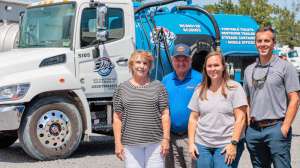
In our On Location feature this month, “The Power to Please,” I introduce you to PROs Ed and Diana Trzebiatowski of Trebco Services in Amherst, Wis. I caught up with this can-do couple as they provided portable sanitation services for the 20th Annual Midwest Renewable Energy Association Fair, billed as the biggest alternative energy event in the U.S.
The Trzebiatowskis place and maintain about 80 restrooms and 14 hand-wash and sanitizing stations on the large rural grounds in Custer, Wis., every June. For the small company with a shade over 200 restrooms, this is their biggest event of the season and they scramble a small workforce to keep the restrooms clean and fresh.
They’re happy to serve the event that puts this rural central Wisconsin community on the national stage. And if you’re interested in new technologies of green building, energy efficiency or ending U.S. reliance on foreign sources of energy, you might want to make the trip to this year’s fair, set for June 18-20.
For those of you looking to reduce your energy consumption —whether at home or in your portable sanitation business — the Energy Fair has a lot of good information to offer. Some 275 exhibitors and 200 workshops teach attendees everything from how to provide better insulation for homes to how to build a wind generator to ways to convert vehicles to be powered by electricity or fryer oil. Presenters explain how to construct sustainable buildings made of everything from straw bales to old tires.
While some of the topics explored at the Energy Fair were once the domain of a more fringe alternative energy crowd, green construction techniques are now frequently employed by traditional builders. And that’s where concepts like super insulation, geothermal heating and cooling and solar power could potentially help PROs lower their operating costs, if not now, then at some point in the future.
If you live in a northern climate, imagine being able to cut your warehouse utility costs by half through a newfound energy efficiency program. That would allow you to raise your bottom line without raising prices or renting more units.
To learn more about the Energy Fair, call 715/592-6595 or go to www.the-mrea.org.
CARDBOARD RESTROOMS
In my March column, I included a photo of an obscure prototype restroom going back to the 1980s and asked readers to identify the material used to make the unit. Contractor Craig Mendenhall of American Sani-Can in Portland, Ore., was quick to provide the correct answer and some background on this peculiar product.
The prototype, from early fiberglass restroom manufacturer and portable sanitation contractor Harvey Heather, was constructed of cardboard. As I wrote in my column, Heather’s fiberglass USANCO restrooms were a major advance for a fledgling industry more than 30 years ago, and some of them are still found on construction sites today. But his cardboard units didn’t share the same success story.
“These units could knock down flat and in theory you could stack or nest hundreds or thousands of units on a flatbed trailer. In a short time, at a festival event, pop them up together and be ready for service,’’ Mendenhall, who at one time worked for Heather, explained in an e-mail.
The restrooms were made of corrugated material, for added strength, and had a waxy outer coating to resist stains and promote longevity for an admittedly temporary restroom solution. Thanks go out to Mendenhall for his response. If you have any interesting historical photos to share with the rest of the portable sanitation industry, please send them to me at editor@promonthly.com.
Continue reading for free