THE TEAM
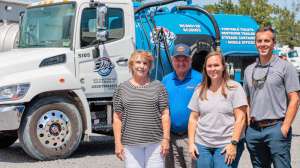
Ed and Diana Trzebiatowski run a portable sanitation and pumping business located in Amherst in central Wisconsin. Ed works in the field and Diana manages the office. Miles Murphy is a full-time driver for the septic service and Jeff Gallagher is a portable restroom technician. All hands are on deck for big events like the Midwest Renewable Energy Association’s annual Energy Fair, including Ed’s brother-in-law, Rick Seefeldt, who helps out as needed on this and another big summer job, the annual North Central Wisconsin Antique Steam and Gas Engine Show in Edgar.
COMPANY HISTORY
Trebco Services was started in 1985 by Ed’s father and brother, Clarence and Russ Trzebiatowski. The couple bought the business in 1990, then eventually moved from nearby Stevens Point to their own 7-acre commercial property in Amherst. They built an 1,800-square-foot office and a later a 60- by 80-foot shop to house a growing fleet of equipment.
They continue to expand portable sanitation services, now offering 220 restrooms, about 75 percent T.S.F. Company Inc. Tuff Jon units and 25 percent Satellite Industries Maxim 3000 models and a variety of older units. They have a small number of ADA units from Satellite Industries.
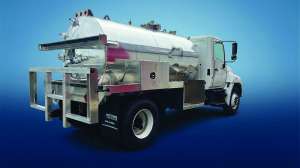
The fleet includes a portable sanitation service rig from Imperial Industries, built on a 2003 GMC 5500 with an 18-foot flatbed and fiberglass 400-gallon waste and 200-gallon freshwater tanks, a Masport pump and a lift gate on the back; two septic trucks, a 1994 Ford LTS 8000 with a 3,500-gallon tank and Wittig pump, and a 2000 GMC with a 2,500-gallon steel tank and Battioni pump from Imperial. For car wash pits and municipal work, they have a 2003 Peterbilt 378 vacuum loader from Keith Huber Inc. They also have a 2000 Chevy van used for sewer rodding and a Spartan trailer jetter.
MAKING CONNECTIONS
When Trebco moved to its Amherst location several years ago, they were located across the street from the then-grounds of the fast-growing Energy Fair. A smaller PRO was handling the summer event, and Trebco was asked to furnish an additional 10 units. “They just kept calling us back and I don’t know why we ended up with the job,’’ Ed Trzebiatowski recalls. “We ended up with the whole thing, and we just get along so well with them,’’ he said of the fair organizers. When the non-profit group later moved the fair to its own 40-acre property, they continued to contract with Trebco for portable sanitation, and the restroom order has grown along with the fair.
THE MAIN EVENT
The Midwest Renewable Energy Association (www.the-mrea.org) promotes the use of renewable energy, and as part of its mission, started the Energy Fair in 1989. Its 20th annual event last June 19-21 drew a record 23,000 attendees who came to see 275 exhibitors selling wind and solar energy products, sit in on 200 seminars, see an experimental energy efficient home and a green energy car show. The fair is billed as the largest event of its kind in the U.S. Many attendees came for all three days, pitching tents in the MREA’s “Back 40’’ campground and at local parks.
BY THE NUMBERS
Trebco set up 73 standard portable restrooms, five ADA units, 14 wash stations — T.S.F. units and PolyJohn Applause sinks — and six PolyJohn SaniStands throughout the grounds. “We put SaniStands anywhere we didn’t have sinks, and also where some of the units were more heavily used,’’ Trzebiatowski says. “Some years in the past, we would run out of water. One time we placed the SaniStands in a few areas and the water lasted longer.’’ The stand-mounted foam sanitizer stations are a good alternative for areas that experience heavy water usage, he observes.
The placements include four units at a bus stop near the event entrance, 10 units inside the main gate, about a dozen units near several seminar tents, about a dozen units and a few wash stations near one building and a dozen units and wash stations near several buildings used for indoor exhibits. Another bank of units, including ADA units and hand-wash stations — along with a 300-gallon T.S.F. Co. holding tank for food service greywater — are set up near a dining area. The campground received 20 units, in groupings of about four restrooms and a wash station. They put an ADA unit next to a solar-powered shower trailer that wasn’t placed by Trebco.
The setup was completed Monday through Wednesday leading up to the weekend event, so everything was in place before vendors arrived. Trebco used two trailers to deliver the inventory, a 20-restroom unit made in-house and a 10-unit Chilton trailer.
KEEPIN’ IT CLEAN
After setup and once the crowds built toward the weekend, Trebco would swing into its morning cleaning routine. The service routine begins at 4:30 or 5 a.m. at the fairgrounds, then winds up at the campground about 8:30 a.m. The goal is to finish before crowds start arriving at 9 a.m.
The servicing goes smoother with the addition of the smaller septic truck with the 2,500-gallon tank. Trzebiatowski starts by pumping the units dry. The rest of the crew follows, washing, drying, restocking paper supplies and recharging the units. Each servicing generates 1,500 to 2,000 gallons of wastewater — including the food service greywater — which is transported seven miles to the Amherst treatment plant for offloading.
“Everybody has their routine. One guy is spraying the units, one guy is washing with soap and water, and the other is squeegeeing and drying. They’re through with a bank of toilets in 15 minutes and on to the next one,’’ Trzebiatowski says. They primarily use deodorizers from J & J Chemicals, including Ever Pro tablets during tank recharge and J-Disks fragrance enhancers (They use mulberry scent for both).
On Friday, Saturday and Sunday, Ed and Diana Trzebiatowski do regular walk-throughs, replenishing paper products, topping off soap dispensers and replacing scent disks.
THE END GAME
Breakdown is mostly casual. The MREA wants units in one area removed the Monday following the event, but Trebco can remove the remaining units at its own pace. They’re usually out in a day or two. “We’re there Monday morning along with the tent people, pumping out the units and cleaning them on site,’’ Trzebiatowski says. “We spray them down, then bring them back and clean them again at the shop before they go out again.’’
GREAT PARTNERS
The MREA’s concern about the comfort of visitors makes this job a pleasure to work, according to Trzebiatowski. The group orders plenty of units to avoid overuse issues. By service time, the units are typically 50-60 percent full, with a few reaching 80 percent of capacity. “They’re not trying to scrimp. They know their customers are happy and have adequate facilities to use,’’ he says. “Some (customers) want the bare minimum, but they don’t look at it that way. If we make a recommendation, they’re usually going with it. They’re a good group of people to work with.’’
Continue reading for free