QUESTION:
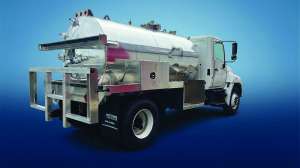
I bought a used portable sanitation service truck last winter. In the spring, we noticed after we dump the sight glass remains full. So I opened the manhole cover to check the inside of the tank and there was more than a foot of solids left in the tank after dumping. I have no idea on how to clean the tank. Do you have any suggestions?
Jerome Foscett
Chicago, Ill.
ANSWER:
There are a few things you can try, none of which are very pleasant. The older the solids are, the more compacted they will be, especially after sitting for a winter. But, let’s give it a try. Here are your options:
1. If a fitting can be accessed (or added) to the tank, then you can purchase a vibrator that will “shake” things up. In this case, you would insert the vibrator and turn it on. The vibration will loosen the sludge at least to the point where it will fall out the rear manhole if the truck is parked on a slope. If the loosened sludge won’t fall out, you can add water through the top manhole and hope the water lubricates the sludge before, during and after the vibration. If there is no rear manhole, this technique isn’t going to work.
2. Without a vibrator, you can add water through the top and drive the truck around to see if bouncing the load will help. Most likely you’ve already done this, but it is worth a shot.
3. If you have access through a rear manhole and a top manhole, then you can use a sharp rod to break up the sludge. The goal is to break the sludge into pieces and either wash the chunks out the rear or shovel them out the old-fashioned way using a shovel, a pair of rubber gloves and rubber boots.
4. The poke-and-chop method is a tough way to go. If that is the only way to get some of this stuff loosened up, do a section at a time, add some water, and then drive the truck around. Return to your dumpsite and try dumping.
5. If you have a four-way valve and want to try pressurizing the tank, there is no problem trying. Just remember, if the stuff isn’t loose it has literally become part of the tank and is most likely rock solid. Without loosening it up in some way prior to the pressurization, there is not much chance of success.
6. At this time, I don’t know of any chemicals that can be added to the sludge to loosen it.
FOLLOW THE RULES
Whenever you are dumping, make sure you are in compliance with your state’s dumping laws. It can be incredibly frustrating to buy a used truck and then find out six months later that the tank has a residual layer of sludge. That doesn’t mean you can dump it anywhere.
HERE’S THE LESSON
They call it “looking under the hood.” My father always said that before you
buy a car, look under the hood. Of course, for my dad, that meant something. He understood engines, valves, lines, spark plugs and the works. I wasn’t that smart, but when I bought a used car I did look under the hood. Once you buy a used car or piece of equipment, the deal isn’t going to be undone by a later discovery that something is wrong.
When you buy a used vacuum truck, check out all the components. Make sure everything is functioning properly and there are no strange, unexplainable sounds. And look inside the tank! Grab a flashlight, open up the manhole or whatever openings are available and look inside.
If there is a foot of solid sludge on the bottom, the vacuum system could run as smooth as possible but you’ve lost as much as 300 gallons of tank capacity. Also, you run the danger of some of that sludge chipping off as you are operating the system and who knows where it will end up.
Maybe the previous owner never checked the inside of the tank and wasn’t intending to sell you a half-ton of sludge. It doesn’t matter whether he knew or not, it is the buyer’s responsibility to check things out before writing the check.
Continue reading for free