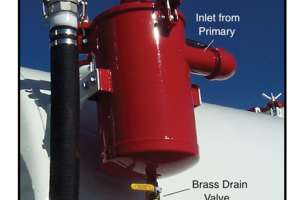
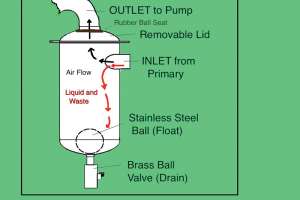
The secondary moisture trap is exactly what it claims to be: A trap for moisture and waste, coming from the primary shutoff. Obviously, the primary shutoff on top of the tank is intended to stop the airflow should the waste tank become too full. Since it is not a perfect world, some liquid and waste may make its way past the primary to the secondary.
The concept behind the secondary is basically the same as the primary except it counts on gravity to do some of the work. As material escapes from the primary, for whatever reason, it moves to the secondary. The vacuum system, as you know, provides constant airflow through the tank, primary, secondary, pump and finally the oil-catch muffler.
FLOAT BALL OPERATION
Gravity pulls liquid and other materials down to the bottom of the secondary. As the liquid builds up, the stainless steel float ball in the secondary rises. When it rises to the top, the ball stops any flow from continuing to the pump. Thus, you have the basic operation of the secondary.
Most units are made from 7- or 10-gauge carbon steel. When it comes to determining what size of a secondary to put on a truck, airflow is the key. The inlet and outlet fittings are the same size. For example, a unit with a 1½-inch inlet has a 1½-inch outlet. Most secondaries are constructed using 1½- or 2½-inch inlets and outlets and three fittings. The pumps involved with the 2-gallon secondary usually produce around 130 cfm. Larger secondaries – the 4- and 5-gallon type – are generally installed on septic service trucks with pumps producing 250 to 500 cfm. It would be unusual to have a portable sanitation service truck using these larger pumps.
It is impossible to determine how much liquid has made its way from the primary to the secondary. While the primary should be checked once a month for wear and corrosion, the secondary needs more attention. An especially important maintenance point, the brass drain valve on the bottom of the secondary should be drained at the end of each day’s service. Letting a secondary sit overnight and then putting the truck into service the next day is asking for trouble.
Even if draining the secondary yields little liquid waste, don’t stop the daily practice. Simply get a bucket for catching the contents of the secondary and take care of the liquid appropriately to suit your state’s environmental laws.
MONTHLY INSPECTION
If left unserviced, the ball will settle in the waste overnight. When the pump is started the next day, some materials may be sucked directly into the outlet. The next stop for those liquids and materials is the pump. This is a more serious concern in freezing temperatures, when some of the contents may come loose before the ball moves, sending damaging materials into the pump.
Another aspect of effective secondary maintenance is knowing when to remove the lid and check for corrosion to see if anything is blocking or potentially blocking the air path. Secondary lids are secured either with bolts or wing nuts. As we have advised checking the primary once a month, it’s a good idea to add the secondary to your day of inspections. The rule of thumb is to check the interior of a secondary once a month.
The secondary is located between the pump and primary. And for the sake of common sense, it should be mounted high enough that no one bumps their head while walking by.
The secondary is a vital component in the protection of your vacuum pump. Minimize your problems, maximize your profits, maintain your secondary, and drain it every day.