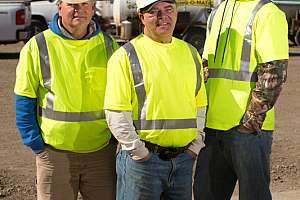
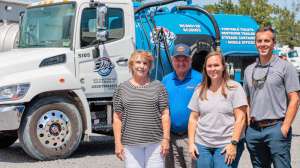
R& L Sanitary, a small portable sanitation enterprise in Huron, S.D., did not come about as the result of a long-range plan. Owners Robin and Lanny Olson were already in the construction business – specializing in underground water and sewer work, site preparation and demolition – when they needed a few restrooms for their work crews.
They bought a few units, then a vacuum truck to service the units, and voila, they were in the pumping business. During the last 30 years, they added more restrooms to serve a growing number of events and customers. Up until five years ago, most of their clients were sporting events, weekend parties and construction jobs.
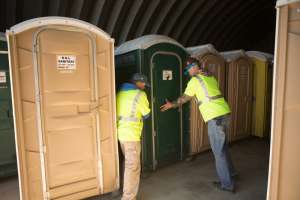
Then a section of the Keystone XL Pipeline came through their part of South Dakota. Now they own about 500 units, mostly from PolyJohn Enterprises, and some from PolyPortables Inc. and Satellite Industries, to serve firms working on the pipeline that is proposed to move oil reserves in Canada to refineries in Texas. The portion of the project in their area is complete, so the Olsons have their units in storage except for about 100 deployed on jobs.
Lanny is 63, and Robin is 62, and they don’t have any plan to give up the portable sanitation business. Their thinking is just the opposite. They are considering turning the construction business over to Lanny’s son, Tony, and operating the restroom business as a “retirement” venture. With two of them handling the work it would be easy for one or the other to take a long break now and then, Lanny says.
“Routinely the two of us can manage it on our own and still have pretty decent income,” Lanny says.
“We’ve got a pretty good life out here in the middle of nowhere,’’ he continues. “We just have to learn to appreciate it more.”
Explore five issues that affect R & L Sanitary:
• Seizing opportunities
The larger number of units, and work on the pipeline, came because the brothers took advantage of opportunities when they came along. They did some calculating and found they were about in the center of the pipeline work, which covered a 325-mile-diameter circle around Huron.
“We bought used portable restrooms all over the country,” Lanny says. Most of them came from Florida.
“We were pretty fortunate when the pipeline came along,” Robin says. “The economy was still real good here locally, and – unfortunately for those people in Florida – we were able to get good used units because things weren’t good down there.”
Their construction business benefitted from the portable restrooms, which they supplied to pipeline firms.
“We were told they never had anybody take care of restrooms the way we did. And they simply asked if we do our normal construction work as quickly and as efficiently as we did the portable restrooms,” says Lanny Olson. He runs the construction company. Brother Robin runs the restroom end.
“Because we did such a good job they started hiring us to dig for them and haul granular materials, and things like that,” Lanny says.
• Adapting equipment for the environment
The equipment R & L uses is non-standard because they have had to adapt to the conditions they face. “The ground is either frozen or falling apart six months of the year,” Lanny says.
“The main thing we use is a 3/4-ton pickup, four-wheel drive, with a tow-behind trailer,” Robin says. “We found out in our area you’re better off with a smaller unit because the roads are bad in the winter, and in the spring and summer, if it’s raining, a big, heavy truck is too heavy to get into the job.”
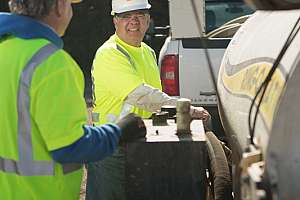
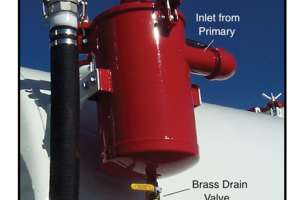
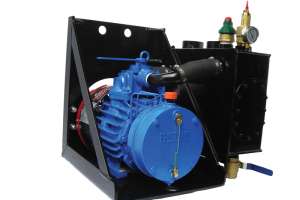
Pump units are carried on the trailers. One trailer carries a 1,000-gallon steel tank and the other a 750-gallon steel tank. These are pit pumpers from Ring-O-Matic. If the roads are bad, they unhitch the tank trailer and take advantage of the four-wheel drive to deliver a restroom to a rugged location. Then they hitch and go with the trailer to provide vacuum service.
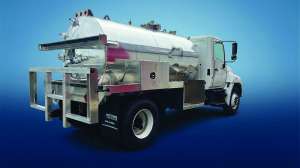
They do have two vacuum trucks with 1,500-gallon tanks – single-axle, about 30,000 pounds GVW, and equipped with Masport pumps – for their other needs. Those needs include pumping out sewage when they’re replacing a broken pipe, pumping septic tanks (they do about 500 annually), and controlling water while they’re installing pipes.
One of the trucks is a Chevrolet with a steel tank and was purchased used. The other is on a GMC chassis and has a steel tank. TrueNorth Steel of Huron, S.D., fabricated the tank and built the truck.
• Taking advantage of a flexible workforce
In rural South Dakota, just like with the pipeline work, R & L can pile up the miles reaching a portable sanitation job. If several restrooms are deployed, it is not uncommon for Lanny or Robin to drive 500 miles to service them.
Although the brothers do most of the work themselves, they are fortunate to have a companion business to draw additional workers from when needed. If a contract lasts one or two weeks, the brothers handle it themselves. If it’s a big contract, they may shift one of the construction workers to the R & L side of their operation for a short time.
Often they need an extra person for only two hours a day, one day a week, Robin says. It would be almost impossible to find a temporary employee agreeable to that sort of schedule. But shifting workers between the businesses is convenient and gets the most out of each employee.
If another large, long-term project comes along – such as another pipeline – they would shuffle the construction employees into R & L until they could hire a person to work exclusively on the portable sanitation work, Lanny says
• Making sure a job is profitable
The company has never been reluctant about charging what it needs to service a far-flung territory, Lanny says. After years of doing the work, they know exactly what they must charge in order to keep the business running. They tell customers the money buys very good value, and few turn them down.
Of course, adds Robin, the nearest portable sanitation competitor is 50 miles away, so they’re not forced into a position of bidding below cost. Occasionally a new competitor moves into the area with a few restrooms, but history has shown that the units won’t be serviced for two months because the operator did not charge enough to make the task profitable, Lanny says.
“The real key is, if you’re not getting what you need to maintain them right, don’t do it,” Lanny says.
Another competitive advantage is their lack of debt. They don’t owe a dime on the business, Lanny says, so it doesn’t bother him to store 400 unused restrooms from the pipeline contract. “However, if the deal is right, we also have no problem ordering another 1,000 of them and taking on whatever is available out there,” Lanny says.
They don’t advertise because they don’t have to. They’ve been in business for so long they’re known for 200 miles around, Robin says. “Honestly,” he says, “we haven’t spent $10 in advertising in 30 years.”
• Hitting the road for education and supplies
The Olsons love living and working in the remote Dakotas, but the tradeoff is that there isn’t a lot of support for products or ways for them to pick up technical knowhow. With so few operators in the area, portable sanitation manufacturers’ representatives don’t stop by to talk about products, ask about an order or pass on the latest knowledge, Robin says. The brothers have to find time for industry conferences – such as the Pumper & Cleaner Environmental Expo International – and bring new knowledge and techniques back home.
The same challenge exists for replenishing supplies and building equipment inventory. Everything from replacement parts to chemicals comes from a distance. If South Dakota doesn’t have the highest shipping rates in the nation, it’s close to the highest, Robin says.
When feasible, they do their own shipping. Through the season they will keep notes on what they need. In the winter when work is slow and they want a break from the snow-covered prairie, they’ll drive a truck to Chicago. Before they head home from their recreation, they’ll stop to pick up a load of supplies – saving the high shipping costs to deliver to Huron.