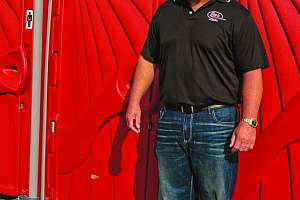
For years, Jason Aparo has been collecting cracked, broken or otherwise damaged portable restroom parts in piles at several yards at Aparo’s Little John in Bay Shore, N.Y. The piles were small at first, but he now has plastic remnants equaling 100 restrooms or more and wonders what to do about them.
“One unit would get destroyed, and then I’d wait until I had two or three of them. Then all the sudden it would be five or 10 units and then you forget about it,’’ Aparo recalls. In what he says must be a similar story for many PROs, Aparo says the plastic piles grew from a small problem to a larger nuisance. “Other things take your time up, like making money, and it’s just easier to let it sit there.’’
But ultimately, Aparo didn’t want to keep pushing the problem into the future. And he didn’t just want to fill some trash containers and haul the polyethylene to the landfill. He didn’t think that was the right thing to do. Most of the bathroom tissue used by the portable sanitation industry is made up of recycled paper products, Aparo says, so he should be able to find a way to responsibly recycle the worn-out restrooms.
Unsuccessful at finding an outlet to recycle his restrooms, Aparo sent me an email.
CAN WE GO GREEN?
“Everyone is so green nowadays and there are all these plastic recycling companies, but nobody wants the toilets,’’ he wrote. “I’m just one company and I have a lot of plastic to get rid of. There has to be more companies in the same situation. The planet and the industry need this service.’’
In a follow-up conversation, Aparo told me he’d called many recycling companies over the past two years and received few callbacks. When they did return his call, the recyclers lost interest in the material when they found out the plastic used to be the foundation for portable restrooms.
“The guys all wanted perfectly clean plastic. A portable toilet? They’re not even getting into it,’’ Aparo says. “You can take anything to the landfill, but I didn’t want to do that. I want to try and do something to recycle them.’’
I believe it. All these years, Aparo was disassembling damaged units and saving all of the thermoformed side panels, roofs, tanks and skids that could be reused. He runs about 1,000 units on New York’s Long Island, and he repairs units and gets them back on the job.
I know many PROs operate the same way as Aparo’s Little John. They salvage what they can from old units, and then start a pile of unusable parts, hoping to one day find a use for them or a way – at least – to keep them out of the landfill.
ENVIRONMENTAL STEWARDS
So I made a few phone calls, first to several of the restroom manufacturers. They share Aparo’s and other PROs’ concern for the environment and have implemented programs allowing them to recycle all of the post-industrial trimmings and waste plastic associated with building new restrooms. The clean plastic bits and pieces have great value and can be worked right back into the product at the factory or sold in the recycling market to make a variety of products.
“There are better uses for it than to sit inert in a landfill for 10,000 years,’’ says Steve Brinton, of Satellite Industries. “We all should be protecting the environment as much as we can.’’ To that end, Brinton says Satellite tries to help PROs with large quantities of usable older restrooms connect with buyers in third-world markets.
PolyJohn Enterprises recycles all of the waste plastic from the manufacturing process back into its units, according to Jamie Kostelyk, a company design engineer. “We go up to 30 percent reused material, depending on how much regrind we’ve generated. We do utilize every bit of plastic; nothing gets thrown away,’’ he explains.
At the PolyPortables factory, the manufacturing waste product – called floor sweeps – is gathered, sorted, cleaned and shredded by a recycling company. “We want to minimize our waste streams coming out of our manufacturing facilities,’’ says Henry Davis of PolyPortables. “You can at least know you’re doing the right thing.’’
The owner of the recycling company PolyPortables uses, Jackson Industries, says the plastic from portable restrooms is of such high quality that PROs should be able to find a source to take it for free or find a recycler who may pay for the product if it’s stacked and palletized for easy transport.
DOLLARS AND SENSE
“If you’re dealing in volume, you’re going to make some money recycling them. And you’ll save money by not taking them to the landfill,’’ says Ben Jackson. He gives an example:
If a PRO has about 100 restrooms, or about 20,000 pounds of plastic that can be loaded onto a container for shipping, a Chinese recycler might pay 20 cents per pound, or $4,000 for the load. If that same plastic material is taken to the landfill and is subject to a tipping fee of 5 cents per pound, the cost to the PRO is about $1,000 for getting rid of it.
Each PRO’s circumstances will dictate whether they can sell the plastic, or at least find a recycling company that will take the material at no cost. Jackson says a PRO’s proximity to recyclers plays a role. If you’re located near a major city, say Chicago or somewhere on the East or West Coasts, you’ll have better luck finding a buyer or taker for your waste. Your chances are also better if you thoroughly clean the plastic, remove metal rivets and prepare the load for transport.
Jackson has machinery to grind or shred polypropylene and sell it from his Georgia operation, but he only takes restroom parts that are cleaned and he assumes the same is true for any recycler. The units should be disassembled and washed with bleach and water. Odors aren’t a concern, he explains, because plastics that retain odors, like shampoo bottles and barrels of soft drink syrup, find use in underground pipe or other products where the odors aren’t an issue.
The color of the plastic isn’t an issue, either, he says. Comingled plastics of all colors and qualities are called utility-grade material and are typically used to create black plastic products, such as pipe, fender wells for cars and pallets.
For PROs with small quantities of waste plastic, Jackson suggests cutting restroom components into small pieces that would be acceptable for disposal through a municipal recycling program.
“If you really care about the environment and want to recycle, take 30 minutes or an hour and cut two [units] up and put them in the recycling bin,’’ he says.
PROs with large quantities may contact Jackson through his email, ugaben85@hotmail.com, and he’ll try to help them find a source for their material.
WHAT’S YOUR STORY?
Have you heard this phrase “reduce, reuse, recycle’’ associated with the green movement? Well, Aparo and other PROs are great at reusing parts of restrooms and keeping these units working for them for years on end. And they help reduce the use of water when restrooms are used in place of permanent public bathrooms. (For an example, see this month’s On Location feature about the California drought.)
Maybe some PROs have figured out the recycling challenge. If your business has found the solution to recycling, I’d love to hear from you. Send me an email sharing your tips for finding a portable restroom recycler and I’ll include the information here in my column.
Continue reading for free