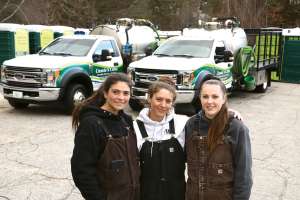
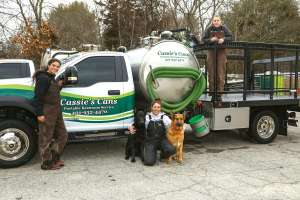
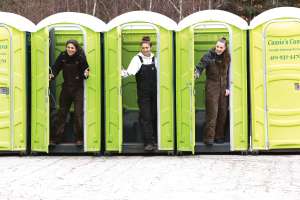
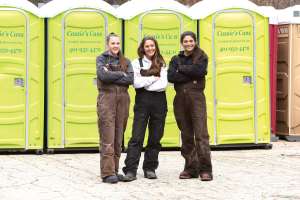
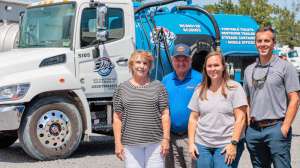
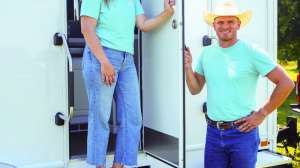
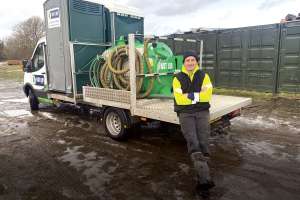
Cassie Collinson started her business, Cassie’s Cans, before she could drink in a bar. She was just 20 and admits that after long days and weeks of physically challenging work plus office tasks, there were days when she wondered why she hadn’t gone to college instead. Collinson learned everything about the portable restroom business through trial and error. Six years later, she’s glad she persisted through the first two years. Now, with her team of three other women and two-tone lime green restrooms, Cassie’s Cans has branded itself and can be spotted all over Rhode Island.
BRANCHING OFF
When Collinson jotted ideas for a portable restroom business on the back of a restaurant’s placemat, she was with her father, Richard Collinson. Collinson was working full time with him in his rooter service business while figuring out what business she should start. She prefers working in the field rather than in an office and had met a few people in the wastewater industry, who led her to think it could be a lucrative opportunity.
“After writing up a proposal for a business I truly knew nothing about, I got approved for a $68,000 business loan, which allowed me to purchase my first flatbed, tank and 20 toilets from PolyJohn,” she recalls.
She had office/bookwork experience working with her dad, but everything else was unknown territory. One thing she had in her favor was a good role model and very supportive parents.
With contacts from her dad’s customer list, she started picking up customers, mostly for construction sites, which continues to be about 90% of her business. With “physical grit,” she learned how to pump, unload at the treatment plant, fix and maintain her truck and restrooms.
The hard learning curve was not endured alone, as she recalls relying on her father and boyfriend, Tyler Tuchon, many times through the years.
“There were nights at 9 p.m. when I’d call Tyler in tears, exhausted, staring at a broken hose or valve on the truck. Completely at my wits’ end, he’d show up and somehow fix the problem on the spot with wrenches and duct tape. There were Saturday nights when my parents left dinner dates and drove to my unheated shop at the time. My mother would just hug me while my dad sang to himself and wrenched on a broken pump because I had no idea how to fix it. Those are moments I will never forget.”
GETTING HELP
By the time she was 22, Collinson was working long days transporting and pumping restrooms and doing all the office work.
“When I was on the road full time, I was practically running my office out of my service truck and running myself dry,” she recalls. But she had built up her business enough to afford to hire an employee. Later she added two more to her team.
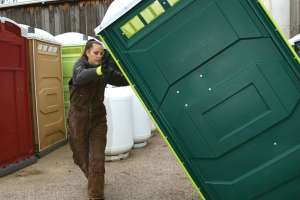
“I’ve been lucky enough to hire young, hardworking girls who go out in the pump trucks every day, all week and service our job site toilets. The girls have come on board, trained on the road, been taught to service their own trucks daily, stock supplies, fix and repair toilets, and pretty much manage themselves at their designated service routes for the week. We work year-round, as a team,” Collinson says.
The all-female crew, including Karissa Doak and Selena Gordon, is unusual in portable sanitation. New customers are often surprised when female pumpers deliver and service restrooms. But there haven’t been any issues for the women in a male-dominated industry. “The working class has no restrictions,” Collinson says. “Women can be in any trade just as long as they put in the work.”
THE JOB
“In 2020, my job became more managerial. It isn’t my favorite thing, but I need to be at my desk so I’m not falling behind,” Collinson notes, adding she also drives routes two or three days a week.
She uses QuickBooks for accounting but sets up route sheets the old-fashioned way. Each night she looks at the jobs and sets up routes with three drivers going in different directions and prints them out in Word documents. Each driver services 40-70 restrooms a day during a 10- to 12-hour shift.
Collinson has a website and Facebook page, though she admits she doesn’t spend as much time with social media as she should. Most of her advertising is word-of-mouth from satisfied customers and through local chambers of commerce.
To keep the business running smoothly, she often spends at least part of her Saturday hanging around at the shop she shares with her dad. Working alone, she details the trucks parked inside and makes sure everything is ready for the next week.
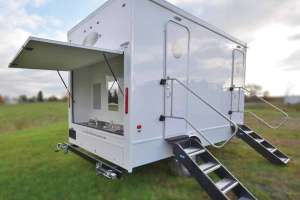
Cassie’s Cans has steady work year-round with construction clients from small home remodelers to bigger companies that contract a couple dozen restrooms for a couple of years. The business also provides restrooms for beaches, events and private parties. Collinson invested in a 2019 A Restroom Trailer Co. (ART Co.) restroom trailer to develop higher end markets. But, due to COVID-19, there wasn’t much demand for it in 2020. There was a need for sinks, however, so she purchased 10 single-sink units from PolyJohn for construction customers.
Plus, with more people preferring to travel with campers during the pandemic, Cassie’s Cans picked up extra work pumping RVs at small campground as well as for individual homeowners who used campers for guests.
THE FLEET
Because most of the restrooms are for construction sites, about 90% of the 350 portable restrooms are standard PJN3s from PolyJohn. The other 10% are split between PolyJohn handicap and luxury restrooms. Cassie’s Cans has two Liquid Waste Industries trailers for hauling multiple units.
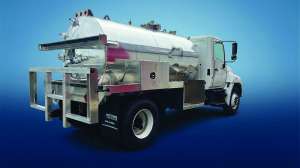
Smaller numbers of restrooms can be hauled on the vacuum trucks in Collinson’s fleet. She has a 2008 Ford F-550 flatbed carrying a 540-gallon waste/260-gallon freshwater aluminum tank from TankTec that she and her father put together for her first truck. She also has a 2017 Ford F-550 with FlowMark 700-gallon waste/300-gallon freshwater stainless steel tank,
National Vacuum Equipment 304 pump and fold-down restroom carrier, and a 2019 Ford F-550 flatbed with a FlowMark 500-gallon waste/300-gallon freshwater stainless tank and NVE 304 pump. The newest truck can hold up to six restrooms accessible with a Tommy Gate lift.
For backup and small operations, she has a 2007 Chevy 3500 Duramax pickup. Collinson had a local welder fabricate a 150-gallon waste tank from a propane tank, and she and her dad added two 50-gallon plastic freshwater tanks, a Conde pump and Honda engine.
TRAINING AND MAINTAINING
Though the trucks don’t require CDLs, Collinson acknowledges it takes training and experience for new hires to learn to maneuver the wide dually trucks on the highway and backing down driveways and into sites for restroom delivery and servicing. She makes sure drivers are trained in safety and that they understand the truck’s limitations.
Cassie’s Cans emphasize cleanliness in their trucks and restrooms, and Collinson’s slogan is “The Greenest & Cleanest Can serving all of Rhode Island!”
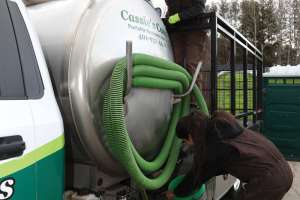
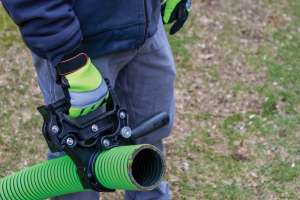
“They (drivers) service their own trucks — empty pump oil every day, clean secondary pumps and power-wash equipment,” Collinson says. The skills empower them with the knowledge they are capable of many kinds of work.
The job hasn’t been right for everyone, and Collinson knows workers may not stay with her forever, but she shows appreciation through cash tips and encouraging supportive energy around the shop.
“We don’t have a policy to hire just women, but just having girls on board is kind of fun. We take pride in our hard, blue-collar work,” she says. “They’ve come and learned the job, young girls who enjoy working hard and are tightknit. When you build this team, it’s something to be proud of, and I try to reciprocate my appreciation.”
FINDING BALANCE
Collinson is proud of how she’s grown her business from 20 restrooms and one truck to 350 restrooms and three pumper trucks. “Cassie’s Cans is a crazy idea that worked,” she says, and 2020’s pandemic didn’t slow it down.
She acknowledges her success is based on her stubbornness, hard work and long days, especially during her first two years in business. “I wanted people to take me seriously. I didn’t want to fail,” she recalls.
Now, with her team, she acknowledges another reason for continued success is positive branding for Cassie’s Cans.
“Just having the girls pull up, wave and smile adds brightness to a job site. We try to be diligent about calls and over all absolutely caring about every issue,” Collinson says. “I appreciate my team of girls very much.
Yes, I worked my butt off. But without people showing up every day, you don’t have a business that’s going to grow.”
Besides that, having a crew allows Collinson to regain some of the social time she missed in her early 20s. Though the phone is never turned off, she actually finds time to be with her friends, boating on the ocean or sitting around a campfire, enjoying a beer.