In 2018, Jonathan Ibbetson’s wife Cara, a nurse, told him he needed to start exercising again. He went all-out and signed up for an Ironman triathlon in Wales. He spent a year training for the 2.5-mile swim, 110-mile bike ride and 26-mile run. But it turns out he was training for more than just the Ironman. By the time he finished the triathlon the following December, he was on his way to a new career.
Ibbetson had been working in the food-packaging printing business for 24 years, most recently in management. But he was increasingly bored. “Although it pays very well and gives us a nice lifestyle, it was slowly killing me inside,” he says. He had in the back of his mind he’d like to start a business.
Ironman training gave him three things: First, the guilt he felt for spending so much time away from the family led him to thinking he could have used that time pursuing his entrepreneurial dream. Second, it gave him confidence he could achieve anything he put his mind to. And third, he used a lot of portable restrooms, which gave him a business idea as he was exposed to the good, the bad and the ugly of the industry. He started looking online at companies and his enthusiasm grew. He didn’t quit his job but in early 2020 Fast Loo in Leeds, England, was born.
FIRST STEP — GET HELP
Although research helped, Ibbetson knew he had to talk to people and get hands-on experience. He called a few companies, and all were helpful and encouraging. Then he contacted a company 100 miles away and asked if he could work for them for a day. After that experience he was ready to put in an order with the local PolyJohn dealer for 10 units.
The next helping hand came from Richard Poulton at Rapide Tankers. “He basically makes all the tankers in the U.K. for all the toilet companies,” Ibbetson says. “He was really nice and gave me lots of advice and told me what I needed.”
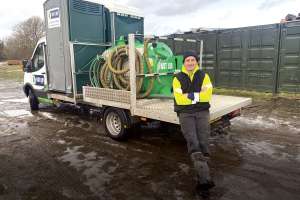
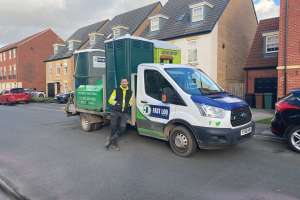
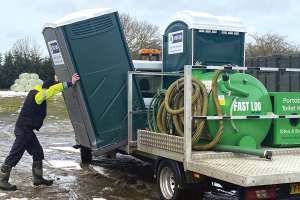
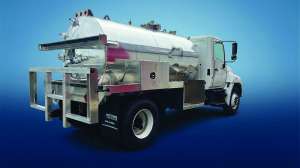
Ibbetson bought a 2016 long-wheeled Ford Transit van, which Poulton converted to a flat bed with room to carry four units, a 180-gallon waste/100-gallon freshwater steel tank with a Honda GX240 pump, and a Honda GC160 power washer. He lowered the bed to facilitate manual loading of units.
A BLESSING IN DISGUISE
Ibbetson was now anxious to get started, but world events interfered. In March the prime minister announced the country was going into full COVID lockdown. “I started panicking, thinking, ‘What have I done?’”
Poulton reassured him everything would work out. “And then I just put my head down and really started planning,” Ibbetson says. It turned out there was a lot to plan: figuring out a name, creating a logo, pricing, bookkeeping, marketing, where to store equipment. The name basically just popped into Ibbetson’s head. His website designer convinced him he needed a logo, so he had to work out a design and choose colors. He says he quite likes the blue and green Cara picked because it stands out. His website was to be his only form of marketing so, being especially concerned about ranking well on Google searches, he learned all he could about search engine optimization, or SEO.
Everything came together by June, just as the country opened back up, and the phone started to ring.
RAMPING UP
By the end of July, all 10 units were rented out and Ibbetson was ready to order more. Unfortunately his supplier had none in stock. He found a large contractor in another part of the country, AndyLoos, who agreed to sell him some units (Satellite Industries) and, again, the owner, his daughter and an associate gave Ibbetson lots of advice and encouragement.
Every month or so Ibbetson now goes to the Satellite plant in Coventry and buys four units. Satellite personnel have also been very helpful, he says. He was especially encouraged when the salesman told him the big companies were buying lots of units. “I’m thinking if they’re buying a lot, there’s obviously work out there.”
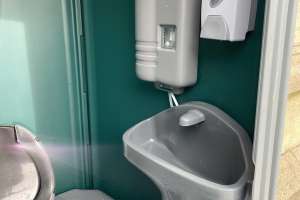
Ibbetson is now up to 65 Maxim 3000s, two PolyJohn wheelchair-accessible units, and two units with hot-water sinks which he built himself using Hotshot heaters from RLT Design in York (one is currently in a barn, the other at Leeds City Center), all with hand-pump flush systems and foot pump-operated sinks and liquid soap dispensers per U.K. legal requirements. Ibbetson keeps track of his equipment using Google maps.
BIGGEST HEADACHE
Ibbetson says invoicing has been the hardest part — the book work, the collections, the time. He started out using Excel but as the company grew it just wasn’t working. “It was too time-consuming and we were making too many mistakes,” he says. His sister, also a business owner, recommended Xero accounting software. “It’s like a breath of fresh air,” he says. “It now takes seconds to send an invoice.” He currently invoices customers once a month but believes biweekly would be better.
Ibbetson is now working on automating the collections process. “I rely on customers to pay and some don’t. Then you’re chasing overdue invoices and sending emails and when they don’t respond you’ve got to ring them up. I want a better system, so I’m working on going cardless where they pay online.” Ideally, he’d like to set it up so when a customer orders units and pays a deposit online, he sees when they’ve paid and delivers the units, and each month automatically collects payment from the customer’s bank.
PLANS AND ADVICE — AND ONE REGRET
Ibbetson’s first goal was to get to a point where he could quit his printing job, which he was able to do by March 2021. Near-term plans include making improvements to the website, especially emphasizing that he’s a local company; finding a covered facility with utilities to store equipment and provide him an office so he can quit working out of his van; getting into events; purchasing routing software; and hiring help once he gets up to 80 or 90 units.
Ibbetson’s biggest bit of advice is to just have confidence in yourself and do it. “I didn’t know anything about (the industry), but you just read up on it and speak to people. You can think about it and dream about it, but you’ve got to actually put things in place and do it. I honestly believe you do reap what you sow. And if there’s a problem, there’s always a solution, always.”
Although holding down a full-time job while getting a business off the ground was brutal, Ibbetson, now 40, says his only regret is not starting the business 10 years earlier. “I still get excited. When the phone rings, I still get a buzz. I love the process, the journey of starting a business and growing it. The money’s coming in and it’s great, but it’s more the journey, really, and enjoying it.”