You might think a large urban city like would have ample access to permanent public bathrooms. But you would be wrong. Many of the existing facilities are connected to private businesses like restaurants and retailers that provide limited public access. So when the COVID-19 pandemic hit in early 2020, many shelters serving a large homeless population closed their doors, sending users into the streets with no place to relieve themselves.
To ease this crisis, city officials appointed the Seattle Public Utilities Department to find a solution. And the utility turned to portable sanitation as an efficient way to serve many homeless encampments that would pop up and move around to a variety of locations across the city.
Urban areas in the temperate Pacific Northwest have long been a magnet for the transient poor, and restrooms and shower trailers employed by Seattle have provided much-needed hygiene options, according to Gavin Patterson, a project manager for the public utilities.
The city budgeted $6.3 million in 2021 to fund the program, with money spent to purchase shower trailers and hand-wash stations, rent, service and repair portable sanitation equipment and cover labor costs.
Portable sanitation is playing a critical role in serving people in need and keeping the city sidewalks and public places clean and safe for everyone, according to Patterson. And while the city looks for a longer-term solution to providing adequate permanent sanitation facilities, the city program will offer much-needed relief for a long time to come.
STRATEGIC PLACEMENT
“Everyone would like for there not to be a homelessness problem, but in the interim we at least need to provide some hygiene facilities for them or they will go all over the place and it gets pretty disgusting,” Patterson said. The city has purchased a few of the self-contained, sewered stainless steel Portland Loo bathrooms that are becoming popular in public locations in larger cities. But portable restrooms appear to give places like Seattle more bang for their buck and greater flexibility at this time.
“The broader question of public restrooms is being talked about,” Patterson explained. But in the meantime, the public utilities effort is to place and service the portable sanitation equipment effectively while also dealing with a growing vandalism problem.
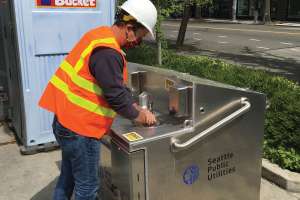
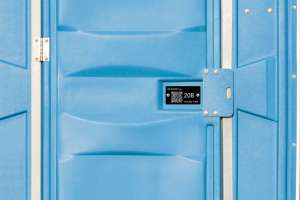
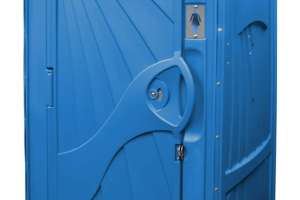
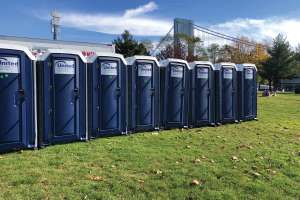
The utilities are strategically placing 15-18 “hygiene stations” throughout the city. These consist of a pair of standard and ADA-compliant restrooms and an ADA-compliant hand-wash station. The restrooms are provided and serviced by a subcontracting portable restroom operator, while the city purchases and maintains sinks that do not use foot pumps so they can be operated by disabled persons in wheelchairs.
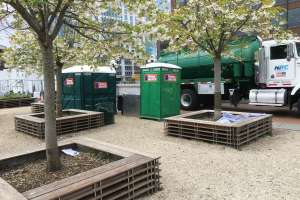
The hygiene stations are typically placed where encampments emerge, usually in open public areas. The encampments typically have up to 30-50 tents as well as homeless using cars, RVs and camping in the open. Seattle has many hills, and one challenge is finding enough flat space to place the units and sinks on level ground for safety. They also try to put the restrooms in lighted areas for added security.
SHOWER SERVICE
The strategy for the city’s dual shower trailers is different. They currently own two shower trailers manufactured by Comforts of Home Services, each with three individual rooms with a shower, toilet and sink, as well as a matching attached ADA unit. One trailer is stationed permanently in the downtown area near an Amtrak station and several homeless shelters, while the other one moves around the city and its location can be tracked at a map of all sanitation facilities at a city website: seattlecitygis.maps.arcgis.com/apps/webappviewer/index.html?id=311fcaa38e1c45328ade2de388cefcc6.
Currently the hygiene stations are available for use 24/7 and are unsupervised. The trailers, which had provided more than 40,000 showers near the end of 2021, are a different story.
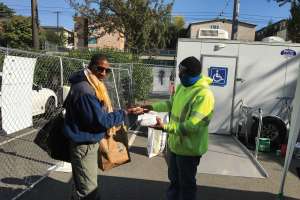
The trailers operate 8:30 a.m. to 4:30 p.m. most days and are staffed by 4-5 attendants at all times. The city contracts with nonprofit Northwest Uplift to provide the workforce, which are homeless or recently homeless individuals getting back on their feet. The workers monitor users, hand out fresh towels and clean and restock each shower room between users. Users are given up to 30 minutes at a time.
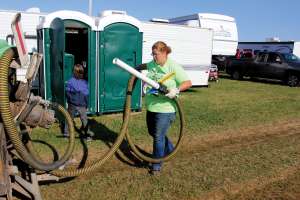
The city looks for trailer locations with easy access to utilities. That’s typically not a problem for electricity or fresh water, but there is little access to sewers for disposal of gray and black water. So a pumping subcontractor is hired to empty the 400- to 500-gallon holding tanks twice a day, Patterson explained.
VANDALISM A PROBLEM
As we have reported in past stories about this type of urban sanitation program, vandalism is a problem in Seattle. Some of it is caused by the homeless community, which includes many people suffering from mental health issues, Patterson said. But he believes more of it is caused by passersby who don’t appreciate seeing the encampments or restrooms in the neighborhood.
Most of the vandalism is to the portable restrooms and sinks, and there is really no damage being done to the trailers. Patterson says that’s because of the limited hours of operation, the supervision by Uplift employees and because each trailer is fenced off and watched through the night.
At first, much of the restroom vandalism could be traced to the hand sanitizers placed inside each unit. Those were often being pulled off the walls and stolen or used for an arson accelerant.
“Burning is a big thing and it used to be started off the hand sanitizers; that stuff burns really well. We’d see burn marks in the melted plastic right above the dispensers,” Patterson said. “There have been several times where restrooms were completely burned to the ground and we find just a pancake of molten plastic.”
Unfortunately the damage can eat up a significant part of the budget and limit the number of restroom placements, he said.
The vandalism also raises concerns about the safety of those who service the portable restrooms. The city does not provide security for the PROs or pumpers who care for the facilities, but there are measures the subcontractors can take to improve safety on the service routes. The contractors could send teams of two workers rather than have lone drivers. And Patterson said for a number of sinks maintained by the city, workers now bring damaged units back to a garage rather than repair them in the field.
IMPROVING RESTROOM AVAILABILITY
Patterson grew up in Scotland and said public restrooms are more common throughout Europe than he sees in the U.S. He said the governments in his homeland and other European countries take responsibility for providing ample basic sanitation while in the U.S. governments rely more on private business for that service.
“When I came to this country, it’s not something you do so well. Everybody goes and providing that service makes for a more livable city,” he said. But in Seattle today, he said, the government had to step in and provide bathrooms to keep the streets safe and clean for all.
This is a critical issue, Patterson said, and one where portable restroom operators can play an important role in preventing disease and helping an underserved population seeking relief.
“Any place that has similar problems, and wherever there are people living in the streets, it’s a public health problem,” he said, adding that PROs in medium to large cities should reach out to local governments, social service agencies and food banks, and offer to become a partner to provide sanitation services.
It’s quite possible that officials in many cities served by PROs have no idea how to go about providing these targeted sanitation services, Patterson said. “If you’re suggesting that people like me don’t know what to do about (portable sanitation), you’re right. I know a lot more now than I did before.”
What Patterson said is important. Just as he was thrust into trying to solve a sanitation problem, officials in many parts of the country must be facing the same learning curve regarding portable sanitation. Reaching out, you might just provide a helping hand to your community and gaining new customers at the same time.