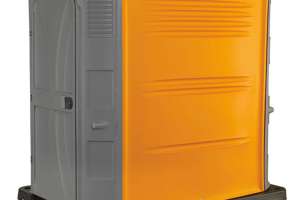
Recent media reports show the critical nature of declining public bathroom infrastructure, exposing a need portable sanitation providers are ready to fill. You have the equipment and crew to address this crisis. As an industry we need to bring that to light and change lingering negative perceptions people have about portable restrooms.
I provide commentary on a few situations across the country, and invite you to share your views.
Strong-arming a church over a portable restroom is a bad look
File this story under the heading, “No good deed goes unpunished.” In Albany, Oregon, members of the city council are getting bent out of shape over a house of worship’s decision to post a portable restroom to serve the homeless community. I have to ask myself: What would Jesus do? And the answer is, not this.
Citing an antiquated municipal code, the public works department argued that if the Albany First Christian Church has access to plumbing of any kind within 300 feet of its premises, the church would have to hook into the city sewer system rather than continuing to offer a portable restroom used by about 100 homeless people in the area. The issue came up when the congregation attempted to extend a temporary permit for the portable restroom, according to a story in the Albany Democrat-Herald.
“The city has built a nice sanitary sewer system. Part of the anticipation of having a sanitary sewer system is that we will define how you are required to connect,” Chris Bailey, the city’s director of public works, said during a city council meeting. He said the restroom was out of step with city code. He said the church could build more permanent bathrooms and a few council members suggested the church could open its doors 24/7 for public use.
The Rev. Tim Graves told the city council that the restroom is needed and being watched over carefully by the congregation. “We keep it very clean. I just feel like we have the best toilet in town,” added Ethel Ellingson, a church volunteer.
It seems obvious to me that a portable restroom is the perfect solution for temporary facilities for the homeless or any individuals in the neighborhood who find themselves in need of relief. It’s probably not realistic or economically feasible for a church to build more permanent facilities for this purpose, so the portable unit makes a lot of sense.
It’s equally obvious to me that other forces are at work with neighbors or passersby who just don’t want to look at a portable restroom and have no concern about providing a service for less fortunate individuals. This issue has been coming to a head across the country and portable restroom operators are often caught in the middle. They are providing a practical service to a customer and somebody doesn’t like it.
So it’s not really about following the municipal code as much as soothing the complaints of those who are offended by seeing a portable restroom in the neighborhood. Sound familiar?
Not everyone agrees with the detractors.
“As someone who has experienced human waste right outside the back door of my own business, I can say that we need to seriously look at changing the municipal code to allow portable toilets in certain places,” Council member Matilda Novak said at the meeting. She added that adding more portable restrooms could serve many workers in the city as well as the homeless.
Council member Bessie Johnson agreed. “It’s not like it’s going to be a port-a-potty every 100 feet. It’s just going to be where it’s needed,” she said.
Council member Marilyn Smith countered. “It’s not the Wild West any longer. We don’t need port-a-potties popping up everywhere.” One restroom in question and they’re popping up everywhere?
Then Council member Ray Kopczynski put it the way I would if I addressed this body. He said portable restrooms are a fast and inexpensive solution to a dirty problem, according to the news report.
“There’s nothing that the city has to do at all save for the fact some people probably don’t like the look of a port-a-potty,” he summed it up.
And to that I say, Amen!
Serving the Truckers
A story out of Pennsylvania might point to potential commercial customers for your portable sanitation services. State legislators there have introduced a bill to require restrooms are made available at all transportation terminals and warehouses frequented by truckers. The bill, HB2465, says these can be permanent bathroom facilities or portable restrooms.
The new rule would cover retail establishments, shippers, receivers and port terminals, according to Land Line, a trade publication of the Owner-Operator Independent Drivers Association. These would be “a place of business open to the general public for the sale of goods and services, including commercial warehouses,” according to the proposed law.
Lawmakers recognize what PROs already know, that restroom facilities are often in short supply for workers on the job. The drivers’ association supports the restroom mandates and we do, too. Everyone on the job deserves access to restrooms that provide basic human dignity.
“Truck drivers are often on the road without proper restroom facilities for many hours, with their first chance of a break coming when they are either picking up or dropping off a shipment. Allowing these drivers access to business’ facilities will prevent them from having to pull over on the highway, creating unsafe conditions for both themselves and other motorists,” said one of the bill sponsors, Rep. Jason Silvis, R-Washington Township.
PROs can relate to the truckers’ plight. You know what it’s like to wait on construction sites and commercial locations to be able to service restrooms. Thankfully, PROs typically have better access to necessary facilities on the road.
So the next time you pass truckers stopped at a remote warehouse or port terminal, consider stopping and asking the manager in charge if they’d thought about providing restroom service for the guys driving the big rigs.
Urban centers in great need of restrooms
Pressure is mounting for the city of Chicago to provide more public bathrooms, and it appears portable restrooms could provide a practical answer in many situations.
In a recent report, the Chicago Tribune noted it could not find any public bathrooms on a long stretch of the downtown Magnificent Mile shopping district. The paper’s research found fewer than 500 public restrooms in a city with a population of 2.7 million. At the same time, according to the Tribune, Chicago Police have issues more than 29,000 tickets for public urination and defecation over the past six years.
The paper noted that the United Nations considers free and available access to restrooms a basic human right, a mandate the city is falling woefully short on. The lack of restrooms is posing health risks as people urinate and defecate out in the open, spreading potentially deadly pathogens.
Chicago is just one of many cities reaching a crisis point. San Francisco has been utilizing portable restrooms to alleviate the problem of lack of facilities for some time now. Its Pit Stop program places units where they are most needed, Beth Rubenstein, of the city’s department of public works,
told the Tribune.
“We definitely feel like it’s a service that we must provide,” she told the newspaper. “By having portable toilets we feel like we’re actually addressing the issue of the need for people to go to the bathroom. If you’re cleaning up the sidewalk, you’re just dealing with the symptoms.”
Public utilities are strapped for cash to build adequate permanent bathroom infrastructure and maintaining additional facilities after construction would be a major challenge. However, cities would find a responsive partners and a cost-effective solution in our portable sanitation companies.
Continue reading for free