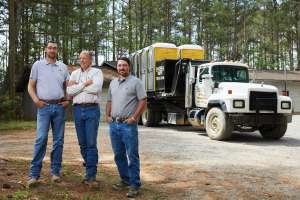
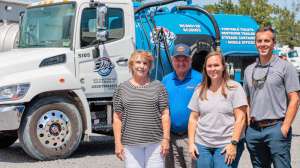
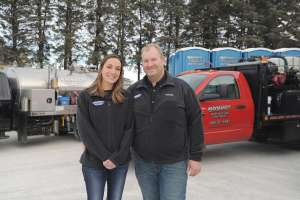
In 2016, William Smith and his friends the Bagwell brothers (Johnny, Mike and Jacin) started a roll-off container business in Calhoun, Georgia. The brothers were silent partners, while William handled management and operations along with his son Graham who joined a few years later.
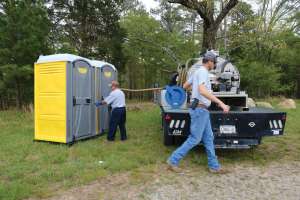
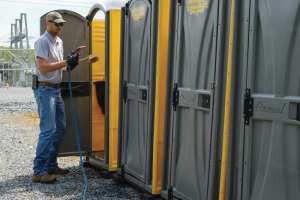
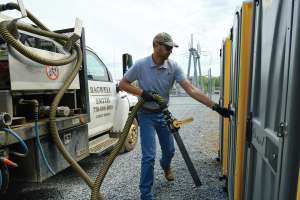
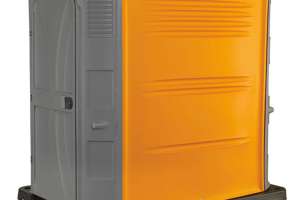
In early 2020, they began thinking about adding portable restrooms. William put in a bid to provide units for a September rodeo event “just for the fun of it.” When they won the bid, the company bought a 2005 GMC 5500 with a FlowMark 300-gallon waste/150-gallon freshwater stainless steel slide-in tank and a Masport pump and 10 Armal portable restrooms. That’s when the company became Bagwell Smith Rolloff Service and Portable Toilets.
They knew nothing about the portable sanitation industry and relied heavily on Armal representative Sam Calleiro to answer numerous questions. Graham started pounding the pavement. “Being the hometown local boy, you keep your eye out for business, just out of habit,” he says. “And we got busier and busier and it turned into a full-time job.”
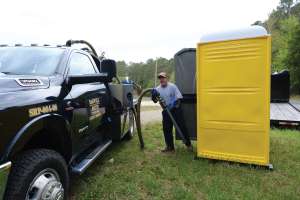
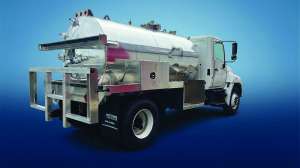
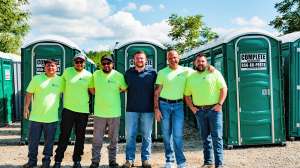
By early this year, the company had 300 Armal standard units, six Armal and Satellite Industries wheelchair-accessible units, seven Satellite hand-wash stations, a second vacuum truck, a 2019 Dodge with a 300-gallon waste/150-gallon freshwater Brenner tank and Masport pump mounted on a flatbed from CM Truck Beds. They also have a third truck, carrying a 600-gallon waste/300-gallon freshwater stainless steel slide-in tank and Masport pump from Satellite Vacuum Trucks.
William and Graham handled everything for about a year until they hired a route driver, Derek Pierce. And when William’s other son, Denton, wrapped up his job in 2022 he also joined the company.
Licensing was an unexpected issue that caused a delay in getting started. “We thought we’d be licensed because of the roll-off business,” William says, “but that wasn’t the case. So we had to stop and do all that.” They got the bad news from the water treatment plant they visited. So Graham went down to the Georgia Department of Public Health to get a permit, only to get more bad news — that they first had to learn the rules, pass a test and have the vehicle inspected.
The process ended up being more confusing and time-consuming than usual because testing was sporadic due to COVID-19, and it was a new process for the health department who was figuring it out as well.
SERVING VARIOUS MARKETS
Construction is booming in the Atlanta area and the synergy the company now has between the roll-off business and portable restrooms has proven beneficial. They now also stock holding tanks for construction trailers — six 250-gallon Satellite freshwater tanks and 10 300-gallon Armal and Satellite wastewater tanks.
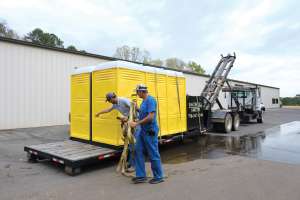
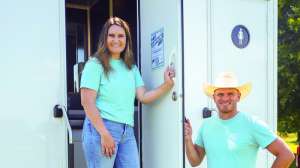
On the event side, the company provides units for school activities (even offering them in school colors), county fairs, rodeos, street fairs, pumpkin patches, fall festivals, Christmas programs — even a few funerals. For higher-end occasions — weddings, registered livestock sales, equipment auctions, concerts — they rent restroom trailers from a vendor in Atlanta. “We go get them, service them, take them back,” William says. The partnering contractor has started letting Bagwell Smith store trailer units in their yard.
For agricultural clients, the company provides units for fieldworkers in the highly monitored produce market. But they also created their own niche in the less regulated poultry farm business. After providing units for several poultry house construction projects, they had the idea of leaving a few units on site at no cost to the growers.
“We said, ‘Just keep them here, see how you like them. We won’t charge you for a couple months. If you like it we’ll start billing and if not we’ll pick them up.’ It didn’t take long before they said, ‘This is great.’ And a truck driver who goes to four or five different poultry houses starts wondering why they all don’t have them,” William says. So we hope it’s going to be a big boon for us.” With 550 poultry houses in their county alone, they see a huge potential market.
TACKLING THE HARDEST PROBLEMS
Business came on faster than anticipated and, as a result, William and Graham let the billing slide for the first few months, mainly because they didn’t have a good system to handle it. The manual system that worked fine for 10 customers quickly became hopeless. Graham worked with local business consultant Jeremy Barton to develop an email billing system using Excel. “It was a little bit of a bear to do but it’s working great now,” William says. “But you’ve got to keep up with it. It’s no better than what we put into it.”
They now spend a couple hours a month on billing and are meeting or exceeding their goal to get it done by the 10th. Customers pay by check or through Venmo but in 2022 it will all be online.
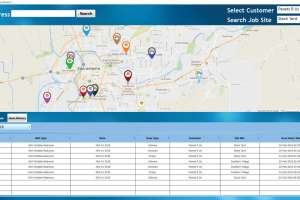
Their expanding customer base also inspired Graham to create a vehicle routing program. “I just sat down, looked at the maps and made it work,” he says. “Each day is a different area where it’s all one big circle and at the end of the day you end up back at the yard.”
William and Graham don’t want to grow the company any faster than they can handle the work and expenses. “My two biggest fears are telling somebody we can do something and then not being able to do it, and somebody wanting us to do something and we’re not able to do it,” William says. “If one person gets unhappy in this day and time, the whole world can know it in a second.”
They financed their vehicles but paid cash for the inventory, buying 10 units per month. They have a Facebook page but are hesitant to put up a website until they know they can handle any extra work it might generate. More business does not always mean more profit, William says, as operating expenses also go up. “Not every problem is obvious.”
TAKEAWAYS
Surprises: The Smiths were unprepared for how quickly the business took off and how busy they got. “At one point Graham and I worked 55 days in a row,” William says.
Advice: William and Graham both emphasize how important it is to answer the phone and call people back — reflecting a complaint they heard over and over again about other companies.
In hindsight: William says they may have been a bit hasty when they bought their second vacuum tank and probably should have gotten a used one to save money. And he says they should have gotten a bigger one. “We got panicky about getting another one and just bought the same thing,” he says.
Best thing about it: William and Graham say they enjoy the challenge, making their own schedule and learning about the industry. “It wasn’t something we used to think about doing,” William says, “but it fell in our lap and we like it.”