An offer from a national site-services company to buy A Royal Flush, which came on the heels of an earlier offer that Malone had rejected, only added to the tumult as employees feared for their jobs if the sale was approved.
But Butler rejected the purchase offer, deciding it wasn’t in the best interests of the company or its employees, who were emotionally distraught about the prospects of an acquisition.
And despite all the upheaval, A Royal Flush emerged intact and now is stronger than ever. Its journey from those dark days to the prosperous present testifies to the power of something many portable restroom operators can appreciate: family.
TRUE FAMILY AFFAIR
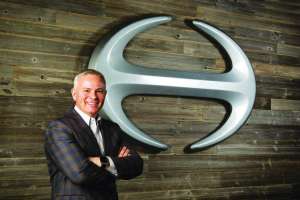
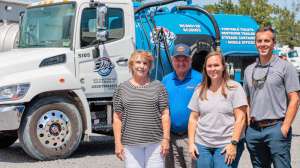
The catalyst for the company’s revival was a decision by Butler and two of his brothers (who were semiretired at the time), Thomas and David, to band together and pull the company out of its tailspin. Thomas and David Butler became the company’s chief executive officer and chief financial officer, respectively.
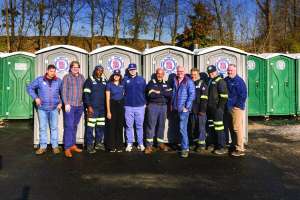
“We met and decided that our family would take on a rebuild of the company and invest in it for the future of not only our family, but for our many long-term employees,” Butler says. “We have many multi-generational employees — people whose children and nieces and nephews work here,” he explains. “It’s a family-operated and family-run company in the truest sense of the word.”
The new management team had its work cut out for it. A fleet of 50 or so trucks and its restroom inventory were aging and needed upgrades, as did restroom trailers and software systems that ran sales and marketing operations. The website was antiquated, too, Butler says.
So the company refinanced its debt and Butler made what he calls “a major reinvestment” in the company.
“It was a big-gulp moment,” he says. “But the outpouring of support I received from employees who I’d been working with for decades, backed by Mauro (co-owner Mauro DaSilva, a founder of the company and now its chief operating officer) and my family, truly moved me to make the commitment.
The takeaway here for other portable sanitation contractors? Have a succession plan in place.
“You never know what’s going to happen,” he says.
NEW FLEET EMERGES
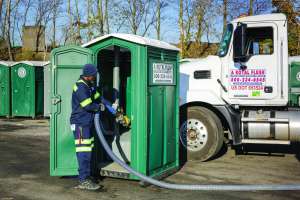
One of the biggest investments centered on renewing the truck fleet. The company replaced about one-third of the trucks annually and over the ensuing years, the fleet grew to about 75 trucks.
Most of the trucks were built by Robinson Vacuum Tanks on Kenworth chassis with 1,500-gallon waste/500-gallon aluminum tanks, vacuum pumps from Masport and water pumps from AMT Pump Co. (a Gorman-Rupp company) for washdown jetters.
The company also runs Ford F-600 trucks that feature either a 700-gallon waste/300-gallon freshwater steel tank paired with a 270 cfm blower from National Vacuum Equipment or a 775-gallon waste/400-gallon freshwater stainless steel tank paired with a 210 cfm NVE vacuum pump, all built out by Imperial Industries.
In addition, the company also owns seven slide-in units made by KeeVac Industries Inc., mounted on a 2019 Ford F-350 chassis and featuring 400-gallon waste/200-gallon freshwater aluminum tanks, Conde vacuum pumps (Westmoor Ltd.) and Shurflo water pumps from Pentair.
DaSilva says the company now replaces trucks on a 7-year cycle because older trucks require too much recurring upkeep and repairs that get increasingly expensive after warranties expire. The company strives to keep tanks for 21 years, he says.
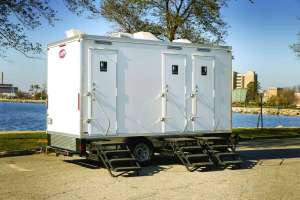
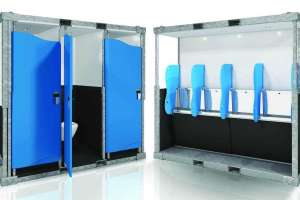
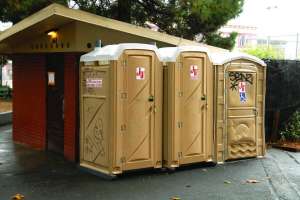
The company also brought thousands of new restrooms, mostly Tufway units from Satellite Industries and new restroom trailers from JAG Mobile Solutions, Lang Specialty Trailers, Black Tie Products and Advanced Containment Systems Inc..
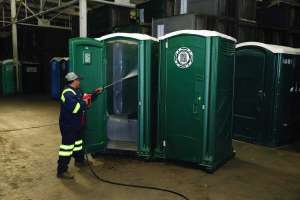
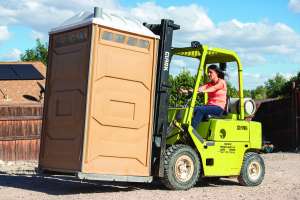
The company now owns about 10,000 restrooms and 65 restroom trailers, plus handwash stations from Satellite, construction high-rise restrooms from PolyJohn Enterprises Corp. and Explorer delivery trailers from McKee Technologies Inc.
EXPANSION PLANS
In addition, the company invested in a new service-management software platform from ServiceCore and a customer-relationship management platform from HubSpot, Butler says.
“We have a lot of accounts and serve customers in seven different marketplaces,” he explains. “So to control and manage marketing in so many different places, we needed a robust system to manage email marketing, our web presence, Google ads and social media marketing.”
The company also grew geographically in the first five years under new management, with significant market expansions within states it served before the company makeover: Connecticut, New York and New Jersey, Butler says.
“Now we’re expanding into the southeast states to add some diversity and be less dependent on one region of the country,” Butler says. “When business in the northeast slows down during winter, we have the ability to move assets down south and take advantage of the better climate down there.
“Then we move the assets back up when things slow down in the South during the hot summer months.”
Isn’t that expensive? Yes, Butler says, but not as expensive as having inventory sit idle for five or six months during winter.
SERVICE IS EVERYTHING
When Butler, DaSilva, Malone and two other investors (who have since retired) started the company in 1992, they owned just two trucks and worked out of a construction trailer. What primarily drove such exponential growth? Two words: customer service.
“Our company also has grown on the backs of the employees that provide that customer service,” he adds. “I’m very grateful for that because without that customer service, we wouldn’t have grown to where we are.”
Butler agrees that every company says it provides great customer service. On the other hand, few deliver it, he notes.
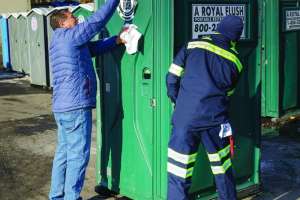
So how does A Royal Flush define great customer service? It means that employees have the emotional intelligence to always look out for customers, whether it’s ensuring restrooms are clean or that they’re set up in easy-to-access locations.
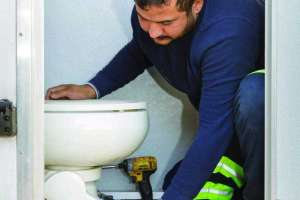
“Our drivers treat the restrooms like they’re located at their families’ homes or businesses,” he adds. “They do an exceptional job. And I know from experience that when companies switch restroom providers, they don’t usually change suppliers because of price — they do so because they want better customer service.”
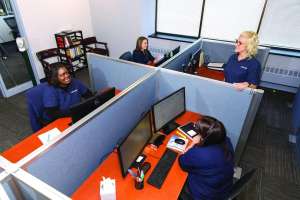
The company instills a service mindset through solid initial training and random spot-checks of restrooms. It also hired a dedicated customer service manager, Shelly Hernandez, nearly two years ago to deal with customer issues, Butler says.
“That was one of the best things we’ve done since we started running the company,” he says.
RECRUITING WORKERS
Kelly Luf, senior vice president, says the company’s employees are key to its customer service.
How does the company find employees in a tight labor market and in an industry where it’s notoriously difficult to find workers? Luf says referrals from existing employees is a great resource.
“If they’re great employees and they refer someone, there’s a higher level of accountability there,” she says.
In addition, the company offers bonuses to employees, from frontline technicians to sales people, all based on different performance metrics.
“When you reward people, the work gets done and done well,” Luf notes.
The company also retains employees by publicly recognizing people, which inspires other employees to do great work.
“We have a very positive employee culture because it’s a family-run business and everyone has opportunities to contribute,” she says. “If someone comes up with a great idea, we’re always willing to consider it. That builds employee buy-in and pride in their work.”
SLOW AND STEADY
Butler says a company that’s not growing is dying. So management will push for continued growth, but in moderate and controlled fashion, both within its current northeastern markets and in southern states where the company has already established beachheads.
“We possibly might move a bit west as well,” he says. “But we’ll do it in a measured way for both new markets and existing markets. Growth should be a well-planned and well-executed process.”
As Butler looks back at the traumatic last five years, he’s gratified how the company emerged from a potential disaster.
“It’s an amazing story and living it has been quite a trip,” he says. “My father (Thomas Butler Sr.) always dreamed that we’d all come together and run a business, so this is very special — especially since he’s here to see it.”