

As PROs we are always aware of safety and safety equipment. Regularly scheduled safety meetings often cover first aid, personal protective equipment, spill handling procedures and safety protocols for vacuum pumps and power tools. One item that is often mentioned in passing is fire extinguishers. These devices are important and worthy of increased focus as part of your safety program as this month’s column demonstrates.
Question: Our company values safety and safety training. In a recent analysis of our safety program, we concluded that as far as fire extinguishers are concerned, we merely make sure that we have them and that they are inspected annually. Could you please share information and suggestions on putting additional emphasis on fire extinguisher safety?
Answer: Fire extinguishers are an important part of a comprehensive company safety plan. These safety devices should protect the office, the yard and the service vehicle. Employees should be familiar with the location and the proper use of fire extinguishers.
Various classes of fire extinguishers serve the needs of fighting various types of fires. The proper class of extinguisher needs to be placed in the area in which the most common combustibles are present in that immediate location.
Class A – used to put out fires of ordinary combustibles such as paper, cloth, plastics, trash and wood.
Class B – used for flammable liquids such as grease, oils, gasoline, paint and other similar solvents.
Class C – used for electrically energized equipment such as office equipment, overloaded surge protectors, and bad wiring in the building. Attempting to cut off the power in the building and then using the extinguisher is an ideal strategy in these cases.
Class D – used for combustible metals as fuel sources. Class D fires often occur in laboratory environments and other industry production operations.
Class K – used for cooking fires involved in food preparation. Flammable materials in these environments include cooking oils, greases and vegetable and animal fats. While most fire extinguishers are red, Class K is silver.
The most common fire extinguishers purchased for general use in the office or in the yard are known as Class ABC extinguishers. They are red and the contents are a fine dust consisting of ammonium phosphate and ammonium sulfate, which interferes with the chemical reaction needed to sustain a fire.
The sizes and weights of this equipment vary depending on the location and the use. The typical office will have a 5-pound Class ABC model whereas a larger warehouse would have a 10-pound model, which would cover a greater area. For comparison purposes, a 2.5-pound model is the most common in a home kitchen or laundry room. Fire extinguishers are offered in 20-to-50-pound models, but keep in mind that the person using this equipment must be able to transport and use it at the location of the fire.
When selecting a fire extinguisher, be aware of the UL Solutions (formerly Underwriters’ Laboratories) rating. This third-party organization validates that the product meets or exceeds the highest safety standards. In some states, a UL rating is required to sell a fire extinguisher.
The National Fire Protection Association standards are that disposable fire extinguishers should be replaced every 12 years and that rechargeable models should be recharged every six years. Fire extinguishers need to be recharged after every use, regardless of the quantity of contents used. This is to ensure the device will have both the proper pressure and quantity of suppressant to use again.
Locating fire extinguishers requires forethought and adherence to OSHA, and NFPA guidelines. OSHA requires that all workplace areas have at least two unobstructed fire exits that are not near each other. Fire extinguishers should be located near these exits so workers can escape easily if a fire grows out of control or if smoke begins to consume the area. The NFPA suggests one extinguisher for every 3,000 square feet of office and warehouse space.
Smaller kitchen-style models can be mounted in breakroom areas and areas where copiers, printers, and network computers are located.
Extinguishers should be mounted so the bottom of the device is no more than 27 inches from the floor. Per federal Americans with Disabilities Act guidelines, if mounted inside a cabinet, the cabinet handle must be accessible to a person in a wheelchair.
OSHA has no precise requirements regarding the use and placement of fire extinguisher signs. The requirement reads that “fire extinguishers be mounted, located and identified such that they are readily accessible during an emergency.” Many signage options are available from simple decals to plastic signs (standard and glow-in-the-dark) to large red plastic squares which mount behind the extinguisher for ease of visibility. Red wall-mounted cabinets are also an option to store these devices.
Placement of these signs can vary from being mounted near a ceiling for maximum visibility to just above the extinguisher. Another popular option is to add arrows nearby that point in the direction of the device. If your company has a location map posted for ease of use, showing the positions of the fire extinguishers is an excellent idea.
During the stress of an emergency, you do not want people to hesitate or forget the location of these safety devices.
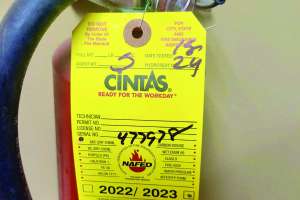
OSHA requires annual third-party inspection of all fire extinguishers for commercial businesses as set forth in Standard 1910.1200. This can be done by either contacting your local fire department or by employing a fire extinguisher inspection company. After the inspection, a tag is completed with the expiration date and attached to each extinguisher.
NFPA suggests monthly inspections. They suggest designating a safety officer from within the company who has been trained to inspect the following:
General usage
Company training should make employees feel comfortable and confident using a fire extinguisher. The basic rule is to make sure everyone has exited the premises, call the fire department and then if the fire is not out of control to use the fire extinguisher using the “PASS Method:”
P – Pull the discharge pin and hold the extinguisher nozzle away from you
A – Aim low at the base of the fire
S – Squeeze the lever below the handle
S – Sweep from side to side
Companies should also appoint a safety officer. This is an employee who has received additional training from either the local fire department or fire inspection company. This person would be responsible for monthly equipment inspections and could assist in basic instruction to other employees.
OSHA requirements for fire extinguishers on commercial vehicles
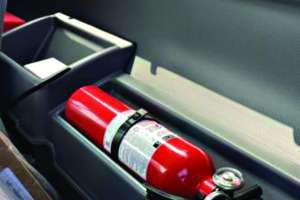
For commercial vehicles with non-hazardous materials onboard, OSHA requires a “5-BC” or a “5-ABC” fire extinguisher. This translates to a 2-pound unit that is 3.25 inches in diameter and 10.95 inches long with a discharge range of 6-8 feet. It must be secure and within reach of the driver. Common positions are seat-mounted behind the driver’s seat or mounted to the cab on either side of the driver.
We suggest a once-a-month special truck checklist including inspecting the fire extinguisher as previously discussed. (Other safety items such as the first aid kit could also be inspected monthly.)
Fire extinguishers are often overlooked when safety matters are presented and discussed. We hope this helps change that. We recommend fire extinguisher inspection, training and location be included in the company policy manual. Safety is a vital part of your company’s culture and employees should feel secure in this commitment.
Continue reading for free